

Ready & Packaged Foods
All →Vegetables & Legumes
All →Desserts & Confectionery
All →Meat & Protein
All →Grains & Bakery
All →Beverages
All →Milk & Dairy
All →

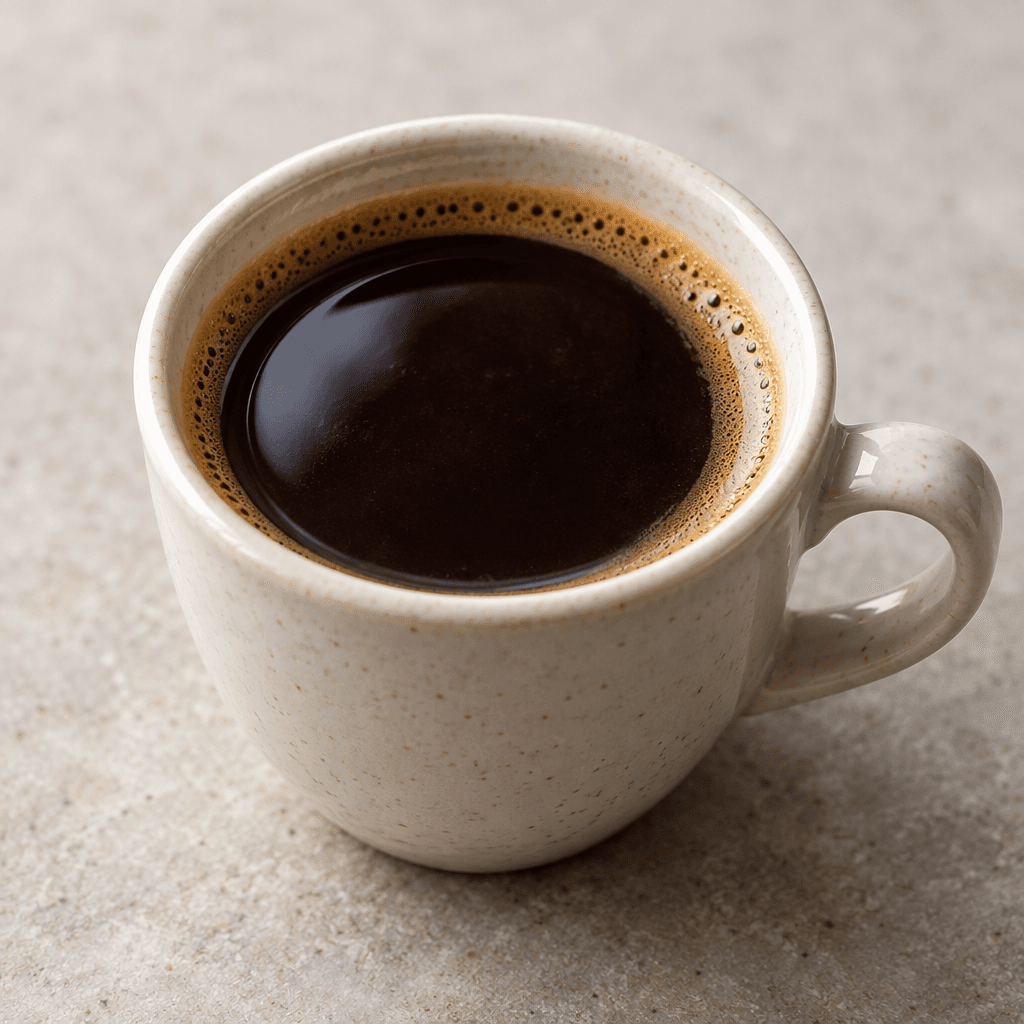
Moka pot coffee Calories
Brewed, unsweetened concentrated coffee
CALORIES
GI
POTASSIUM
FIBER
Quick answer
1 cup (small) of Moka pot coffee (60 g) has 1 calories. That works out to 2 calories per 100 g. It contains 0 g of carbs, 0.2 g of protein, 0.1 g of fat and 0 g of fiber. Its glycemic index is 0 (low), so it raises blood sugar slowly.
What is Moka pot coffee?
Moka pot coffee is brewed on the stovetop in a moka pot, an Italian coffee maker that pushes hot water through ground coffee. It is bold and concentrated, often stronger-tasting than filter coffee, though it is not technically espresso. The cup can have a rich aroma and a little natural foam.
In Italy it is commonly served in a small cup, often after a meal; elsewhere, people may drink it plain or soften it with milk. Unsweetened, it has just 2 calories per 100 g. Enjoy it black for its full intensity, or add hot water or milk for a gentler cup.
Moka pot coffee Nutrition Facts
Selected: 100 g
2
KCAL / 100G
Carbs
0g
· 0% DV
Protein
0.3g
· 1% DV
Fat
0.1g
· 0% DV
Fiber
0g
· 0% DV
DV is the share of the daily value covered, on a 2,000 kcal reference diet.
Calories come from: Carbs 0% · Protein 57% · Fat 43%
Moka pot coffee Vitamins & Minerals
Vitamins
B2
0.06mg · 5% DV
B3
0.2mg · 1% DV
Folate
2µg · 1% DV
Vitamin A
0µg · 0% DV
Minerals
Magnesium
8mg · 2% DV
Potassium ⭐
49mg · 1% DV
Calcium
2mg · 0% DV
Iron
0mg · 0% DV
How Nutritious Is Moka pot coffee?
Nutrient density
Low
How many vitamins, minerals and how much fiber this food carries per calorie. A high score means a lot of nutrition for few calories.
Satiety score
Medium
An EatBetter score computed from fiber, protein and calorie density. A high score means staying full longer on the same calories.
Both scores are calculated per 100 g and do not change with the selected portion. The satiety score is EatBetter's own calculation, not a clinical measure.
Moka pot coffee Glycemic Index
GLYCEMIC INDEX
GLYCEMIC LOAD
Accounts for portion size — a more realistic measure than GI alone.
How to Burn Off Moka pot coffee
To burn the 2 calories in 100 g:
🚶
Walking (5 km/h)
🏃
Running (8 km/h)
🚴
Cycling
🏊
Swimming
Times are calculated with the MET equation for a 70 kg adult. Actual burn varies with your weight, age and pace.
Is Moka pot coffee Processed?
NOVA 2
Minimally Processed
1. Unprocessed
2. Minimally Processed
3. Processed
4. Ultra-Processed
NOVA classifies foods into 4 groups by industrial processing. NOVA 1 (unprocessed) is the healthiest.
Does Moka pot coffee Contain Allergens?
No known major allergens
Which Diets Is Moka pot coffee Good For?
Vegan
✓ Suitable
Vegetarian
✓ Suitable
Gluten-Free
✓ Suitable
Dairy-Free
— Not suitable
Mediterranean
✓ Suitable
Paleo
✓ Suitable
Whole30
— Not suitable
DASH
— Not suitable
Keto
✓ Suitable
Low FODMAP
— Not suitable
Moka pot coffee Fat Profile
SATURATED
0.02g
MONOUNSATURATED
0.03g
POLYUNSATURATED
0.01g
Compare Moka pot coffee
Foods Similar to Moka pot coffee
Frequently Asked Questions About Moka pot coffee
How do you make Moka pot coffee?
To make Moka pot coffee, fill the bottom chamber with water up to just below the safety valve, add ground coffee to the basket without pressing it down, and screw the pot together. Heat it over medium-low heat and remove it once the stream starts to sputter.
What grind size is best for Moka pot coffee?
A medium-fine grind works best for Moka pot coffee: finer than most drip coffee, but not as fine as espresso. Espresso-fine grounds can clog the basket or make the brew bitter, while coarse grounds may produce a weak, watery cup.
Why does Moka pot coffee sputter?
Moka pot coffee sputters when steam pushes the last water through the coffee and into the upper chamber. A brief change in sound near the end is normal, but continuing to heat the pot can scorch the brew; take it off the stove promptly.
Is Moka pot coffee the same as espresso?
No, Moka pot coffee is not espresso. A moka pot brews under less pressure than an espresso machine, so the result is concentrated but does not have the same extraction or crema as espresso.
Why does Moka pot coffee taste bitter?
Moka pot coffee often tastes bitter when the grind is too fine, the heat is too high, or the pot stays on the stove after brewing. Try a medium-fine grind, gentler heat, and remove the pot as soon as the flow turns to sputtering.
Should you tamp the grounds for Moka pot coffee?
No, do not tamp the grounds for Moka pot coffee. Fill the basket loosely and level the surface; compacting the coffee can obstruct water flow and increase pressure inside the pot.
Can you use Moka pot coffee to make iced coffee?
Yes, Moka pot coffee works well as a concentrated base for iced coffee. Brew it as usual, then pour it over ice or chill it before serving; adding milk or water can soften its strong flavor.
Can you make Moka pot coffee on an induction stove?
Only if your moka pot is induction-compatible. Many classic aluminum pots will not work directly on an induction hob, while stainless-steel models often do; check the pot’s material or use a suitable induction adapter.
How should you clean a moka pot after making Moka pot coffee?
Let the moka pot cool, take it apart, rinse the pieces with warm water, and dry them fully before reassembling. Avoid putting an aluminum pot in the dishwasher, and follow the maker’s care instructions for detergent use.
Does Moka pot coffee have more caffeine than drip coffee?
Not necessarily. Moka pot coffee is more concentrated by volume, but caffeine in a serving depends on the amount and type of coffee used as well as the cup size, so a small cup is not automatically higher in caffeine than a larger drip coffee.
Have another question about Moka pot coffee?
Ask the AI nutrition coach — calories, portions, alternatives and more, answered in seconds in the app.

Scan calories with your camera
Instant AI nutrition analysis

Nutrition data compiled from USDA FoodData Central and scientific sources.