

Ready & Packaged Foods
All →Vegetables & Legumes
All →Desserts & Confectionery
All →Meat & Protein
All →Grains & Bakery
All →Beverages
All →Milk & Dairy
All →

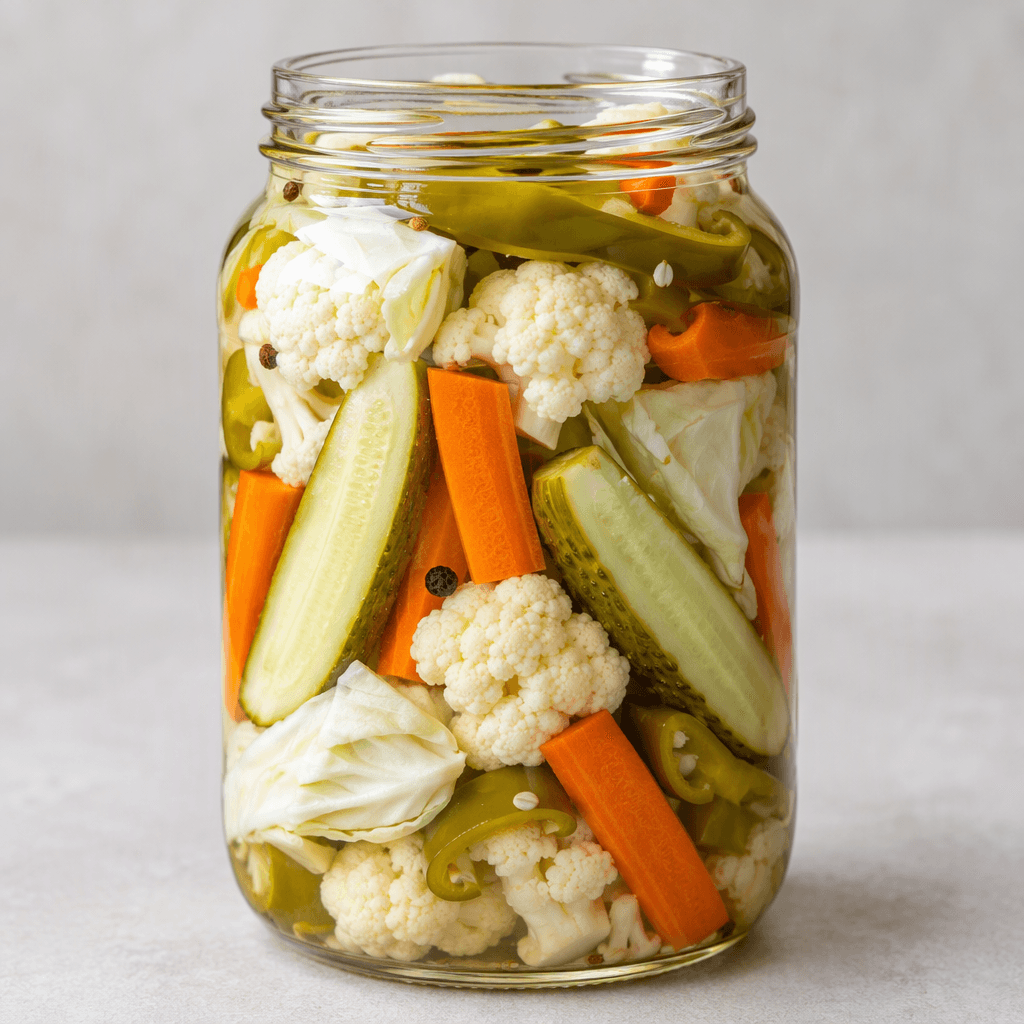
Mixed Pickles Calories
Assorted vegetables fermented or pickled in vinegar and salt.
In season: Autumn · Winter
CALORIES
GI
POTASSIUM
FIBER
Quick answer
1 serving (medium) of Mixed Pickles (50 g) has 11 calories. That works out to 22 calories per 100 g. It contains 2.1 g of carbs, 0.4 g of protein, 0.1 g of fat and 0.8 g of fiber. Its 450 mg of Sodium covers 20% of the Daily Value. Its glycemic index is 15 (low), so it raises blood sugar slowly.
What is Mixed Pickles?
Mixed Pickles are a colourful assortment of vegetables—often cucumber, carrot, cauliflower, cabbage and peppers—preserved in brine or a vinegar-and-salt solution. They are a familiar part of Turkish home cooking, where families often make jars to enjoy through the colder months; the vegetables and level of tang vary from recipe to recipe.
Crisp, sour and salty, they’re served in small portions alongside meals such as beans and rice, grilled meats or sandwiches. They add some vegetable fibre while remaining light in calories: a 100-gram serving has 22 calories. If you’re watching your salt intake, drain the brine and keep the serving modest.
Mixed Pickles Nutrition Facts
Selected: 100 g
22
KCAL / 100G
Carbs
4.2g
· 2% DV
Protein
0.7g
· 1% DV
Fat
0.1g
· 0% DV
Fiber
1.5g
· 5% DV
DV is the share of the daily value covered, on a 2,000 kcal reference diet.
Calories come from: Carbs 82% · Protein 14% · Fat 4%
Mixed Pickles Vitamins & Minerals
Vitamins
Vitamin K
20µg · 17% DV
Vitamin A
25µg · 3% DV
B6
0.05mg · 3% DV
Folate
10µg · 3% DV
Minerals
Sodium
900mg · 39% DV
Calcium
25mg · 3% DV
Phosphorus
20mg · 3% DV
Magnesium
7mg · 2% DV
How Nutritious Is Mixed Pickles?
Nutrient density
Medium
How many vitamins, minerals and how much fiber this food carries per calorie. A high score means a lot of nutrition for few calories.
Satiety score
Medium
An EatBetter score computed from fiber, protein and calorie density. A high score means staying full longer on the same calories.
Both scores are calculated per 100 g and do not change with the selected portion. The satiety score is EatBetter's own calculation, not a clinical measure.
Mixed Pickles Glycemic Index
GLYCEMIC INDEX
GLYCEMIC LOAD
Accounts for portion size — a more realistic measure than GI alone.
How to Burn Off Mixed Pickles
To burn the 22 calories in 100 g:
🚶
Walking (5 km/h)
🏃
Running (8 km/h)
🚴
Cycling
🏊
Swimming
Times are calculated with the MET equation for a 70 kg adult. Actual burn varies with your weight, age and pace.
Is Mixed Pickles Processed?
NOVA 3
Processed
1. Unprocessed
2. Minimally Processed
3. Processed
4. Ultra-Processed
NOVA classifies foods into 4 groups by industrial processing. NOVA 1 (unprocessed) is the healthiest.
Does Mixed Pickles Contain Allergens?
No known major allergens
Which Diets Is Mixed Pickles Good For?
Vegan
✓ Suitable
Vegetarian
✓ Suitable
Gluten-Free
✓ Suitable
Dairy-Free
— Not suitable
Mediterranean
✓ Suitable
Paleo
✓ Suitable
Whole30
— Not suitable
DASH
— Not suitable
Keto
— Not suitable
Low FODMAP
— Not suitable
Mixed Pickles Fat Profile
SATURATED
0.02g
MONOUNSATURATED
0.01g
POLYUNSATURATED
0.03g
Omega 6:3 ratio 2:1
Below the ideal 4:1 — a good omega balance.
Compare Mixed Pickles
Foods Similar to Mixed Pickles
Frequently Asked Questions About Mixed Pickles
How do you make mixed pickles at home?
Mixed pickles are made by packing prepared vegetables into a jar and covering them with brine or a vinegar-based pickling liquid. Keep the vegetables submerged, use a clean jar, and follow a tested recipe for the salt and vinegar proportions.
Which vegetables are usually in mixed pickles?
Mixed pickles commonly combine cucumber, carrot, cauliflower, cabbage, and green peppers. The exact mix varies by recipe, but cutting the vegetables into similar-sized pieces helps them pickle more evenly and makes the jar easier to serve from.
Are mixed pickles fermented or made with vinegar?
Mixed pickles can be either naturally fermented in salted brine or preserved in vinegar. Fermented pickles develop acidity through fermentation, while vinegar pickles get their tang from added vinegar; the two methods can differ in taste and storage needs.
Why are my mixed pickles cloudy?
Cloudiness can occur naturally in the brine of fermented mixed pickles. Look at the whole jar rather than the liquid alone: discard the pickles if you also notice mold, slimy vegetables, or an unpleasant rotten smell.
How should you store mixed pickles after opening?
Store opened mixed pickles in the refrigerator with the vegetables covered by brine. Use a clean utensil each time and close the jar promptly; discard the contents if you see mold or notice an unusual, unpleasant odor.
Why did my mixed pickles turn soft?
Mixed pickles often soften when the vegetables were old, stayed above the brine, or were stored somewhere too warm. Start with fresh, firm vegetables, keep them submerged, and store the jar in a cool place.
Can you freeze mixed pickles?
You can freeze mixed pickles, but freezing usually makes their vegetables softer and less crisp after thawing. They are generally better kept refrigerated in their brine; freeze them only if the changed texture will work in a cooked dish.
Can leftover mixed-pickle brine be reused?
Leftover mixed-pickle brine can add a sharp, salty note to salad dressings, marinades, or sauces. Reuse it as an ingredient rather than assuming it is safe for a new batch of pickles, since its acidity and salt level may no longer be suitable.
Is bubbling in a jar of mixed pickles normal?
Bubbling can be normal while mixed pickles ferment because fermentation produces gas. Keep the jar from overflowing and make sure the vegetables stay submerged; bubbling with mold, sliminess, or a foul smell is a reason to discard them.
What foods go well with mixed pickles?
Mixed pickles pair well with sandwiches, burgers, grilled meats, and rich or hearty meals. Their sour, salty crunch cuts through fatty flavors, so serve a small dish alongside the main food rather than mixing them into every component.
Have another question about Mixed Pickles?
Ask the AI nutrition coach — calories, portions, alternatives and more, answered in seconds in the app.

Scan calories with your camera
Instant AI nutrition analysis

Nutrition data compiled from USDA FoodData Central and scientific sources.