

Ready & Packaged Foods
All →Vegetables & Legumes
All →Desserts & Confectionery
All →Meat & Protein
All →Grains & Bakery
All →Beverages
All →Milk & Dairy
All →

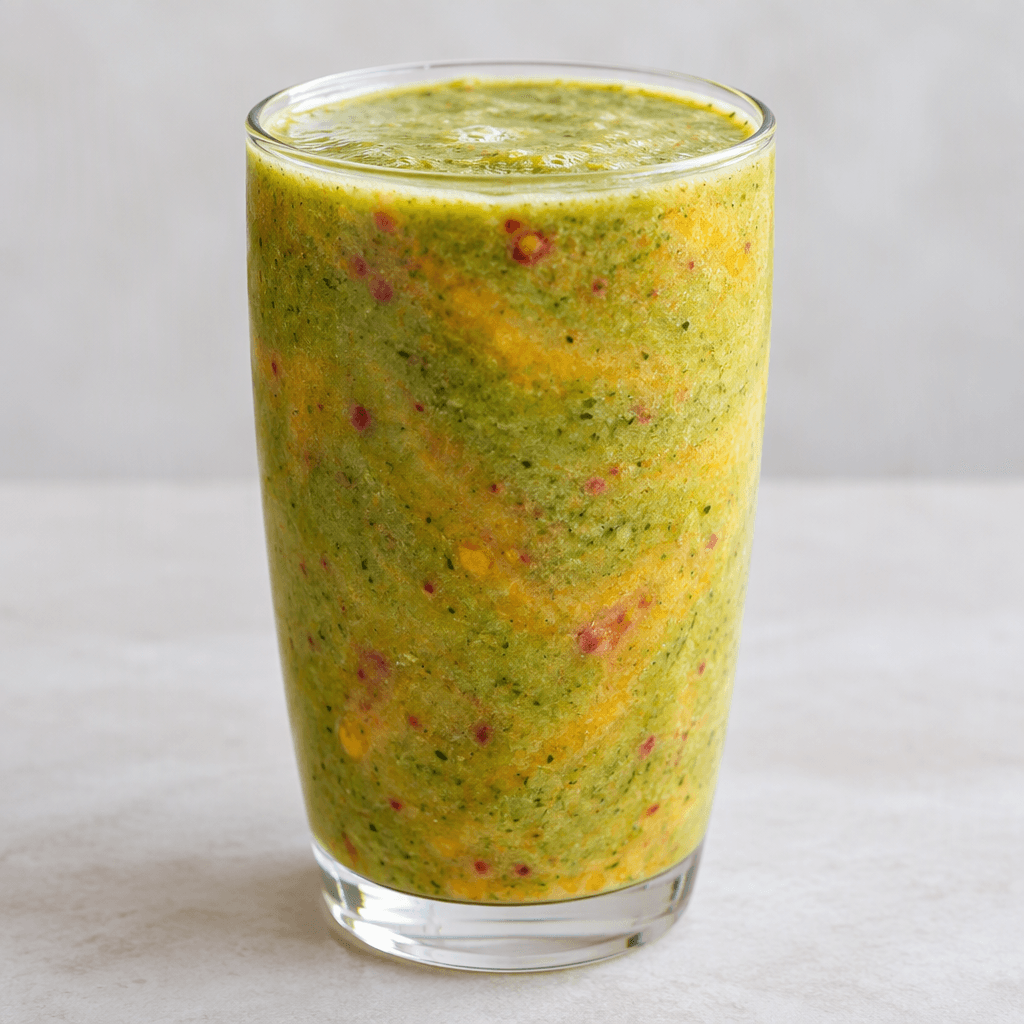
Mixed fruit and vegetable smoothie Calories
Blended fruit and vegetable smoothie with fiber and vitamin C
In season: Spring · Summer · Autumn · Winter
CALORIES
GI
POTASSIUM
FIBER
Quick answer
1 cup (medium) of Mixed fruit and vegetable smoothie (240 g) has 144 calories. That works out to 60 calories per 100 g. It contains 33.6 g of carbs, 1 g of protein, 0 g of fat and 1.9 g of fiber. Its 43.2 mg of Vitamin C covers 48% of the Daily Value. Its glycemic index is 45 (low), so it raises blood sugar slowly.
What is Mixed fruit and vegetable smoothie?
A mixed fruit and vegetable smoothie is made by blending fruit and vegetables into a thick, drinkable mixture. The ingredients vary, and it may be loosened with water, milk or a plant-based drink. Rather than belonging to one particular cuisine, it is a flexible preparation found in many places.
It is usually served cold at breakfast or as a snack, both at home and in cafés. Its texture is smooth and often substantial, with sweetness from the fruit balanced by the fresher, sometimes earthy taste of vegetables. It provides fibre and vitamin C, while carbohydrates make up most of its energy. For a more filling version, blend it with plain yoghurt; add extra vegetables if you prefer a less sweet taste.
Mixed fruit and vegetable smoothie Nutrition Facts
Selected: 100 g
60
KCAL / 100G
Carbs
14g
· 5% DV
Protein
0.4g
· 1% DV
Fat
0g
· 0% DV
Fiber
0.8g
· 3% DV
DV is the share of the daily value covered, on a 2,000 kcal reference diet.
Calories come from: Carbs 97% · Protein 3% · Fat 0%
Mixed fruit and vegetable smoothie Vitamins & Minerals
Vitamins
Vitamin C
18mg · 20% DV
Vitamin A
95µg · 11% DV
Vitamin K
9µg · 8% DV
B6
0.07mg · 4% DV
Minerals
Potassium ⭐
185mg · 5% DV
Magnesium
14mg · 3% DV
Phosphorus
22mg · 3% DV
Calcium
18mg · 2% DV
How Nutritious Is Mixed fruit and vegetable smoothie?
Nutrient density
High
How many vitamins, minerals and how much fiber this food carries per calorie. A high score means a lot of nutrition for few calories.
Satiety score
Medium
An EatBetter score computed from fiber, protein and calorie density. A high score means staying full longer on the same calories.
Both scores are calculated per 100 g and do not change with the selected portion. The satiety score is EatBetter's own calculation, not a clinical measure.
Mixed fruit and vegetable smoothie Glycemic Index
GLYCEMIC INDEX
GLYCEMIC LOAD
Accounts for portion size — a more realistic measure than GI alone.
How to Burn Off Mixed fruit and vegetable smoothie
To burn the 60 calories in 100 g:
🚶
Walking (5 km/h)
🏃
Running (8 km/h)
🚴
Cycling
🏊
Swimming
Times are calculated with the MET equation for a 70 kg adult. Actual burn varies with your weight, age and pace.
Is Mixed fruit and vegetable smoothie Processed?
NOVA 2
Minimally Processed
1. Unprocessed
2. Minimally Processed
3. Processed
4. Ultra-Processed
NOVA classifies foods into 4 groups by industrial processing. NOVA 1 (unprocessed) is the healthiest.
Does Mixed fruit and vegetable smoothie Contain Allergens?
No known major allergens
Which Diets Is Mixed fruit and vegetable smoothie Good For?
Vegan
✓ Suitable
Vegetarian
✓ Suitable
Gluten-Free
✓ Suitable
Dairy-Free
— Not suitable
Mediterranean
✓ Suitable
Paleo
— Not suitable
Whole30
— Not suitable
DASH
— Not suitable
Keto
— Not suitable
Low FODMAP
— Not suitable
Mixed fruit and vegetable smoothie Fat Profile
SATURATED
0.04g
MONOUNSATURATED
0.03g
POLYUNSATURATED
0.07g
Omega 6:3 ratio 2.5:1
Below the ideal 4:1 — a good omega balance.
Compare Mixed fruit and vegetable smoothie
Foods Similar to Mixed fruit and vegetable smoothie
Frequently Asked Questions About Mixed fruit and vegetable smoothie
How do you make a mixed fruit and vegetable smoothie?
Blend fruit and vegetables with a little water, milk, or an unsweetened alternative until smooth, adding liquid gradually to control the thickness. Start with mild-tasting vegetables such as spinach or cucumber, then adjust the fruit and liquid to suit your taste.
What fruits and vegetables go well in a mixed fruit and vegetable smoothie?
Banana, berries, and mango pair well with spinach, kale, or carrots. Choose produce with complementary flavors, and add a small amount of tart fruit such as citrus if the vegetables make the smoothie taste earthy.
Can you freeze a mixed fruit and vegetable smoothie?
Yes, freeze it in an airtight container, leaving a little room for expansion. Thaw it in the refrigerator and shake or blend it again before drinking, since freezing and thawing can separate the liquid and solids.
Can you make a mixed fruit and vegetable smoothie the night before?
Yes, you can prepare it the night before and keep it covered in the refrigerator. It may separate or lose some freshness overnight, so shake or stir it well before drinking and avoid leaving it at room temperature.
Is a mixed fruit and vegetable smoothie better than fruit juice?
A smoothie made in a blender and not strained usually keeps more of the fruit and vegetable pulp than juice. That pulp provides fiber and makes the drink thicker, though either option can contain a lot of fruit if portions are large.
Should you peel fruit and vegetables for a mixed fruit and vegetable smoothie?
Not always. Wash produce thoroughly, and leave edible skins on apples, pears, and cucumbers if you like the texture. Remove peels that are tough or unpleasant, such as those on citrus, and discard damaged areas.
How do you make a mixed fruit and vegetable smoothie less bitter?
Use less bitter greens, such as spinach, and balance them with ripe banana, pear, or mango. Remove tough kale stems, add ingredients gradually, and avoid adding too much raw cruciferous vegetable, which can make the flavor sharp.
Can you use frozen vegetables in a mixed fruit and vegetable smoothie?
Yes, frozen spinach, cauliflower, and other suitable vegetables blend well, especially when combined with fruit. Add them straight from the freezer for a colder, thicker drink; cut large frozen pieces small enough for your blender.
Do you need to add liquid to a mixed fruit and vegetable smoothie?
Usually, yes, especially if the ingredients are frozen or mostly firm produce. Add water, milk, or an unsweetened alternative a little at a time until the blender runs smoothly and the drink reaches your preferred consistency.
Can you drink a mixed fruit and vegetable smoothie before a workout?
Yes, it can work as a light pre-workout drink if you tolerate it well. Allow time for digestion, since a thick smoothie with lots of fiber may feel uncomfortable during exercise, and choose a smaller serving if you are about to start.
Have another question about Mixed fruit and vegetable smoothie?
Ask the AI nutrition coach — calories, portions, alternatives and more, answered in seconds in the app.

Scan calories with your camera
Instant AI nutrition analysis

Nutrition data compiled from USDA FoodData Central and scientific sources.