

Ready & Packaged Foods
All →Vegetables & Legumes
All →Desserts & Confectionery
All →Meat & Protein
All →Grains & Bakery
All →Beverages
All →Milk & Dairy
All →

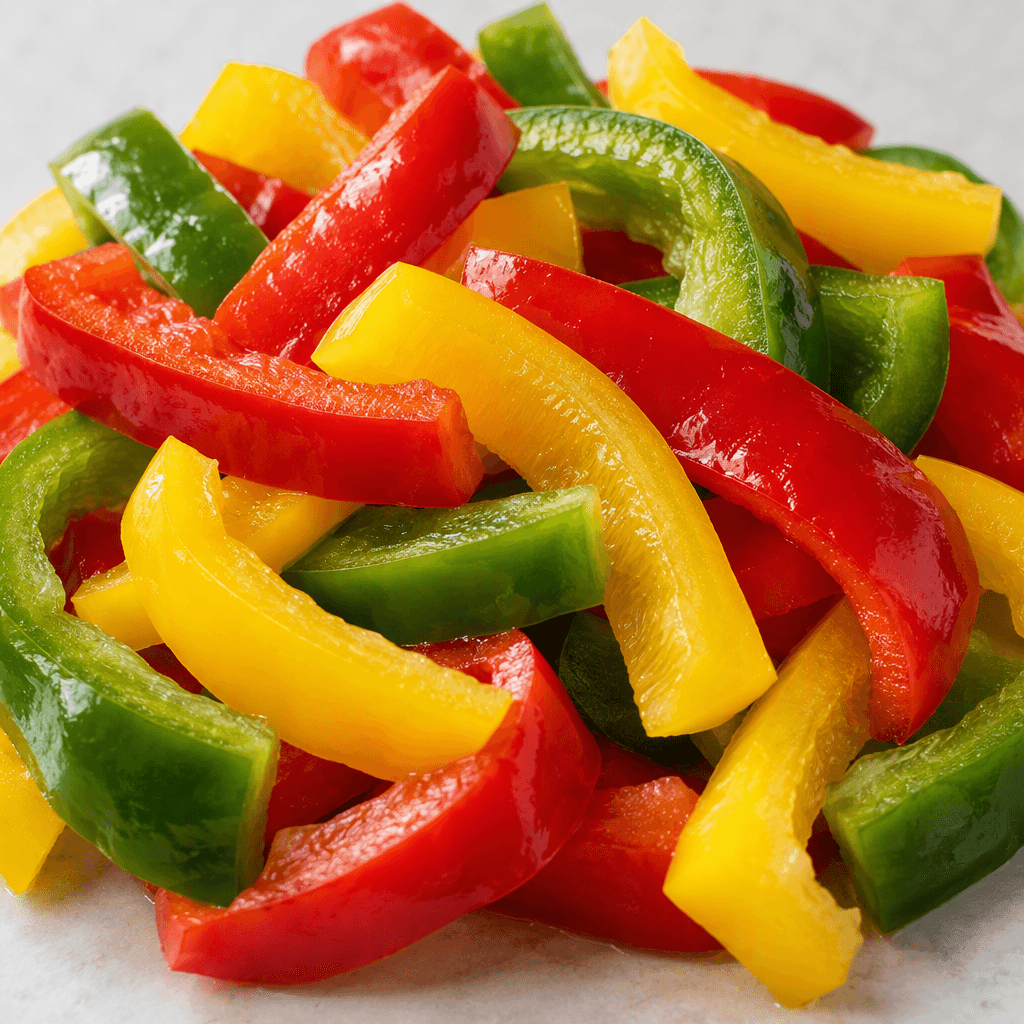
Mixed bell peppers Calories
Rich in vitamin C
In season: Summer · Autumn
CALORIES · 100 G
GI
POTASSIUM · 100 G
FIBER · 100 G
Quick answer
1 piece (medium) of Mixed bell peppers (120 g) has 37 calories. That works out to 31 calories per 100 g. It contains 7.7 g of carbs, 1.2 g of protein, 0.4 g of fat and 2.5 g of fiber. Its 120 mg of Vitamin C covers 133% of the Daily Value. Its glycemic index is 15 (low), so it raises blood sugar slowly.
Mixed bell peppers Nutrition Facts
Selected: 1 piece (medium) · 120 g
37
KCAL / 120G
Carbs
7.7g
· 3% DV
Protein
1.2g
· 2% DV
Fat
0.4g
· 1% DV
Fiber
2.5g
· 9% DV
DV is the share of the daily value covered, on a 2,000 kcal reference diet.
Calories come from: Carbs 79% · Protein 12% · Fat 9%
Mixed bell peppers nutrition facts table · 1 piece (medium) (120 g)
| Nutrient | Amount | % DV |
|---|---|---|
| Calories | 37 kcal | |
| Total fat | 0.4 g | 1% |
| Saturated fat | 0.04 g | 0% |
| Trans fat | 0 g | |
| Sodium | 4.8 mg | 0% |
| Total carbohydrate | 7.7 g | 3% |
| Fiber | 2.5 g | 9% |
| Protein | 1.2 g | 2% |
Calories: Calories measure energy. Average daily need is 2,000 kcal. Excess calories are stored as fat, too few cause weight loss.
Carbs: Your body's primary energy source. The brain runs exclusively on carbs. Daily need: 275g.
Protein: Essential for muscle repair and cell growth. Daily need: 50g. Keeps you full and boosts metabolism.
Fat: Needed for hormone production and vitamin absorption. Daily need: 78g. Limit saturated fats, choose unsaturated.
Fiber: Critical for digestive health and satiety. Daily need: 28g. Stabilizes blood sugar, lowers cholesterol.

Log this food in EatBetter
100,000+ people use it
- Get your daily calorie target
- Snap your meal, log it in seconds
- See every vitamin and mineral

📸 Scan the code to get the app free.

How Many Calories in 1 Medium Mixed bell peppers?
| Serving | Amount | Calories |
|---|---|---|
| 1 piece (medium) | 120 g | 37 kcal |
| 1 piece (quarter) | 30 g | 9 kcal |
| 1 piece (half) | 60 g | 19 kcal |
| 1 piece (small) | 80 g | 25 kcal |
| 100 g | 100 g | 31 kcal |
| 1 cup (diced) | 135 g | 42 kcal |
| 1 cup (chopped) | 150 g | 47 kcal |
| 1 piece (large) | 180 g | 56 kcal |
| 1 piece (jumbo) | 250 g | 78 kcal |
Calculated from 31 calories per 100 g.
Frequently Asked Questions About Mixed bell peppers
How should you store mixed bell peppers so they stay fresh?
Keep mixed bell peppers unwashed and dry in the refrigerator’s crisper drawer, preferably in a breathable bag or container. Moisture encourages soft spots and spoilage. Once cut, refrigerate the pieces in a covered container and use them promptly.
Can you freeze mixed bell peppers?
Yes, mixed bell peppers freeze well for cooked dishes. Remove the stems and seeds, cut the peppers into strips or dice, and freeze them in a sealed freezer bag. They may soften after thawing, so use them in stir-fries, soups, or sauces rather than salads.
Can you eat mixed bell peppers raw?
Yes, mixed bell peppers are commonly eaten raw in salads, sandwiches, and snack plates. Rinse them under running water, then remove the stem and seeds if you prefer. Their crisp texture and the mild sweetness of the differently colored peppers work well with dips.
Are the different colors in mixed bell peppers different varieties or ripeness stages?
They can be both. Green bell peppers are generally less ripe, while red, yellow, and orange peppers are often riper stages of a pepper; some varieties mature to a particular color. Color also brings differences in sweetness, with green usually tasting more vegetal.
How do you roast mixed bell peppers and remove their skins?
Roast mixed bell peppers whole or halved until their skins blister and char in spots. Cover them briefly after roasting so trapped steam loosens the skin, then peel if desired. The flesh is especially useful in sandwiches, salads, sauces, and antipasto.
Are the seeds inside mixed bell peppers safe to eat?
Yes, mixed bell pepper seeds are safe to eat, though many people remove them because they are firm and can be unpleasant in a dish. For stuffing, remove the seed cluster and the pale ribs to make room for the filling.
Why do mixed bell peppers taste different from one another?
The green peppers in a mix tend to taste more grassy and slightly bitter, while red, yellow, and orange ones are usually sweeter. Ripeness and variety both contribute to the difference, so a mixed batch can add more contrast to a recipe than one color alone.
How can you tell if mixed bell peppers have gone bad?
Discard mixed bell peppers that are moldy, leaking, badly shriveled, or soft and slimy. A small dry blemish can often be trimmed away, but widespread soft spots or an off smell indicate that the pepper should not be used.
Do mixed bell peppers need to be peeled before cooking?
No, mixed bell peppers do not usually need peeling before cooking; their skins are edible and soften in many dishes. Peeling is mainly a preference after roasting, when the skin may become charred or loose. Wash the peppers before cutting them.
Why do mixed bell peppers cook unevenly when stuffed?
Mixed bell peppers can cook unevenly because color does not determine their thickness or size. Choose peppers of similar size for stuffing, or take thinner, smaller ones out earlier. If the peppers wobble, trim a little from the base without cutting through the bottom.
Mixed bell peppers Vitamins & Minerals
Vitamins
Vitamin C
120mg · 133% DV
B6
0.3mg · 18% DV
Vitamin A
96µg · 11% DV
Folate
36µg · 9% DV
Minerals
Copper
0.1mg · 11% DV
Potassium ⭐
252mg · 7% DV
Manganese
0.14mg · 6% DV
Phosphorus
28mg · 4% DV
Sodium
4.8mg · 0% DV
Mixed bell peppers Glycemic Index
GLYCEMIC INDEX
GLYCEMIC LOAD
Accounts for portion size — a more realistic measure than GI alone.
How to Burn Off Mixed bell peppers
To burn the 37 calories in 1 piece (medium) (120 g):
🚶
Walking (5 km/h)
🏃
Running (8 km/h)
🚴
Cycling
🏊
Swimming
Times are calculated with the MET equation for a 70 kg adult. Actual burn varies with your weight, age and pace.
What is Mixed bell peppers?
Mixed bell peppers are an assortment of sweet peppers in different colours, often chosen for their broad shape and firm walls, which make them easy to fill. They can also be eaten raw or cooked: slice them into salads, roast them, or sauté them as part of a meal. Their flavour is mild and slightly sweet, while roasting brings out more sweetness and softens the flesh.
In many kitchens, they are served as a side, added to sandwiches and grain bowls, or stuffed with rice, herbs, vegetables or meat. They provide vitamin C and fibre while remaining low in calories. For a lighter stuffed-pepper dish, use plenty of vegetables or legumes in the filling and go easy on the added oil.
How Nutritious Is Mixed bell peppers?
Nutrient density
Very high
How many vitamins, minerals and how much fiber this food carries per calorie. A high score means a lot of nutrition for few calories.
Satiety score
Medium
An EatBetter score computed from fiber, protein and calorie density. A high score means staying full longer on the same calories.
Both scores are calculated per 100 g and do not change with the selected portion. The satiety score is EatBetter's own calculation, not a clinical measure.
Is Mixed bell peppers Processed?
NOVA 1
Unprocessed
1. Unprocessed
2. Minimally Processed
3. Processed
4. Ultra-Processed
NOVA classifies foods into 4 groups by industrial processing. NOVA 1 (unprocessed) is the healthiest.
Does Mixed bell peppers Contain Allergens?
No known major allergens
Which Diets Is Mixed bell peppers Good For?
Vegan
✓ Suitable
Vegetarian
✓ Suitable
Gluten-Free
✓ Suitable
Dairy-Free
— Not suitable
Mediterranean
✓ Suitable
Paleo
✓ Suitable
Whole30
— Not suitable
DASH
— Not suitable
Keto
✓ Suitable
Low FODMAP
— Not suitable
Mixed bell peppers Fat Profile
SATURATED
0.04g
MONOUNSATURATED
0.01g
POLYUNSATURATED
0.11g
Omega 6:3 ratio 10:1
Above the ideal 4:1 (10:1).
Compare Mixed bell peppers
Foods Similar to Mixed bell peppers
Have another question about Mixed bell peppers?
Ask the AI nutrition coach — calories, portions, alternatives and more, answered in seconds in the app.

Scan calories with your camera
Instant AI nutrition analysis

Nutrition data compiled from USDA FoodData Central and scientific sources.