

Ready & Packaged Foods
All →Vegetables & Legumes
All →Desserts & Confectionery
All →Meat & Protein
All →Grains & Bakery
All →Beverages
All →Milk & Dairy
All →

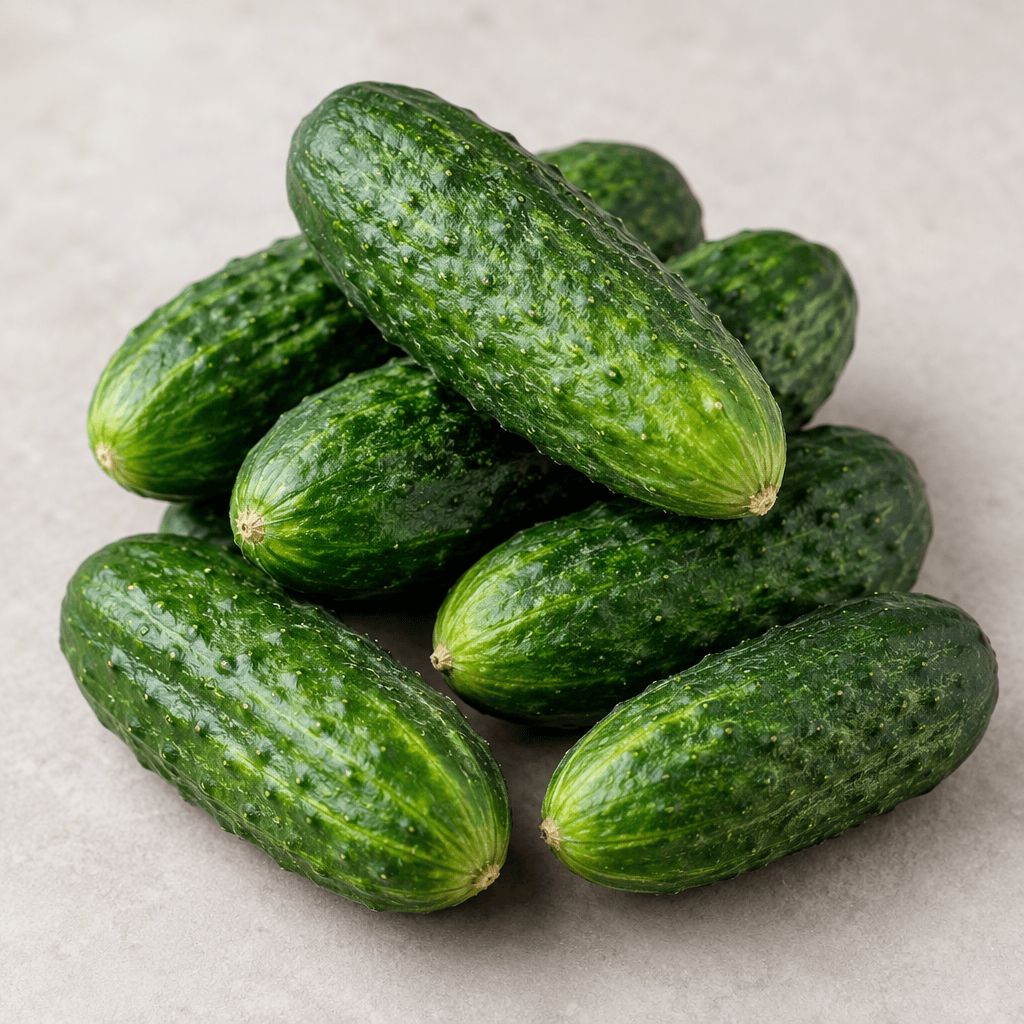
Mini Cucumber Calories
Low calorie, high water content, refreshing, source of fiber
In season: Spring · Summer · Autumn
CALORIES · 100 G
GI
POTASSIUM · 100 G
FIBER · 100 G
Quick answer
1 piece (small) of Mini Cucumber (40 g) has 6 calories. That works out to 16 calories per 100 g. It contains 1.4 g of carbs, 0.3 g of protein, 0 g of fat and 0.2 g of fiber. Its 6.6 µg of Vitamin K covers 5% of the Daily Value. Its glycemic index is 15 (low), so it raises blood sugar slowly.
Mini Cucumber Nutrition Facts
Selected: 1 piece (small) · 40 g
6
KCAL / 40G
Carbs
1.4g
· 1% DV
Protein
0.3g
· 1% DV
Fat
0g
· 0% DV
Fiber
0.2g
· 1% DV
DV is the share of the daily value covered, on a 2,000 kcal reference diet.
Calories come from: Carbs 82% · Protein 18% · Fat 0%
Mini Cucumber nutrition facts table · 1 piece (small) (40 g)
| Nutrient | Amount | % DV |
|---|---|---|
| Calories | 6 kcal | |
| Total fat | 0 g | 0% |
| Saturated fat | 0.01 g | 0% |
| Trans fat | 0 g | |
| Sodium | 0.8 mg | 0% |
| Total carbohydrate | 1.4 g | 1% |
| Fiber | 0.2 g | 1% |
| Protein | 0.3 g | 1% |
Calories: Calories measure energy. Average daily need is 2,000 kcal. Excess calories are stored as fat, too few cause weight loss.
Carbs: Your body's primary energy source. The brain runs exclusively on carbs. Daily need: 275g.
Protein: Essential for muscle repair and cell growth. Daily need: 50g. Keeps you full and boosts metabolism.
Fat: Needed for hormone production and vitamin absorption. Daily need: 78g. Limit saturated fats, choose unsaturated.
Fiber: Critical for digestive health and satiety. Daily need: 28g. Stabilizes blood sugar, lowers cholesterol.

Log this food in EatBetter
100,000+ people use it
- Get your daily calorie target
- Snap your meal, log it in seconds
- See every vitamin and mineral

📸 Scan the code to get the app free.

How Many Calories in 1 Small Mini Cucumber?
| Serving | Amount | Calories |
|---|---|---|
| 1 piece (small) | 40 g | 6 kcal |
| 1 piece (extra small) | 25 g | 4 kcal |
| 1 piece (medium) | 60 g | 10 kcal |
| 1 piece (large) | 80 g | 13 kcal |
| 100 g | 100 g | 16 kcal |
| 1 serving (medium) | 100 g | 16 kcal |
| 1 piece (extra large) | 100 g | 16 kcal |
| 1 cup (chopped) | 104 g | 17 kcal |
| 5 piece (small) | 200 g | 32 kcal |
Calculated from 16 calories per 100 g.
Frequently Asked Questions About Mini Cucumber
Are mini cucumbers different from regular cucumbers?
Yes. Mini cucumbers are smaller, and they often have thin skin, a crisp texture, and small seeds. Their flavour is much like that of regular cucumbers, so they can usually be swapped into salads and other recipes.
Do mini cucumbers need to be peeled?
No, mini cucumbers usually do not need peeling. Their skin is typically thin enough to eat, so rinse the cucumber well under running water before eating it whole or slicing it.
How should you store mini cucumbers?
Keep mini cucumbers dry and refrigerated in the crisper drawer, ideally in a loosely closed or ventilated bag. Wash them just before eating, since moisture left on the skin can encourage spoilage.
Do you need to wash mini cucumbers before eating them?
Yes, rinse mini cucumbers under clean running water and gently rub the surface before eating. Do not use soap or detergent; dry them with a clean towel if you are putting them away afterward.
Can you pickle mini cucumbers?
Yes, mini cucumbers work well for pickling because their small size fits neatly into jars. Choose firm, unbruised cucumbers, wash and dry them, and follow a tested brine recipe for safe, crisp pickles.
Why do mini cucumbers taste bitter?
Bitterness comes from natural compounds in cucumbers, and growing stress can make their taste more pronounced. If a mini cucumber tastes strongly bitter, discard it rather than trying to mask the flavour.
Can you freeze mini cucumbers?
Yes, but freezing makes mini cucumbers soft and watery when thawed, so they will not keep their fresh crunch. Use thawed pieces in cooked dishes, soups, or blended sauces rather than in a crisp salad.
Are the seeds in mini cucumbers edible?
Yes, the small, soft seeds in mini cucumbers are edible and do not need to be removed. If the seeds have become tough and the centre is spongy, the cucumber may be overripe.
Why do mini cucumbers get slimy?
A slimy coating usually means a mini cucumber is starting to spoil, often because it has been stored damp or for too long. Discard it if it is slimy, smells off, or has soft, discoloured patches.
Are mini cucumbers the same as pickling cucumbers?
No. Mini cucumbers are commonly sold for fresh eating, while pickling cucumbers are varieties selected for their firm flesh and suitability for brining. Mini cucumbers can still be pickled, but the names do not mean exactly the same thing.
Mini Cucumber Vitamins & Minerals
Vitamins
Vitamin K
6.56µg · 5% DV
Vitamin A
42µg · 5% DV
B5
0.1mg · 2% DV
Vitamin C
1.12mg · 1% DV
Minerals
Potassium ⭐
59mg · 2% DV
Manganese
0.03mg · 1% DV
Phosphorus
9.6mg · 1% DV
Copper
0.01mg · 1% DV
Sodium
0.8mg · 0% DV
Mini Cucumber Glycemic Index
GLYCEMIC INDEX
GLYCEMIC LOAD
Accounts for portion size — a more realistic measure than GI alone.
How to Burn Off Mini Cucumber
To burn the 6 calories in 1 piece (small) (40 g):
🚶
Walking (5 km/h)
🏃
Running (8 km/h)
🚴
Cycling
🏊
Swimming
Times are calculated with the MET equation for a 70 kg adult. Actual burn varies with your weight, age and pace.
What is Mini Cucumber?
A mini cucumber is a short, small variety of cucumber, with deep-green, lightly bumpy skin and crisp, watery flesh. Its flavour is mild and refreshing. It is commonly eaten whole as a snack or sliced into salads and sandwiches; its compact size also makes it handy for pickling. In many English-speaking kitchens, it is an easy addition to lunchboxes, mezze plates or a simple plate of vegetables and dip.
Mini cucumbers are mostly water, low in calories and provide a little fibre. At 16 calories per 100 g, they make a light, crunchy option when you want something fresh. Wash well and serve whole or sliced; pair with hummus or yoghurt dip for a more substantial snack.
How Nutritious Is Mini Cucumber?
Nutrient density
Medium
How many vitamins, minerals and how much fiber this food carries per calorie. A high score means a lot of nutrition for few calories.
Satiety score
Medium
An EatBetter score computed from fiber, protein and calorie density. A high score means staying full longer on the same calories.
Both scores are calculated per 100 g and do not change with the selected portion. The satiety score is EatBetter's own calculation, not a clinical measure.
Is Mini Cucumber Processed?
NOVA 1
Unprocessed
1. Unprocessed
2. Minimally Processed
3. Processed
4. Ultra-Processed
NOVA classifies foods into 4 groups by industrial processing. NOVA 1 (unprocessed) is the healthiest.
Does Mini Cucumber Contain Allergens?
No known major allergens
Which Diets Is Mini Cucumber Good For?
Vegan
✓ Suitable
Vegetarian
✓ Suitable
Gluten-Free
✓ Suitable
Dairy-Free
— Not suitable
Mediterranean
✓ Suitable
Paleo
✓ Suitable
Whole30
— Not suitable
DASH
— Not suitable
Keto
✓ Suitable
Low FODMAP
— Not suitable
Mini Cucumber Fat Profile
SATURATED
0.01g
MONOUNSATURATED
0g
POLYUNSATURATED
0.01g
Compare Mini Cucumber
Foods Similar to Mini Cucumber
Have another question about Mini Cucumber?
Ask the AI nutrition coach — calories, portions, alternatives and more, answered in seconds in the app.

Scan calories with your camera
Instant AI nutrition analysis

Nutrition data compiled from USDA FoodData Central and scientific sources.