

Ready & Packaged Foods
All →Vegetables & Legumes
All →Desserts & Confectionery
All →Meat & Protein
All →Grains & Bakery
All →Beverages
All →Milk & Dairy
All →

Mate tea Calories
Strong antioxidant, natural caffeine source, low calorie
In season: Spring · Summer · Autumn · Winter
CALORIES
GI
POTASSIUM
FIBER
Quick answer
1 cup (medium) of Mate tea (240 g) has 5 calories. That works out to 2 calories per 100 g. It contains 1 g of carbs, 0.5 g of protein, 0 g of fat and 0 g of fiber. Its 0.2 mg of Manganese covers 10% of the Daily Value. Its glycemic index is 0 (low), so it raises blood sugar slowly.
What is Mate tea?
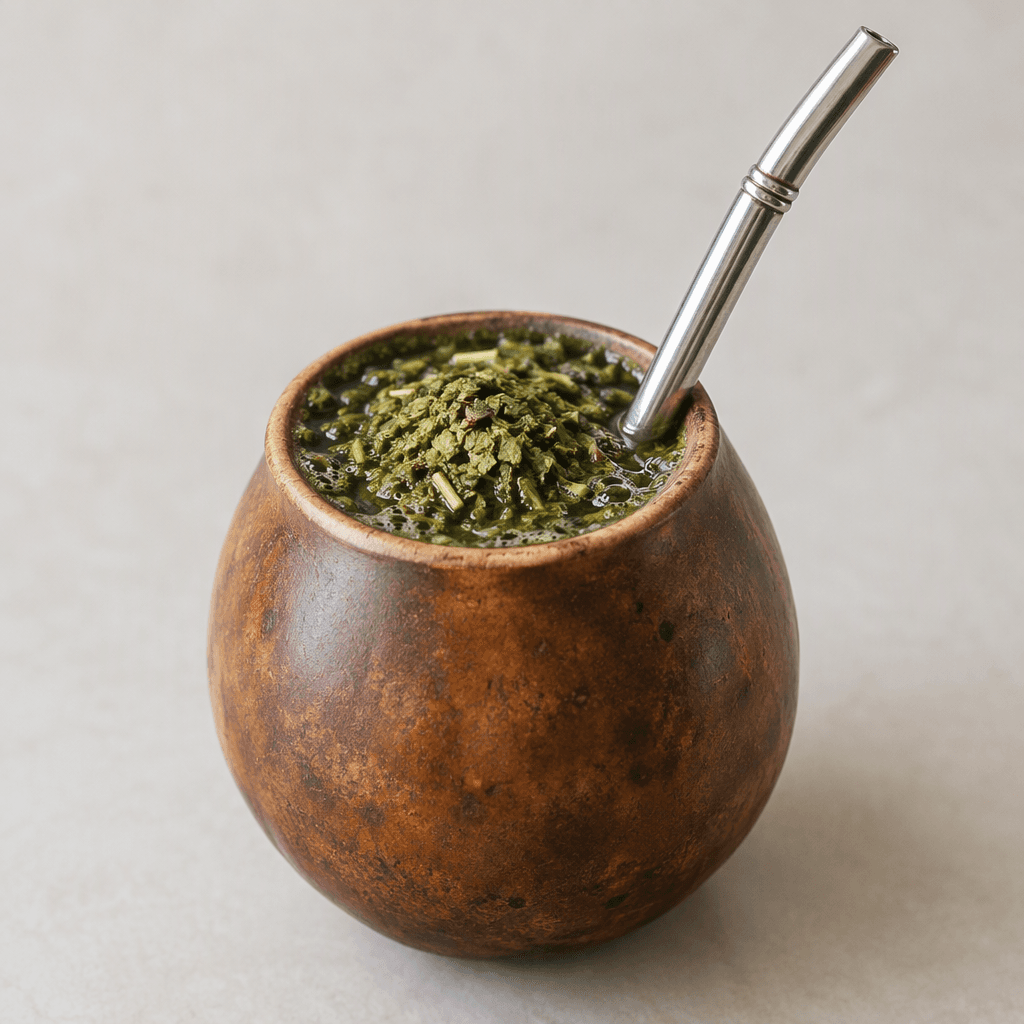
Mate tea is an infusion made from the dried leaves of yerba mate, a South American plant. It is especially closely associated with Argentina, Uruguay, Paraguay and southern Brazil, where it is traditionally shared from a hollow gourd using a filtered metal straw called a bombilla.
Its flavour is grassy and gently bitter, with a green-tea-like edge; a longer steep can make it stronger. Outside South America, it is often brewed in a mug or teapot, either plain or with lemon. Mate tea contains natural caffeine, so it can suit people looking for an alternative to coffee, though it may not be ideal late in the day. Unsweetened, it is very low in calories; start with a short steep if you prefer a milder cup.
Mate tea Nutrition Facts
Selected: 100 g
2
KCAL / 100G
Carbs
0.4g
· 0% DV
Protein
0.2g
· 0% DV
Fat
0g
· 0% DV
Fiber
0g
· 0% DV
DV is the share of the daily value covered, on a 2,000 kcal reference diet.
Calories come from: Carbs 67% · Protein 33% · Fat 0%
Mate tea Vitamins & Minerals
Vitamins
B2
0.02mg · 2% DV
B1
0.01mg · 1% DV
B3
0.1mg · 1% DV
B6
0.01mg · 1% DV
Minerals
Calcium
10mg · 1% DV
Potassium ⭐
20mg · 1% DV
Iron
0mg · 0% DV
Magnesium
2mg · 0% DV
How Nutritious Is Mate tea?
Nutrient density
Low
How many vitamins, minerals and how much fiber this food carries per calorie. A high score means a lot of nutrition for few calories.
Satiety score
Medium
An EatBetter score computed from fiber, protein and calorie density. A high score means staying full longer on the same calories.
Both scores are calculated per 100 g and do not change with the selected portion. The satiety score is EatBetter's own calculation, not a clinical measure.
Mate tea Glycemic Index
GLYCEMIC INDEX
GLYCEMIC LOAD
Accounts for portion size — a more realistic measure than GI alone.
How to Burn Off Mate tea
To burn the 2 calories in 100 g:
🚶
Walking (5 km/h)
🏃
Running (8 km/h)
🚴
Cycling
🏊
Swimming
Times are calculated with the MET equation for a 70 kg adult. Actual burn varies with your weight, age and pace.
Is Mate tea Processed?
NOVA 2
Minimally Processed
1. Unprocessed
2. Minimally Processed
3. Processed
4. Ultra-Processed
NOVA classifies foods into 4 groups by industrial processing. NOVA 1 (unprocessed) is the healthiest.
Does Mate tea Contain Allergens?
No known major allergens
Which Diets Is Mate tea Good For?
Vegan
✓ Suitable
Vegetarian
✓ Suitable
Gluten-Free
✓ Suitable
Dairy-Free
— Not suitable
Mediterranean
✓ Suitable
Paleo
✓ Suitable
Whole30
— Not suitable
DASH
— Not suitable
Keto
— Not suitable
Low FODMAP
— Not suitable
Mate tea Fat Profile
SATURATED
0g
MONOUNSATURATED
0g
POLYUNSATURATED
0g
Compare Mate tea
Foods Similar to Mate tea
Frequently Asked Questions About Mate tea
What is mate tea made from?
Mate tea is made from the leaves of Ilex paraguariensis, a South American holly tree. The leaves are dried and steeped in water; in the traditional preparation, people drink it from a gourd through a filtered metal straw called a bombilla.
How do you prepare mate tea in a gourd?
Put the mate leaves in a gourd, settle them to one side, and insert a bombilla into the open space. Add warm—not boiling—water and sip through the straw; you can add more water to the same leaves for several pours.
Does mate tea contain caffeine?
Yes, mate tea contains naturally occurring caffeine from its leaves. The amount varies with the quantity of leaves, steeping method, and serving, so a cup does not have one reliably fixed caffeine value.
What does mate tea taste like?
Mate tea tastes herbal, earthy, and often somewhat bitter. Longer steeping or very hot water can make the bitterness more noticeable; some people soften the flavor with citrus, mint, or a little sweetener.
Can you drink mate tea cold?
Yes. Cold mate tea is known as tereré in parts of South America: mate leaves are steeped with cold water, often served over ice. Citrus or fresh herbs can be added for extra flavor.
Can you reuse mate tea leaves?
Yes, mate leaves can be steeped repeatedly, especially when prepared in a gourd. Each pour usually tastes lighter than the last, so add fresh leaves when the infusion becomes too weak for your preference.
Is mate tea stronger than coffee?
Not necessarily. Mate tea and coffee can vary considerably in caffeine depending on the serving and how each is prepared. Mate is often sipped through several pours, so the total caffeine across those pours matters too.
Does mate tea help with weight loss?
No, mate tea is not a reliable weight-loss method on its own. Its caffeine may temporarily increase alertness, but drinking it does not guarantee fat loss or replace changes to eating and activity habits.
Can mate tea affect your sleep?
Yes, mate tea can make it harder to fall asleep because it contains caffeine. If you notice that it affects your sleep, have it earlier in the day rather than close to bedtime.
Is mate tea safe to drink during pregnancy?
Mate tea contains caffeine, so it counts toward the caffeine consumed during pregnancy. The appropriate amount depends on your circumstances and other caffeine sources; ask your healthcare professional for advice on your intake.
Have another question about Mate tea?
Ask the AI nutrition coach — calories, portions, alternatives and more, answered in seconds in the app.

Scan calories with your camera
Instant AI nutrition analysis

Nutrition data compiled from USDA FoodData Central and scientific sources.