

Ready & Packaged Foods
All →Vegetables & Legumes
All →Desserts & Confectionery
All →Meat & Protein
All →Grains & Bakery
All →Beverages
All →Milk & Dairy
All →

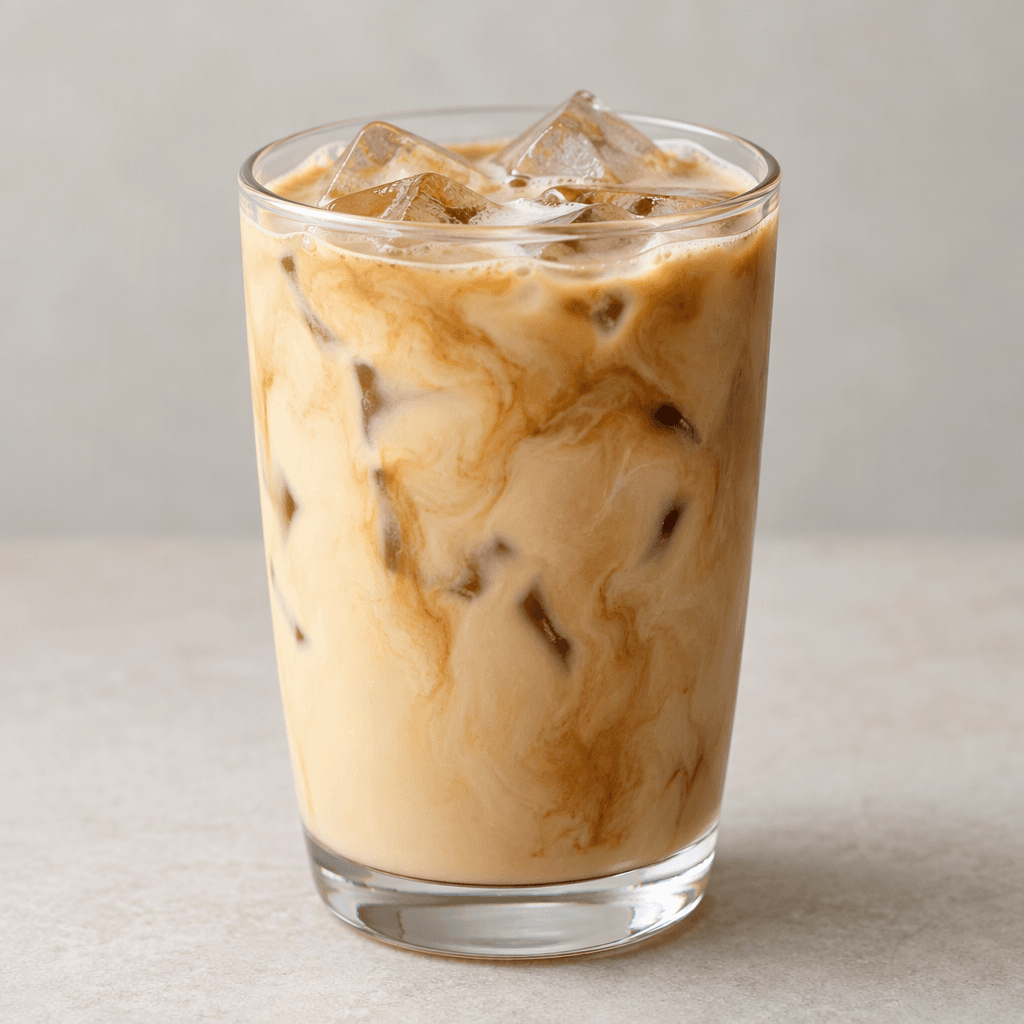
Low-sugar iced latte Calories
Low-sugar milk-based iced coffee
In season: Spring · Summer · Autumn · Winter
CALORIES
GI
POTASSIUM
FIBER
Quick answer
1 cup (medium) of Low-sugar iced latte (300 g) has 114 calories. That works out to 38 calories per 100 g. It contains 12.6 g of carbs, 5.7 g of protein, 4.2 g of fat and 0 g of fiber. Its 0.7 µg of B12 covers 28% of the Daily Value. Its glycemic index is 28 (low), so it raises blood sugar slowly.
What is Low-sugar iced latte?
A low-sugar iced latte combines espresso or strong brewed coffee with milk, ice and just a little sugar. It is a chilled café-style take on the milk-and-coffee combination familiar from caffè latte; recipes vary in coffee strength and sweetness, and some use espresso while others use brewed coffee.
It is commonly sipped as a refreshing coffee break, especially in warm weather, and pairs easily with a pastry or a light breakfast. The milk softens the coffee’s roasted bitterness and gives the drink a smooth, creamy texture. It has less sweetness than a standard sweetened café drink, though milk still contributes carbohydrates and some protein. For a lighter cup, ask for less sugar or use more coffee and ice.
Low-sugar iced latte Nutrition Facts
Selected: 100 g
38
KCAL / 100G
Carbs
4.2g
· 2% DV
Protein
1.9g
· 4% DV
Fat
1.4g
· 2% DV
Fiber
0g
· 0% DV
DV is the share of the daily value covered, on a 2,000 kcal reference diet.
Calories come from: Carbs 45% · Protein 21% · Fat 34%
Low-sugar iced latte Vitamins & Minerals
Vitamins
B12
0.22µg · 9% DV
B2
0.09mg · 7% DV
B5
0.28mg · 6% DV
Biotin
1.1µg · 4% DV
Minerals
Phosphorus
54mg · 8% DV
Calcium
68mg · 7% DV
Iodine
8µg · 5% DV
Selenium
1.6µg · 3% DV
How Nutritious Is Low-sugar iced latte?
Nutrient density
Low
How many vitamins, minerals and how much fiber this food carries per calorie. A high score means a lot of nutrition for few calories.
Satiety score
Medium
An EatBetter score computed from fiber, protein and calorie density. A high score means staying full longer on the same calories.
Both scores are calculated per 100 g and do not change with the selected portion. The satiety score is EatBetter's own calculation, not a clinical measure.
Low-sugar iced latte Glycemic Index
GLYCEMIC INDEX
GLYCEMIC LOAD
Accounts for portion size — a more realistic measure than GI alone.
How to Burn Off Low-sugar iced latte
To burn the 38 calories in 100 g:
🚶
Walking (5 km/h)
🏃
Running (8 km/h)
🚴
Cycling
🏊
Swimming
Times are calculated with the MET equation for a 70 kg adult. Actual burn varies with your weight, age and pace.
Is Low-sugar iced latte Processed?
NOVA 2
Minimally Processed
1. Unprocessed
2. Minimally Processed
3. Processed
4. Ultra-Processed
NOVA classifies foods into 4 groups by industrial processing. NOVA 1 (unprocessed) is the healthiest.
Does Low-sugar iced latte Contain Allergens?
Contains these allergens:
Which Diets Is Low-sugar iced latte Good For?
Vegan
— Not suitable
Vegetarian
✓ Suitable
Gluten-Free
✓ Suitable
Dairy-Free
— Not suitable
Mediterranean
— Not suitable
Paleo
— Not suitable
Whole30
— Not suitable
DASH
— Not suitable
Keto
— Not suitable
Low FODMAP
— Not suitable
Low-sugar iced latte Fat Profile
SATURATED
0.9g
MONOUNSATURATED
0.4g
POLYUNSATURATED
0.07g
Omega 6:3 ratio 2.5:1
Below the ideal 4:1 — a good omega balance.
Compare Low-sugar iced latte
Foods Similar to Low-sugar iced latte
Frequently Asked Questions About Low-sugar iced latte
How do you make a low-sugar iced latte?
To make a low-sugar iced latte, pour cooled espresso over ice, add cold milk, and use less sugar or syrup than a standard recipe. Stir well so the sweetener mixes evenly; adding it to warm espresso first can help it dissolve.
What is in a low-sugar iced latte?
A low-sugar iced latte is made with espresso, cold milk, ice, and less added sugar or syrup than a regular sweetened version. Recipes vary, so the amount of espresso and the type of milk can differ between cafés.
How much caffeine is in a low-sugar iced latte?
The caffeine in a low-sugar iced latte depends on how many espresso shots it contains. Reducing the sugar does not reduce the caffeine; ask for fewer shots or decaf espresso if you want less caffeine.
Is a low-sugar iced latte sugar-free?
No, a low-sugar iced latte is not necessarily sugar-free. It usually means the drink has less added sugar or syrup than the café’s standard recipe; request it unsweetened if you want no added sweetener.
Is a low-sugar iced latte good for weight loss?
A low-sugar iced latte does not cause weight loss on its own. Choosing it instead of a heavily sweetened coffee can reduce added sugar, but extra syrup, cream, or other add-ins can change the drink substantially.
Can you make a low-sugar iced latte with non-dairy milk?
Yes, you can make a low-sugar iced latte with non-dairy milk such as oat, soy, or almond milk. The flavor and texture will change, and some varieties are sweetened, so choose an unsweetened option if you want to keep added sugar low.
Can a low-sugar iced latte keep you awake?
Yes, a low-sugar iced latte can keep you awake because it still contains caffeine from espresso. Less sugar does not make it caffeine-free; choose decaf or have it earlier in the day if caffeine affects your sleep.
Why does a low-sugar iced latte taste watered down?
A low-sugar iced latte can taste watered down when its ice melts into the espresso and milk. Let the espresso cool before pouring it over ice, or use chilled ingredients to slow melting and preserve the flavor.
How long does a low-sugar iced latte last in the fridge?
A low-sugar iced latte is best enjoyed fresh because melted ice changes its flavor and texture. If you need to store it, remove the ice, cover the drink, refrigerate it, and drink it as soon as practical.
Can you order a low-sugar iced latte with decaf espresso?
Yes, a low-sugar iced latte can be made with decaf espresso while keeping the same cold milk-and-ice style. Ask for decaf and specify how little sweetener you want, since cafés may use different default recipes.
Have another question about Low-sugar iced latte?
Ask the AI nutrition coach — calories, portions, alternatives and more, answered in seconds in the app.

Scan calories with your camera
Instant AI nutrition analysis

Nutrition data compiled from USDA FoodData Central and scientific sources.