

Ready & Packaged Foods
All →Vegetables & Legumes
All →Desserts & Confectionery
All →Meat & Protein
All →Grains & Bakery
All →Beverages
All →Milk & Dairy
All →

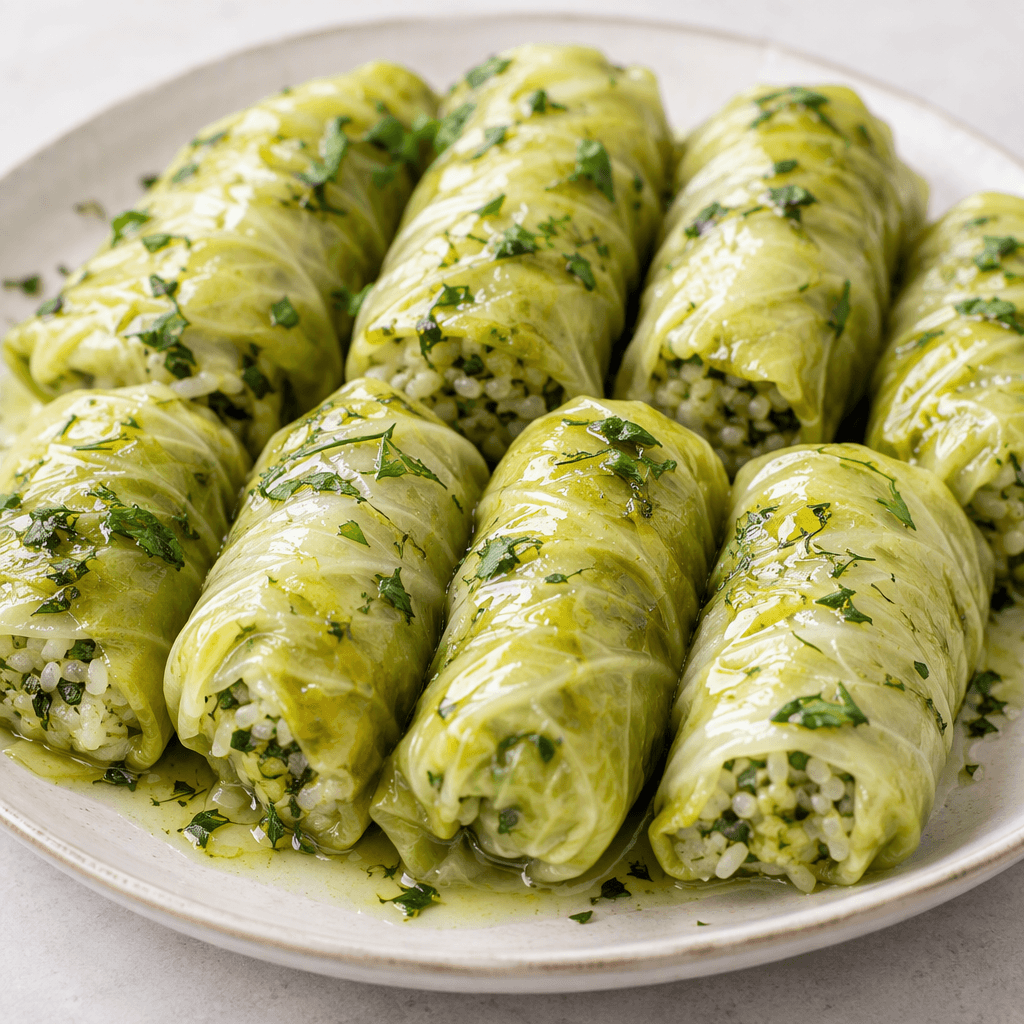
Stuffed Cabbage (Olive Oil) Calories
Vegetarian, olive oil, fiber-rich, stuffed vegetable
In season: Spring · Autumn · Winter
CALORIES
GI
POTASSIUM
FIBER
Quick answer
3 piece (medium) of Stuffed Cabbage (Olive Oil) (120 g) has 132 calories. That works out to 110 calories per 100 g. It contains 17.4 g of carbs, 2.6 g of protein, 6.2 g of fat and 4.3 g of fiber. Its 45.6 µg of Vitamin K covers 38% of the Daily Value. Its glycemic index is 45 (low), so it raises blood sugar slowly.
What is Stuffed Cabbage (Olive Oil)?
Stuffed cabbage with olive oil is made by wrapping rice and finely chopped herbs in softened cabbage leaves. It is a familiar home-cooked zeytinyağlı in Turkey, where the filling can vary from one household or region to another.
The leaves become tender around a gently savoury, herb-scented rice filling. It is commonly served cold or at room temperature, as part of a spread of meze and other olive-oil dishes, and a squeeze of lemon works well alongside it. Cabbage contributes fibre, while rice provides much of the carbohydrate and olive oil gives the dish its richness. Serve it with a salad for a light meal, or add plant-based sides if you want to keep the meal vegan.
Stuffed Cabbage (Olive Oil) Nutrition Facts
Selected: 100 g
110
KCAL / 100G
Carbs
14.5g
· 5% DV
Protein
2.2g
· 4% DV
Fat
5.2g
· 7% DV
Fiber
3.6g
· 13% DV
DV is the share of the daily value covered, on a 2,000 kcal reference diet.
Calories come from: Carbs 51% · Protein 8% · Fat 41%
Stuffed Cabbage (Olive Oil) Vitamins & Minerals
Vitamins
Vitamin K
38µg · 32% DV
Vitamin C
16mg · 18% DV
Folate
38µg · 10% DV
Vitamin E
1.1mg · 7% DV
Minerals
Sodium
310mg · 13% DV
Iron
1mg · 6% DV
Potassium ⭐
220mg · 6% DV
Calcium
54mg · 5% DV
How Nutritious Is Stuffed Cabbage (Olive Oil)?
Nutrient density
High
How many vitamins, minerals and how much fiber this food carries per calorie. A high score means a lot of nutrition for few calories.
Satiety score
Medium
An EatBetter score computed from fiber, protein and calorie density. A high score means staying full longer on the same calories.
Both scores are calculated per 100 g and do not change with the selected portion. The satiety score is EatBetter's own calculation, not a clinical measure.
Stuffed Cabbage (Olive Oil) Glycemic Index
GLYCEMIC INDEX
GLYCEMIC LOAD
Accounts for portion size — a more realistic measure than GI alone.
How to Burn Off Stuffed Cabbage (Olive Oil)
To burn the 110 calories in 100 g:
🚶
Walking (5 km/h)
🏃
Running (8 km/h)
🚴
Cycling
🏊
Swimming
Times are calculated with the MET equation for a 70 kg adult. Actual burn varies with your weight, age and pace.
Is Stuffed Cabbage (Olive Oil) Processed?
NOVA 2
Minimally Processed
1. Unprocessed
2. Minimally Processed
3. Processed
4. Ultra-Processed
NOVA classifies foods into 4 groups by industrial processing. NOVA 1 (unprocessed) is the healthiest.
Does Stuffed Cabbage (Olive Oil) Contain Allergens?
No known major allergens
Which Diets Is Stuffed Cabbage (Olive Oil) Good For?
Vegan
✓ Suitable
Vegetarian
✓ Suitable
Gluten-Free
✓ Suitable
Dairy-Free
— Not suitable
Mediterranean
✓ Suitable
Paleo
— Not suitable
Whole30
— Not suitable
DASH
— Not suitable
Keto
— Not suitable
Low FODMAP
— Not suitable
Stuffed Cabbage (Olive Oil) Fat Profile
SATURATED
0.7g
MONOUNSATURATED
3.2g
POLYUNSATURATED
1.1g
Omega 6:3 ratio 7.5:1
Above the ideal 4:1 (7.5:1).
Compare Stuffed Cabbage (Olive Oil)
Foods Similar to Stuffed Cabbage (Olive Oil)
Frequently Asked Questions About Stuffed Cabbage (Olive Oil)
How do you make olive-oil stuffed cabbage?
Olive-oil stuffed cabbage is made by wrapping a rice-and-herb filling in softened cabbage leaves and simmering the rolls gently. Blanch the leaves until flexible, roll them snugly, arrange them in a pot, and cook with olive oil and enough water to soften the rice.
What goes in the filling for olive-oil stuffed cabbage?
The filling for olive-oil stuffed cabbage usually contains rice, finely chopped onion, olive oil, and herbs such as parsley or dill. Some Turkish home recipes add currants, pine nuts, or spices, so the exact combination varies by household and region.
Which cabbage is best for olive-oil stuffed cabbage?
A fresh green cabbage with broad, flexible leaves works best for olive-oil stuffed cabbage. Choose a head whose leaves separate without tearing; very thick ribs can be trimmed or lightly flattened so the leaves roll evenly around the rice filling.
How do you soften cabbage leaves for olive-oil stuffed cabbage?
Briefly blanch the cabbage leaves in boiling water until they bend without cracking. Remove them as soon as they become pliable, since overcooked leaves tear easily; trimming or thinning the thick central rib also makes rolling easier.
Why do olive-oil stuffed cabbage rolls fall apart?
Olive-oil stuffed cabbage rolls usually fall apart because the leaves were overcooked, the rolls were wrapped loosely, or the pot was stirred during cooking. Roll them firmly, pack them close together, and let them simmer undisturbed.
Is olive-oil stuffed cabbage served hot or cold?
Olive-oil stuffed cabbage is most often served cold or at room temperature. Letting it rest after cooking helps the rice settle and the olive-oil and herb flavors develop, although it can also be eaten warm.
What do you serve with olive-oil stuffed cabbage?
Olive-oil stuffed cabbage goes well with lemon, plain yogurt, or a fresh salad. It can be served as part of a Turkish meze spread or as a light meal on its own, especially when the rolls are served chilled.
How long does olive-oil stuffed cabbage last in the fridge?
Olive-oil stuffed cabbage keeps for about 3–4 days in a covered container in the refrigerator. Refrigerate it once it has cooled rather than leaving it out for an extended period, and take out only the portion you plan to serve.
Can you freeze olive-oil stuffed cabbage?
Yes, you can freeze olive-oil stuffed cabbage, though the leaves may be softer after thawing. Freeze cooled rolls in an airtight container, thaw them in the refrigerator, and reheat gently to help keep them intact.
Can you make olive-oil stuffed cabbage ahead of time?
Yes, olive-oil stuffed cabbage can be cooked a day ahead and refrigerated. Resting gives the rice and herbs time to meld with the olive oil; serve it chilled or let it come to room temperature before serving.
Have another question about Stuffed Cabbage (Olive Oil)?
Ask the AI nutrition coach — calories, portions, alternatives and more, answered in seconds in the app.

Scan calories with your camera
Instant AI nutrition analysis

Nutrition data compiled from USDA FoodData Central and scientific sources.