

Ready & Packaged Foods
All →Vegetables & Legumes
All →Desserts & Confectionery
All →Meat & Protein
All →Grains & Bakery
All →Beverages
All →Milk & Dairy
All →

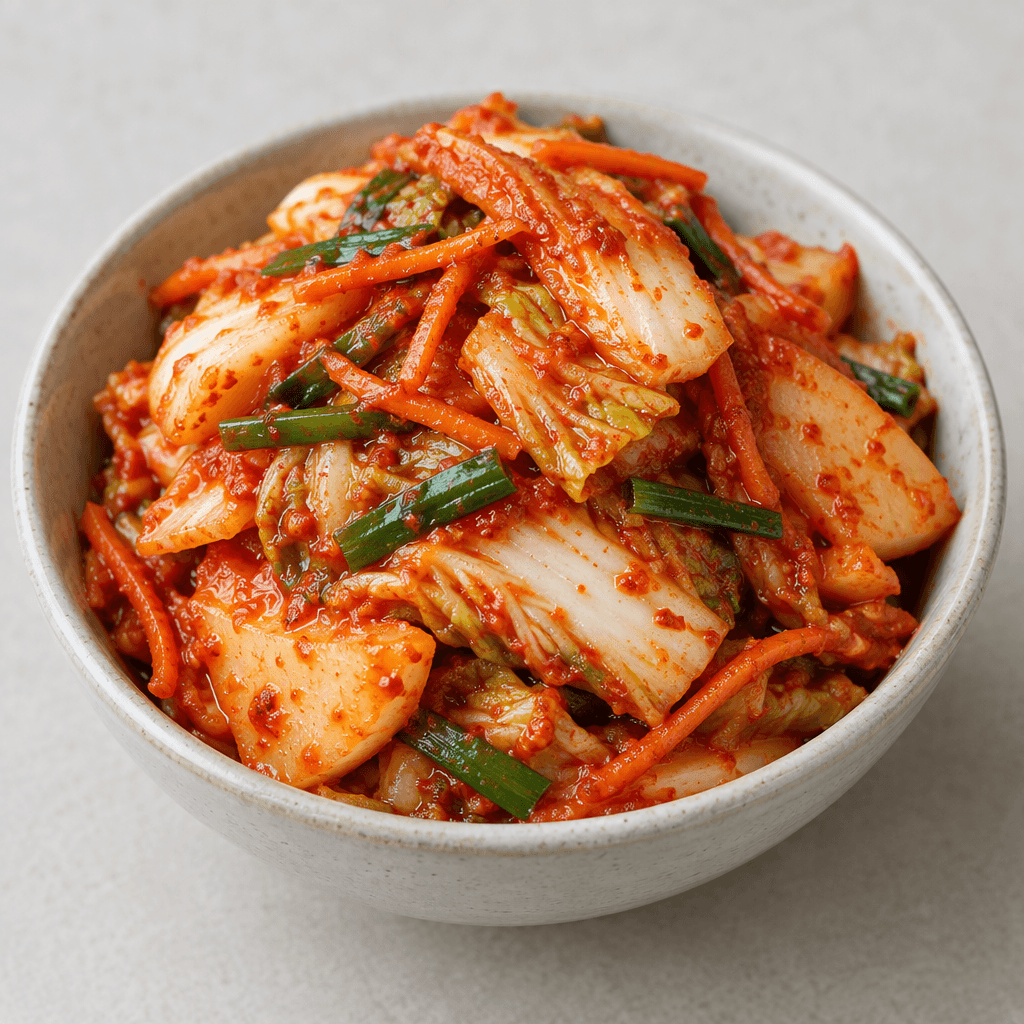
Kimchi Calories
Fermented cabbage, probiotic, low calorie, vitamin C source
In season: Spring · Summer · Autumn · Winter
CALORIES
GI
POTASSIUM
FIBER
Quick answer
1 serving (medium) of Kimchi (50 g) has 8 calories. That works out to 15 calories per 100 g. It contains 1.2 g of carbs, 0.6 g of protein, 0.3 g of fat and 0.8 g of fiber. Its 21.5 µg of Vitamin K covers 18% of the Daily Value. Its glycemic index is 15 (low), so it raises blood sugar slowly.
What is Kimchi?
Kimchi is a Korean fermented vegetable side dish, most often made with napa cabbage and sometimes radish, seasoned with chilli, garlic, ginger and spring onion. Recipes vary by region and household; carrot or other vegetables may be added, and the heat can range from gentle to fiery.
Its tangy, savoury flavour and crisp, juicy bite make it a natural companion to rice, noodles, soups and grilled foods. It is served regularly with meals in Korea, and works just as well in a rice bowl, sandwich or wrap elsewhere. Kimchi is mostly vegetables, with fibre and very few calories per 100 g. Start with a small portion if you are unfamiliar with its sharp, spicy taste, then add more to suit your meal.
Kimchi Nutrition Facts
Selected: 100 g
15
KCAL / 100G
Carbs
2.4g
· 1% DV
Protein
1.1g
· 2% DV
Fat
0.5g
· 1% DV
Fiber
1.6g
· 6% DV
DV is the share of the daily value covered, on a 2,000 kcal reference diet.
Calories come from: Carbs 52% · Protein 24% · Fat 24%
Kimchi Vitamins & Minerals
Vitamins
Vitamin K
43µg · 36% DV
Vitamin C
21mg · 23% DV
Folate
30µg · 8% DV
B12
0.2µg · 8% DV
Minerals
Sodium
498mg · 22% DV
Iron
1mg · 6% DV
Calcium
40mg · 4% DV
Potassium ⭐
151mg · 4% DV
How Nutritious Is Kimchi?
Nutrient density
Very high
How many vitamins, minerals and how much fiber this food carries per calorie. A high score means a lot of nutrition for few calories.
Satiety score
Medium
An EatBetter score computed from fiber, protein and calorie density. A high score means staying full longer on the same calories.
Both scores are calculated per 100 g and do not change with the selected portion. The satiety score is EatBetter's own calculation, not a clinical measure.
Kimchi Glycemic Index
GLYCEMIC INDEX
GLYCEMIC LOAD
Accounts for portion size — a more realistic measure than GI alone.
How to Burn Off Kimchi
To burn the 15 calories in 100 g:
🚶
Walking (5 km/h)
🏃
Running (8 km/h)
🚴
Cycling
🏊
Swimming
Times are calculated with the MET equation for a 70 kg adult. Actual burn varies with your weight, age and pace.
Is Kimchi Processed?
NOVA 2
Minimally Processed
1. Unprocessed
2. Minimally Processed
3. Processed
4. Ultra-Processed
NOVA classifies foods into 4 groups by industrial processing. NOVA 1 (unprocessed) is the healthiest.
Does Kimchi Contain Allergens?
No known major allergens
Which Diets Is Kimchi Good For?
Vegan
✓ Suitable
Vegetarian
✓ Suitable
Gluten-Free
✓ Suitable
Dairy-Free
— Not suitable
Mediterranean
✓ Suitable
Paleo
✓ Suitable
Whole30
— Not suitable
DASH
— Not suitable
Keto
— Not suitable
Low FODMAP
— Not suitable
Kimchi Fat Profile
SATURATED
0.07g
MONOUNSATURATED
0.12g
POLYUNSATURATED
0.18g
Omega 6:3 ratio 2:1
Below the ideal 4:1 — a good omega balance.
Compare Kimchi
Foods Similar to Kimchi
Frequently Asked Questions About Kimchi
What is kimchi made of?
Kimchi is a Korean fermented vegetable dish, most often made with napa cabbage or radish. Garlic, ginger, spring onion, salt and Korean chilli flakes are common additions, though recipes vary by region and style.
How do you make kimchi at home?
To make kimchi, salt cabbage until it softens, rinse and drain it, then coat it with a paste of chilli, garlic, ginger and other vegetables. Pack it firmly into a clean jar and refrigerate once it tastes pleasantly sour.
What does kimchi taste like?
Kimchi tastes tangy, savoury and usually spicy, with a crunchy texture when young. Fermentation makes it progressively more sour and softer, so a freshly opened batch can taste quite different from kimchi that has aged in the fridge.
Is kimchi spicy?
Most kimchi is spicy because it contains Korean chilli flakes, but the heat varies between recipes. White kimchi is a milder, non-chilli version. If you are new to it, try a small bite alongside plain rice.
How do you eat kimchi?
Kimchi is commonly served as a side dish with rice, noodles, soups and Korean meals. You can also add it to fried rice, sandwiches, eggs or tofu; its sharp, savoury flavour works especially well with mild foods.
How long does kimchi last in the fridge?
Kimchi can keep in the refrigerator for several months, becoming more sour as it ferments. Use a clean utensil each time and keep the vegetables submerged in their liquid. Discard it if you see mould or other signs of spoilage.
Can you cook kimchi?
Yes, kimchi can be cooked in stews, soups, pancakes and fried rice. Older, sour kimchi is particularly useful for hot dishes because cooking mellows its sharpness. Heat can reduce live bacteria, so serve it uncooked if that is your priority.
Does kimchi contain probiotics?
Fermented kimchi can contain live lactic acid bacteria, but the amount depends on how it was made and stored. Heating reduces live cultures, and pasteurised kimchi may not contain them, so cooking and fermentation style matter.
Can you freeze kimchi?
Yes, you can freeze kimchi, although thawing makes its cabbage softer and less crisp. Freeze it in a sealed container with room for expansion, then use the thawed kimchi in soups, stews or fried rice rather than as a crunchy side.
What is the difference between kimchi and sauerkraut?
Kimchi is usually a Korean mix of vegetables seasoned with ingredients such as chilli, garlic and ginger, while sauerkraut is typically cabbage fermented with salt. Kimchi tends to have a more complex, spicy flavour; sauerkraut is usually simpler and tangier.
Have another question about Kimchi?
Ask the AI nutrition coach — calories, portions, alternatives and more, answered in seconds in the app.

Scan calories with your camera
Instant AI nutrition analysis

Nutrition data compiled from USDA FoodData Central and scientific sources.