

Ready & Packaged Foods
All →Vegetables & Legumes
All →Desserts & Confectionery
All →Meat & Protein
All →Grains & Bakery
All →Beverages
All →Milk & Dairy
All →

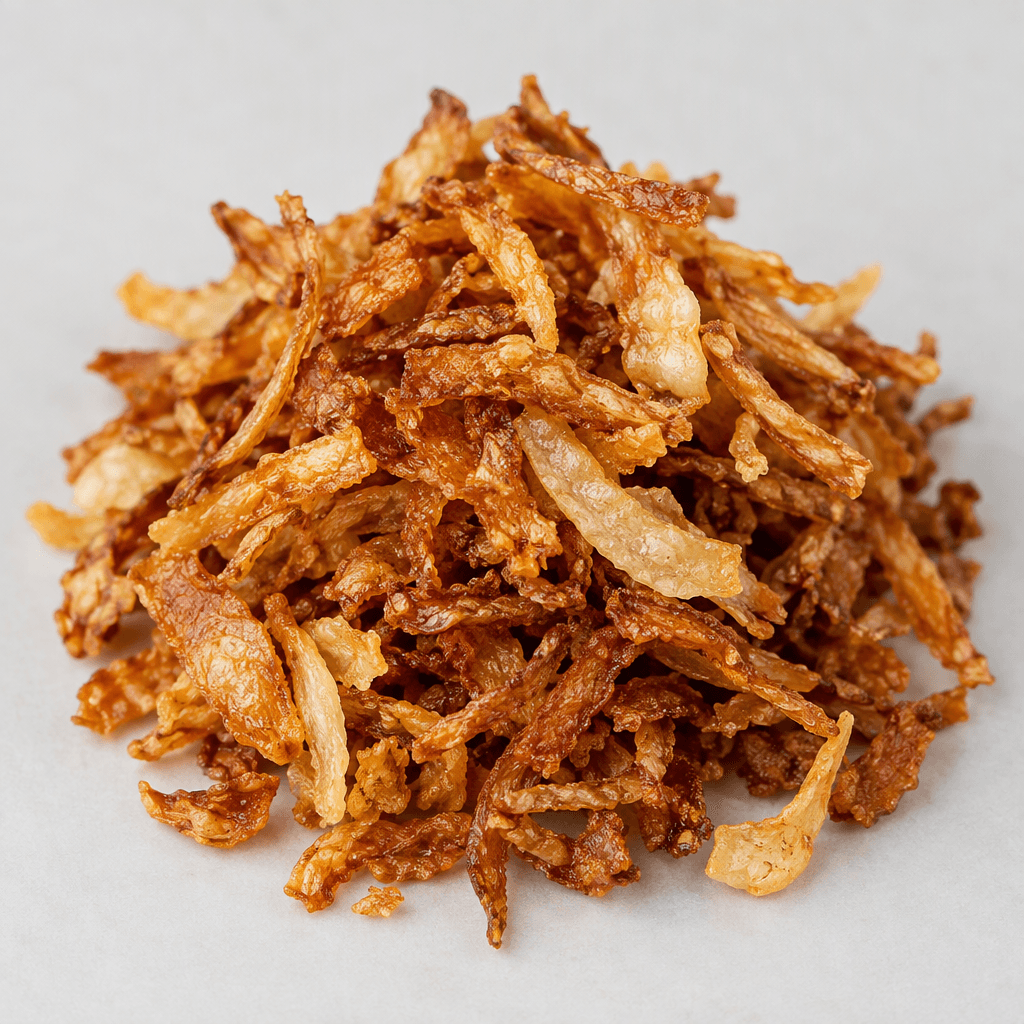
Fried Onion Calories
Fried, flavorful, adds aroma to dishes
In season: Spring · Summer · Autumn · Winter
CALORIES
GI
POTASSIUM
FIBER
Quick answer
1 tablespoon (medium) of Fried Onion (12 g) has 26 calories. That works out to 220 calories per 100 g. It contains 2.9 g of carbs, 0.3 g of protein, 1.6 g of fat and 0.3 g of fiber. Its glycemic index is 45 (medium), so it raises blood sugar at a moderate pace.
What is Fried Onion?
Fried Onion is made by cooking thinly sliced onion in oil until golden and crisp. There is no single origin: crisp fried onions appear in many cuisines, including South Asian biryani and Middle Eastern rice dishes, and are also an easy pantry topping in English-speaking kitchens.
Its sweet, savoury aroma and crunchy texture add contrast to pilaf, soups, salads, burgers or a bowl of beans; add it just before serving to keep it crisp. Alongside the onion’s carbohydrates and fibre, frying contributes fat, so it is more energy-dense than fresh onion. A small spoonful is usually enough to bring flavour and crunch without overwhelming a dish.
Fried Onion Nutrition Facts
Selected: 100 g
220
KCAL / 100G
Carbs
24.5g
· 9% DV
Protein
2.2g
· 4% DV
Fat
13.5g
· 17% DV
Fiber
2.6g
· 9% DV
DV is the share of the daily value covered, on a 2,000 kcal reference diet.
Calories come from: Carbs 43% · Protein 4% · Fat 53%
Fried Onion Vitamins & Minerals
Vitamins
B6
0.13mg · 8% DV
Vitamin C
5mg · 6% DV
B1
0.06mg · 5% DV
Folate
19µg · 5% DV
Minerals
Phosphorus
38mg · 5% DV
Potassium ⭐
180mg · 5% DV
Calcium
32mg · 3% DV
Magnesium
13mg · 3% DV
How Nutritious Is Fried Onion?
Nutrient density
Medium
How many vitamins, minerals and how much fiber this food carries per calorie. A high score means a lot of nutrition for few calories.
Satiety score
Low
An EatBetter score computed from fiber, protein and calorie density. A high score means staying full longer on the same calories.
Both scores are calculated per 100 g and do not change with the selected portion. The satiety score is EatBetter's own calculation, not a clinical measure.
Fried Onion Glycemic Index
GLYCEMIC INDEX
GLYCEMIC LOAD
Accounts for portion size — a more realistic measure than GI alone.
How to Burn Off Fried Onion
To burn the 220 calories in 100 g:
🚶
Walking (5 km/h)
🏃
Running (8 km/h)
🚴
Cycling
🏊
Swimming
Times are calculated with the MET equation for a 70 kg adult. Actual burn varies with your weight, age and pace.
Is Fried Onion Processed?
NOVA 3
Processed
1. Unprocessed
2. Minimally Processed
3. Processed
4. Ultra-Processed
NOVA classifies foods into 4 groups by industrial processing. NOVA 1 (unprocessed) is the healthiest.
Does Fried Onion Contain Allergens?
No known major allergens
Which Diets Is Fried Onion Good For?
Vegan
✓ Suitable
Vegetarian
✓ Suitable
Gluten-Free
✓ Suitable
Dairy-Free
— Not suitable
Mediterranean
✓ Suitable
Paleo
— Not suitable
Whole30
— Not suitable
DASH
— Not suitable
Keto
— Not suitable
Low FODMAP
— Not suitable
Fried Onion Fat Profile
SATURATED
2.2g
MONOUNSATURATED
6.1g
POLYUNSATURATED
3.2g
Omega 6:3 ratio 105:1
Above the ideal 4:1 (105:1).
Compare Fried Onion
Foods Similar to Fried Onion
Frequently Asked Questions About Fried Onion
How do you make Fried Onion crispy at home?
To make crispy Fried Onion, slice onions thinly and fry them in hot oil in small batches until golden. Drain them well and let them cool completely; crowding the pan traps steam and makes the strips soft.
What can you use Fried Onion for?
Fried Onion works as a crunchy topping for rice, soups, salads, burgers, sandwiches, and casseroles. Add it just before serving so steam from hot food does not soften the crisp pieces.
How should you store Fried Onion?
Store Fried Onion only after it has cooled, in a tightly sealed, dry container away from heat and sunlight. Homemade pieces are best used while crisp; follow the storage directions on packaged Fried Onion.
Why does Fried Onion go soggy?
Fried Onion goes soggy when it absorbs moisture from humid air or steam from hot food. Keep it in an airtight container and sprinkle it over a dish at the last moment rather than stirring it in early.
What is the difference between Fried Onion and caramelized onion?
Fried Onion is cooked in oil until browned and often crisp, while caramelized onion is cooked slowly until soft, sweet, and deeply browned. They have different textures and are not interchangeable in every recipe.
Can you make Fried Onion in an air fryer?
Yes, you can make Fried Onion in an air fryer by tossing thin onion slices with a little oil and arranging them in a single layer. Shake the basket during cooking and watch closely near the end, as thin pieces brown quickly.
Can Fried Onion replace fresh onion in a recipe?
Fried Onion cannot fully replace fresh onion when a recipe needs onion to soften and cook into the dish. Use it instead as a finishing garnish, where its browned flavor and crisp texture are useful.
Why does Fried Onion taste bitter?
Fried Onion tastes bitter when the slices are cooked too long or the oil is too hot and they burn. Remove the onions as soon as they turn golden, since residual heat can continue darkening them.
Can you freeze Fried Onion?
Yes, Fried Onion can be frozen, but thawing may make it soft rather than crisp. If you want it as a crunchy topping, use it fresh or store it in an airtight container instead of freezing it.
Is Fried Onion healthy to eat?
Fried Onion can add flavor in a small amount, but frying makes it higher in fat than fresh onion. Use it as a topping rather than the main vegetable, especially if you are keeping an eye on your overall fat intake.
Have another question about Fried Onion?
Ask the AI nutrition coach — calories, portions, alternatives and more, answered in seconds in the app.

Scan calories with your camera
Instant AI nutrition analysis

Nutrition data compiled from USDA FoodData Central and scientific sources.