

Ready & Packaged Foods
All →Vegetables & Legumes
All →Desserts & Confectionery
All →Meat & Protein
All →Grains & Bakery
All →Beverages
All →Milk & Dairy
All →

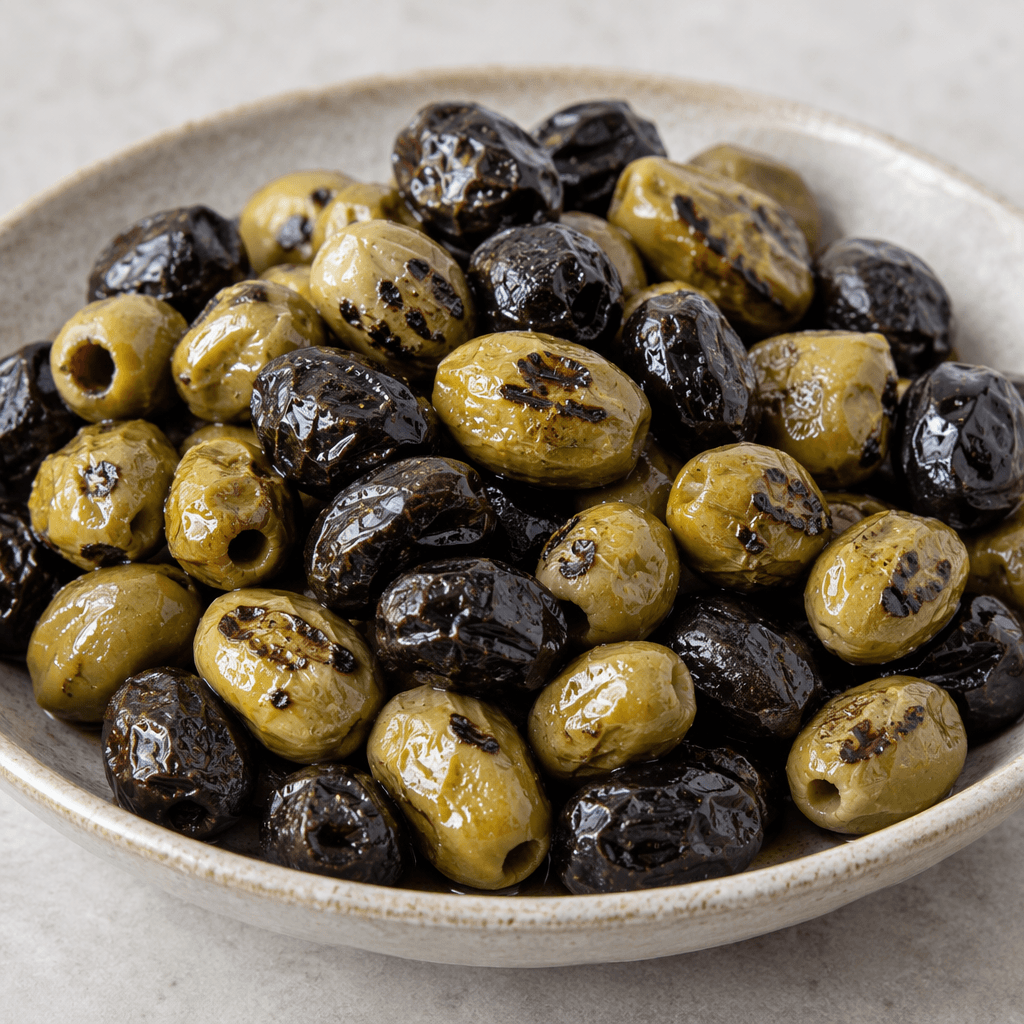
Grilled olives Calories
Grilled, Mediterranean, olive snack
In season: Summer · Autumn
CALORIES
GI
POTASSIUM
FIBER
Quick answer
10 piece (medium) of Grilled olives (35 g) has 51 calories. That works out to 145 calories per 100 g. It contains 1.3 g of carbs, 0.4 g of protein, 5 g of fat and 1.2 g of fiber. Its 542.5 mg of Sodium covers 24% of the Daily Value. Its glycemic index is 15 (low), so it raises blood sugar slowly.
What is Grilled olives?
Grilled olives are whole green or black olives heated until their skins wrinkle and pick up lightly charred marks. The method suits Mediterranean-style cooking, bringing out the olives’ briny, fruity flavour with a subtle smoky edge; they stay tender inside and may be a little crisp around the edges.
Serve them warm as a snack or part of a mezze spread, with bread, cheese or vegetables, or add a few to salads. They’re naturally rich in fat, so a small portion can bring plenty of flavour to a plate. If you’re watching how much oil you use, grill them with just a light coating and finish with lemon or herbs instead.
Grilled olives Nutrition Facts
Selected: 100 g
145
KCAL / 100G
Carbs
3.8g
· 1% DV
Protein
1.2g
· 2% DV
Fat
14.2g
· 18% DV
Fiber
3.3g
· 12% DV
DV is the share of the daily value covered, on a 2,000 kcal reference diet.
Calories come from: Carbs 10% · Protein 3% · Fat 87%
Grilled olives Vitamins & Minerals
Vitamins
Vitamin E
3.8mg · 25% DV
B5
0.3mg · 6% DV
B1
0.03mg · 3% DV
Vitamin A
20µg · 2% DV
Minerals
Sodium
1550mg · 67% DV
Iron
1mg · 6% DV
Calcium
52mg · 5% DV
Magnesium
11mg · 3% DV
How Nutritious Is Grilled olives?
Nutrient density
Medium
How many vitamins, minerals and how much fiber this food carries per calorie. A high score means a lot of nutrition for few calories.
Satiety score
Medium
An EatBetter score computed from fiber, protein and calorie density. A high score means staying full longer on the same calories.
Both scores are calculated per 100 g and do not change with the selected portion. The satiety score is EatBetter's own calculation, not a clinical measure.
Grilled olives Glycemic Index
GLYCEMIC INDEX
GLYCEMIC LOAD
Accounts for portion size — a more realistic measure than GI alone.
How to Burn Off Grilled olives
To burn the 145 calories in 100 g:
🚶
Walking (5 km/h)
🏃
Running (8 km/h)
🚴
Cycling
🏊
Swimming
Times are calculated with the MET equation for a 70 kg adult. Actual burn varies with your weight, age and pace.
Is Grilled olives Processed?
NOVA 2
Minimally Processed
1. Unprocessed
2. Minimally Processed
3. Processed
4. Ultra-Processed
NOVA classifies foods into 4 groups by industrial processing. NOVA 1 (unprocessed) is the healthiest.
Does Grilled olives Contain Allergens?
No known major allergens
Which Diets Is Grilled olives Good For?
Vegan
✓ Suitable
Vegetarian
✓ Suitable
Gluten-Free
✓ Suitable
Dairy-Free
— Not suitable
Mediterranean
✓ Suitable
Paleo
✓ Suitable
Whole30
— Not suitable
DASH
— Not suitable
Keto
✓ Suitable
Low FODMAP
— Not suitable
Grilled olives Fat Profile
SATURATED
2.1g
MONOUNSATURATED
10.2g
POLYUNSATURATED
1.4g
Omega 6:3 ratio 10.9:1
Above the ideal 4:1 (10.9:1).
Compare Grilled olives
Foods Similar to Grilled olives
Frequently Asked Questions About Grilled olives
Can you grill olives?
Yes, olives can be grilled, and the heat wrinkles their skins and adds a lightly smoky flavor. Drain and dry them first, then cook briefly in a grill basket or on a perforated tray so they do not fall through the grates.
How do you make grilled olives?
To make grilled olives, toss drained olives with a little olive oil and grill them over high heat until blistered in spots. Turn them often and remove them before they become too soft; finish with lemon zest or herbs if you like.
Which olives are best for grilled olives?
Firm, meaty olives work best for grilled olives because they hold their shape over high heat. You can use green or black olives, with pits or without; mixing varieties gives a more varied flavor and appearance.
Do grilled olives need to be pitted before cooking?
No, you do not need to pit olives before grilling them. Pitted olives are easier to eat, but they can fall through a grill grate, so cook them in a grill basket or on a tray. Warn guests if you serve them with pits.
Can you make grilled olives in a pan?
Yes, grilled olives can be made in a hot skillet when an outdoor grill is unavailable. Use a heavy or nonstick pan, spread the olives in one layer, and turn them frequently until blistered. Crowding the pan makes them steam instead.
Why are grilled olives so salty?
Grilled olives are often salty because they were cured or packed in brine, not because they were grilled. Drain and taste them before cooking; if they are too salty, briefly soak them in water and dry them thoroughly before grilling.
Are grilled olives served hot or cold?
Grilled olives can be served warm or at room temperature. Their smoky, blistered flavor works well as an appetizer either way; if they have been refrigerated, let them lose their chill briefly or warm them gently in a pan.
What do you serve with grilled olives?
Grilled olives pair well with crusty bread, cheese, hummus, and grilled vegetables. They also make a savory side for grilled fish or chicken. Since olives can be quite salty, balance them with milder foods rather than heavily salted sides.
How should you store leftover grilled olives?
Store leftover grilled olives in a covered container in the refrigerator, and return them promptly after serving. Use a clean utensil when taking some out. Discard them if you notice mold, an unpleasant smell, or an unusual texture.
Can grilled olives be reheated?
Yes, reheat grilled olives briefly in a skillet over low to medium heat, turning them as they warm. Avoid prolonged heating, which can make them mushy and dull the blistered texture. They are also good served cold or at room temperature.
Have another question about Grilled olives?
Ask the AI nutrition coach — calories, portions, alternatives and more, answered in seconds in the app.

Scan calories with your camera
Instant AI nutrition analysis

Nutrition data compiled from USDA FoodData Central and scientific sources.