

Ready & Packaged Foods
All →Vegetables & Legumes
All →Desserts & Confectionery
All →Meat & Protein
All →Grains & Bakery
All →Beverages
All →Milk & Dairy
All →

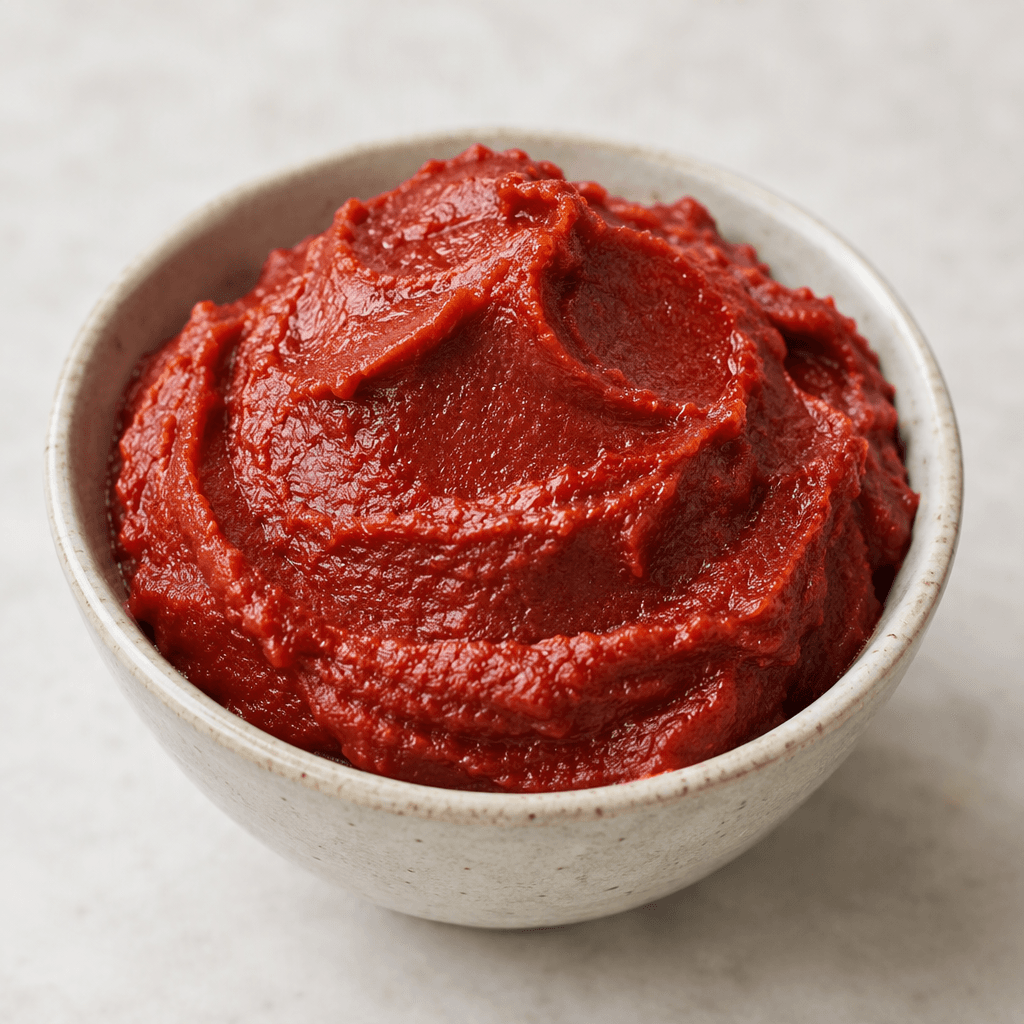
Homemade Tomato Paste Calories
Rich tomato flavor, homemade, additive-free
In season: Summer · Autumn
CALORIES
GI
POTASSIUM
FIBER
Quick answer
1 tablespoon (medium) of Homemade Tomato Paste (18 g) has 15 calories. That works out to 82 calories per 100 g. It contains 3.4 g of carbs, 0.8 g of protein, 0.1 g of fat and 0.7 g of fiber. Its 102.6 µg of Vitamin A covers 11% of the Daily Value. Its glycemic index is 38 (low), so it raises blood sugar slowly.
What is Homemade Tomato Paste?
Homemade Tomato Paste is made by crushing ripe tomatoes and slowly cooking or drying them until much of their water evaporates. The result is a thick, smooth paste with a deep red colour and concentrated, savoury-sweet tomato flavour. In Turkey, home recipes and methods vary; some cooks reduce the tomatoes on the stove, while others dry them in the sun.
It is commonly stirred into soups, bean dishes, stews and sauces as a flavourful base, and can also be spread on bread. Because it is concentrated tomato, it provides carbohydrates and fibre while containing little fat. A small spoonful can go a long way; for a lighter, fresher-tasting dish, use less paste and loosen it with water or fresh tomato.
Homemade Tomato Paste Nutrition Facts
Selected: 100 g
82
KCAL / 100G
Carbs
18.9g
· 7% DV
Protein
4.3g
· 9% DV
Fat
0.5g
· 1% DV
Fiber
3.7g
· 13% DV
DV is the share of the daily value covered, on a 2,000 kcal reference diet.
Calories come from: Carbs 78% · Protein 18% · Fat 4%
Homemade Tomato Paste Vitamins & Minerals
Vitamins
Vitamin A
570µg · 63% DV
Vitamin C
21mg · 23% DV
Vitamin E
2.8mg · 19% DV
Biotin
4.1µg · 14% DV
Minerals
Potassium ⭐
1010mg · 30% DV
Iron
2mg · 11% DV
Magnesium
42mg · 10% DV
Phosphorus
61mg · 9% DV
How Nutritious Is Homemade Tomato Paste?
Nutrient density
High
How many vitamins, minerals and how much fiber this food carries per calorie. A high score means a lot of nutrition for few calories.
Satiety score
Medium
An EatBetter score computed from fiber, protein and calorie density. A high score means staying full longer on the same calories.
Both scores are calculated per 100 g and do not change with the selected portion. The satiety score is EatBetter's own calculation, not a clinical measure.
Homemade Tomato Paste Glycemic Index
GLYCEMIC INDEX
GLYCEMIC LOAD
Accounts for portion size — a more realistic measure than GI alone.
How to Burn Off Homemade Tomato Paste
To burn the 82 calories in 100 g:
🚶
Walking (5 km/h)
🏃
Running (8 km/h)
🚴
Cycling
🏊
Swimming
Times are calculated with the MET equation for a 70 kg adult. Actual burn varies with your weight, age and pace.
Is Homemade Tomato Paste Processed?
NOVA 2
Minimally Processed
1. Unprocessed
2. Minimally Processed
3. Processed
4. Ultra-Processed
NOVA classifies foods into 4 groups by industrial processing. NOVA 1 (unprocessed) is the healthiest.
Does Homemade Tomato Paste Contain Allergens?
No known major allergens
Which Diets Is Homemade Tomato Paste Good For?
Vegan
✓ Suitable
Vegetarian
✓ Suitable
Gluten-Free
✓ Suitable
Dairy-Free
— Not suitable
Mediterranean
✓ Suitable
Paleo
✓ Suitable
Whole30
— Not suitable
DASH
— Not suitable
Keto
— Not suitable
Low FODMAP
— Not suitable
Homemade Tomato Paste Fat Profile
SATURATED
0.09g
MONOUNSATURATED
0.08g
POLYUNSATURATED
0.13g
Omega 6:3 ratio 3:1
Below the ideal 4:1 — a good omega balance.
Compare Homemade Tomato Paste
Foods Similar to Homemade Tomato Paste
Frequently Asked Questions About Homemade Tomato Paste
How do you make homemade tomato paste?
Homemade tomato paste is made by crushing ripe tomatoes, straining out the skins and seeds, then reducing the pulp until thick. You can simmer it on the stove or dry it in the sun, stirring as needed to prevent scorching.
How should homemade tomato paste be stored?
Store opened homemade tomato paste in a clean, airtight container in the refrigerator. Use a clean spoon each time, and freeze small portions if you will not use it soon; homemade paste may not be shelf-stable.
Can you freeze homemade tomato paste?
Yes, homemade tomato paste freezes well. Divide it into small portions in a freezer-safe container or ice-cube tray, then thaw only what you need. Avoid repeatedly thawing and refreezing the same batch.
What tomatoes are best for homemade tomato paste?
Meaty, fully ripe tomatoes with relatively little water work best for homemade tomato paste. They reduce faster and produce a thicker result. Discard tomatoes with mold or rot rather than cutting away the damaged part.
What is the difference between homemade tomato paste and tomato purée?
Homemade tomato paste is cooked or dried down until thick and concentrated, while tomato purée is thinner and contains more water. They are not interchangeable in equal amounts; adding purée may make a recipe too loose.
Why should you fry homemade tomato paste before adding liquid?
Briefly frying homemade tomato paste in oil softens its raw, sharp flavor and helps it blend into the dish. Stir it for a short time over moderate heat, then add broth, water, or other ingredients before it sticks.
How can you tell when homemade tomato paste is thick enough?
Homemade tomato paste is thick enough when it holds its shape and a line drawn through it does not quickly fill with liquid. Reduce it gradually and stir regularly so the bottom does not scorch.
Can homemade tomato paste replace canned tomato paste?
Yes, homemade tomato paste can replace canned tomato paste in the same kind of recipe. Because homemade batches vary in thickness and saltiness, add it gradually and adjust the seasoning and liquid to suit the dish.
Why did my homemade tomato paste grow mold?
Mold means the homemade tomato paste should be discarded in full, not scraped off at the surface. Mold can spread beyond the visible patch; contaminated utensils, air exposure, or storing an opened jar unrefrigerated can contribute.
Can homemade tomato paste be made without salt?
Yes, homemade tomato paste can be made without salt. Keep it refrigerated in a clean, airtight container or freeze it in portions; do not rely on a salt-free batch being safe to store at room temperature.
Have another question about Homemade Tomato Paste?
Ask the AI nutrition coach — calories, portions, alternatives and more, answered in seconds in the app.

Scan calories with your camera
Instant AI nutrition analysis

Nutrition data compiled from USDA FoodData Central and scientific sources.