

Ready & Packaged Foods
All →Vegetables & Legumes
All →Desserts & Confectionery
All →Meat & Protein
All →Grains & Bakery
All →Beverages
All →Milk & Dairy
All →

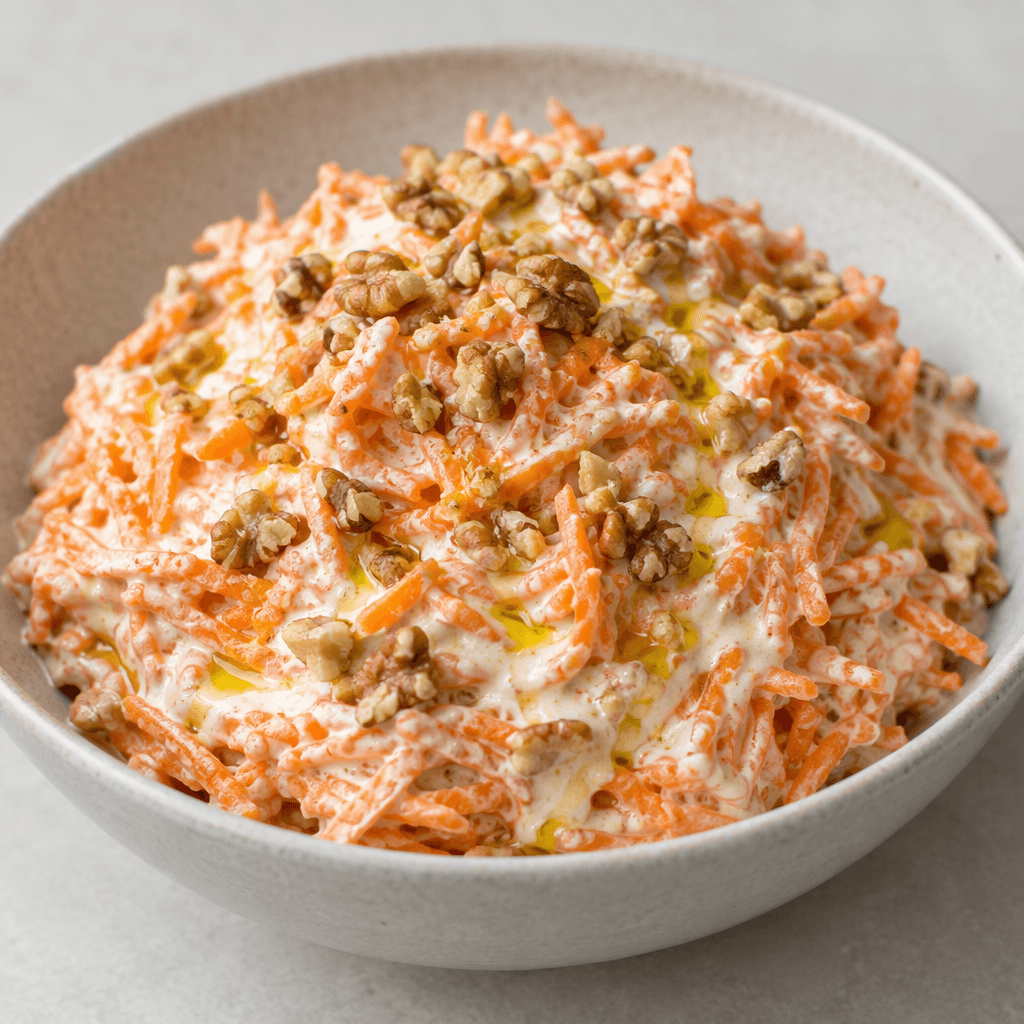
Carrot Tarator Calories
Yogurt-based carrot and walnut dip
In season: Spring · Summer · Autumn · Winter
CALORIES
GI
POTASSIUM
FIBER
Quick answer
100 g of Carrot Tarator has 110 calories. It contains 8.5 g of carbs, 3.2 g of protein, 7.2 g of fat and 2.1 g of fiber. Its 650 µg of Vitamin A covers 72% of the Daily Value. Its glycemic index is 35 (low), so it raises blood sugar slowly.
What is Carrot Tarator?
Carrot Tarator is a Turkish meze made with grated carrots folded into a thick yogurt mixture, often seasoned with garlic. The carrots are commonly softened in a little oil and cooled before mixing; walnuts and a drizzle of olive oil are popular additions, though home recipes vary.
It combines the carrots’ gentle sweetness with cool, tangy yogurt, while walnuts add crunch. Serve it chilled as part of a Turkish meze spread, with bread, or alongside a main meal. It’s a vegetable-based dip with some protein from the yogurt, rather than a particularly high-protein dish. For a lighter version, use plain yogurt instead of a thicker, richer one and keep the oil modest.
Carrot Tarator Nutrition Facts
Selected: 100 g
110
KCAL / 100G
Carbs
8.5g
· 3% DV
Protein
3.2g
· 6% DV
Fat
7.2g
· 9% DV
Fiber
2.1g
· 8% DV
DV is the share of the daily value covered, on a 2,000 kcal reference diet.
Calories come from: Carbs 30% · Protein 11% · Fat 59%
Carrot Tarator Vitamins & Minerals
Vitamins
Vitamin A
650µg · 72% DV
B2
0.13mg · 10% DV
B5
0.5mg · 10% DV
Biotin
2.5µg · 8% DV
Minerals
Zinc
1mg · 9% DV
Phosphorus
52mg · 7% DV
Calcium
62mg · 6% DV
Iron
1mg · 6% DV
How Nutritious Is Carrot Tarator?
Nutrient density
Medium
How many vitamins, minerals and how much fiber this food carries per calorie. A high score means a lot of nutrition for few calories.
Satiety score
Medium
An EatBetter score computed from fiber, protein and calorie density. A high score means staying full longer on the same calories.
Both scores are calculated per 100 g and do not change with the selected portion. The satiety score is EatBetter's own calculation, not a clinical measure.
Carrot Tarator Glycemic Index
GLYCEMIC INDEX
GLYCEMIC LOAD
Accounts for portion size — a more realistic measure than GI alone.
How to Burn Off Carrot Tarator
To burn the 110 calories in 100 g:
🚶
Walking (5 km/h)
🏃
Running (8 km/h)
🚴
Cycling
🏊
Swimming
Times are calculated with the MET equation for a 70 kg adult. Actual burn varies with your weight, age and pace.
Is Carrot Tarator Processed?
NOVA 2
Minimally Processed
1. Unprocessed
2. Minimally Processed
3. Processed
4. Ultra-Processed
NOVA classifies foods into 4 groups by industrial processing. NOVA 1 (unprocessed) is the healthiest.
Does Carrot Tarator Contain Allergens?
Contains these allergens:
Which Diets Is Carrot Tarator Good For?
Vegan
— Not suitable
Vegetarian
✓ Suitable
Gluten-Free
— Not suitable
Dairy-Free
— Not suitable
Mediterranean
✓ Suitable
Paleo
— Not suitable
Whole30
— Not suitable
DASH
— Not suitable
Keto
— Not suitable
Low FODMAP
— Not suitable
Carrot Tarator Fat Profile
SATURATED
1.8g
MONOUNSATURATED
2.2g
POLYUNSATURATED
2g
Omega 6:3 ratio 13.1:1
Above the ideal 4:1 (13.1:1).
Compare Carrot Tarator
Foods Similar to Carrot Tarator
Frequently Asked Questions About Carrot Tarator
How do you make carrot tarator?
Carrot tarator is made by sautéing grated carrots in a little olive oil, cooling them, then mixing them with garlicky yogurt. Add chopped walnuts if you like, and wait until the carrots are cool before stirring in the yogurt.
Are the carrots in carrot tarator cooked or raw?
Carrot tarator is usually made with cooked carrots. Grating and sautéing them softens their texture and mellows their flavor; let them cool fully so they do not loosen or warm the yogurt.
What ingredients go in carrot tarator?
Carrot tarator typically contains grated carrots, yogurt, garlic, and olive oil. Chopped walnuts are a common addition, while thicker yogurt gives the dip a creamier, less runny texture.
Why does carrot tarator turn watery?
Carrot tarator can turn watery if the carrots are still warm or wet when mixed with yogurt. Sauté them until tender and their released liquid has evaporated, then cool them completely and use thick yogurt.
Can you make carrot tarator ahead of time?
Yes, carrot tarator can be made ahead and chilled before serving. Mix the cooled carrots with yogurt, cover the dip, and refrigerate it; add the walnuts close to serving time to keep them crunchy.
How long does carrot tarator keep in the fridge?
Carrot tarator keeps for about 2–3 days in a covered container in the refrigerator. Because it contains yogurt, return leftovers to the fridge promptly and discard the dip if its smell or appearance changes.
What do you serve with carrot tarator?
Carrot tarator works as a cold meze or side dish alongside grilled meat, chicken, or other Mediterranean-style dishes. It is also commonly served with bread or as part of a spread of dips and small plates.
Does carrot tarator need walnuts?
No, walnuts are optional in carrot tarator. They add crunch and a nutty flavor, but the yogurt-and-carrot dip is still complete without them; sprinkle them on top if you want to keep some texture.
Is carrot tarator the same as tzatziki?
No, carrot tarator is not the same as tzatziki. Carrot tarator features cooked grated carrots mixed with yogurt, often with garlic and walnuts, while tzatziki is usually based on cucumber and yogurt.
Can you make carrot tarator without mayonnaise?
Yes, carrot tarator can be made without mayonnaise; yogurt provides the creamy base in the usual version. For a thicker dip, use strained yogurt and make sure the cooked carrots have cooled before mixing.
Have another question about Carrot Tarator?
Ask the AI nutrition coach — calories, portions, alternatives and more, answered in seconds in the app.

Scan calories with your camera
Instant AI nutrition analysis

Nutrition data compiled from USDA FoodData Central and scientific sources.