

Ready & Packaged Foods
All →Vegetables & Legumes
All →Desserts & Confectionery
All →Meat & Protein
All →Grains & Bakery
All →Beverages
All →Milk & Dairy
All →

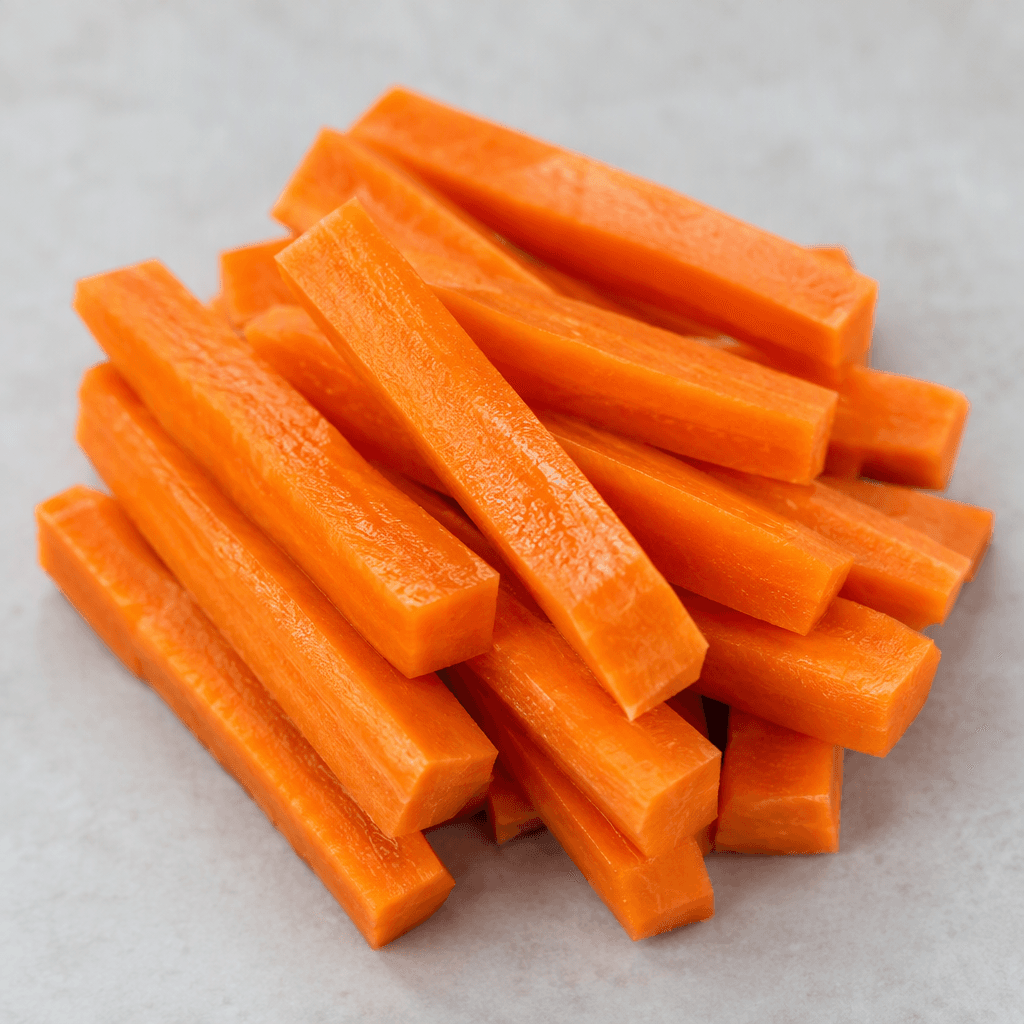
Carrot sticks Calories
Low calorie, high fiber, good source of vitamin A
In season: Spring · Summer · Autumn · Winter
CALORIES
GI
POTASSIUM
FIBER
Quick answer
1 serving (medium) of Carrot sticks (50 g) has 21 calories. That works out to 41 calories per 100 g. It contains 4.8 g of carbs, 0.5 g of protein, 0.1 g of fat and 1.4 g of fiber. Its 417.5 µg of Vitamin A covers 46% of the Daily Value. Its glycemic index is 35 (low), so it raises blood sugar slowly.
What is Carrot sticks?
Carrot sticks are fresh carrots cut into long, easy-to-grab pieces, usually eaten raw as a snack or served alongside a meal. They taste mildly sweet and have a crisp, firm bite; cooking softens them and brings out more sweetness. In many places, they’re packed for lunches, added to snack plates, or served with dips such as hummus and yogurt-based sauces. They also work well alongside sandwiches or as a simple crunchy addition to a salad. Carrot sticks are low in calories and provide fibre and vitamin A. Pair them with a protein-rich dip if you’d like a more filling snack, or enjoy them plain for a light, convenient option.
Carrot sticks Nutrition Facts
Selected: 100 g
41
KCAL / 100G
Carbs
9.6g
· 3% DV
Protein
0.9g
· 2% DV
Fat
0.2g
· 0% DV
Fiber
2.8g
· 10% DV
DV is the share of the daily value covered, on a 2,000 kcal reference diet.
Calories come from: Carbs 88% · Protein 8% · Fat 4%
Carrot sticks Vitamins & Minerals
Vitamins
Vitamin A
835µg · 93% DV
Vitamin K
13.2µg · 11% DV
B6
0.14mg · 8% DV
Vitamin C
5.9mg · 7% DV
Minerals
Potassium ⭐
320mg · 9% DV
Phosphorus
35mg · 5% DV
Calcium
33mg · 3% DV
Magnesium
12mg · 3% DV
How Nutritious Is Carrot sticks?
Nutrient density
High
How many vitamins, minerals and how much fiber this food carries per calorie. A high score means a lot of nutrition for few calories.
Satiety score
Medium
An EatBetter score computed from fiber, protein and calorie density. A high score means staying full longer on the same calories.
Both scores are calculated per 100 g and do not change with the selected portion. The satiety score is EatBetter's own calculation, not a clinical measure.
Carrot sticks Glycemic Index
GLYCEMIC INDEX
GLYCEMIC LOAD
Accounts for portion size — a more realistic measure than GI alone.
How to Burn Off Carrot sticks
To burn the 41 calories in 100 g:
🚶
Walking (5 km/h)
🏃
Running (8 km/h)
🚴
Cycling
🏊
Swimming
Times are calculated with the MET equation for a 70 kg adult. Actual burn varies with your weight, age and pace.
Is Carrot sticks Processed?
NOVA 2
Minimally Processed
1. Unprocessed
2. Minimally Processed
3. Processed
4. Ultra-Processed
NOVA classifies foods into 4 groups by industrial processing. NOVA 1 (unprocessed) is the healthiest.
Does Carrot sticks Contain Allergens?
No known major allergens
Which Diets Is Carrot sticks Good For?
Vegan
✓ Suitable
Vegetarian
✓ Suitable
Gluten-Free
✓ Suitable
Dairy-Free
— Not suitable
Mediterranean
✓ Suitable
Paleo
✓ Suitable
Whole30
— Not suitable
DASH
— Not suitable
Keto
— Not suitable
Low FODMAP
— Not suitable
Carrot sticks Fat Profile
SATURATED
0.04g
MONOUNSATURATED
0.01g
POLYUNSATURATED
0.12g
Omega 6:3 ratio 2:1
Below the ideal 4:1 — a good omega balance.
Compare Carrot sticks
Foods Similar to Carrot sticks
Frequently Asked Questions About Carrot sticks
How do you keep carrot sticks crisp?
Store carrot sticks in a sealed container in the refrigerator, with a slightly damp paper towel to limit drying. If you keep them submerged in water, change the water regularly and drain the sticks before serving.
Do you have to peel carrot sticks?
No, you do not have to peel carrot sticks. Scrub the carrots well under running water before cutting; peel them if the skin is tough, damaged, or still dirty after washing.
Can you freeze carrot sticks?
Yes, but thawed carrot sticks will be softer and less crisp. Blanch them briefly, cool them in cold water, drain thoroughly, and freeze; they work better in cooked dishes than as a crunchy snack.
How long do carrot sticks last in the fridge?
Freshly cut carrot sticks usually keep for several days in a sealed container in the refrigerator. Discard them if they become slimy, smell unpleasant, or turn noticeably soft.
Can you eat carrot sticks raw?
Yes, carrot sticks can be eaten raw once they have been washed thoroughly. They are crisp as a snack, while cooking softens them for use in soups, stir-fries, or side dishes.
How do you cut carrots into even sticks?
Trim the ends, cut each carrot into manageable lengths, and slice each length into planks before cutting the planks into sticks. Halve thick carrots lengthwise first so the pieces cook evenly.
What dips go well with carrot sticks?
Carrot sticks pair well with hummus, ranch-style dip, or a yogurt dip. Pat them dry before serving so excess water does not thin the dip.
Can you roast carrot sticks?
Yes, carrot sticks roast well. Toss them with a little oil and seasoning, spread them in a single layer, and roast until tender; thinner sticks will cook faster than thick ones.
Why do carrot sticks turn white in the fridge?
Carrot sticks can develop a pale, dry-looking surface when they lose moisture in the refrigerator. This is usually dehydration rather than spoilage; store them in a sealed container and discard them if they are slimy or smell off.
Can you prepare carrot sticks the night before?
Yes, you can cut carrot sticks the night before and refrigerate them in a sealed container. Add a slightly damp paper towel to help prevent drying, and keep them chilled until serving.
Have another question about Carrot sticks?
Ask the AI nutrition coach — calories, portions, alternatives and more, answered in seconds in the app.

Scan calories with your camera
Instant AI nutrition analysis

Nutrition data compiled from USDA FoodData Central and scientific sources.