

Ready & Packaged Foods
All →Vegetables & Legumes
All →Desserts & Confectionery
All →Meat & Protein
All →Grains & Bakery
All →Beverages
All →Milk & Dairy
All →

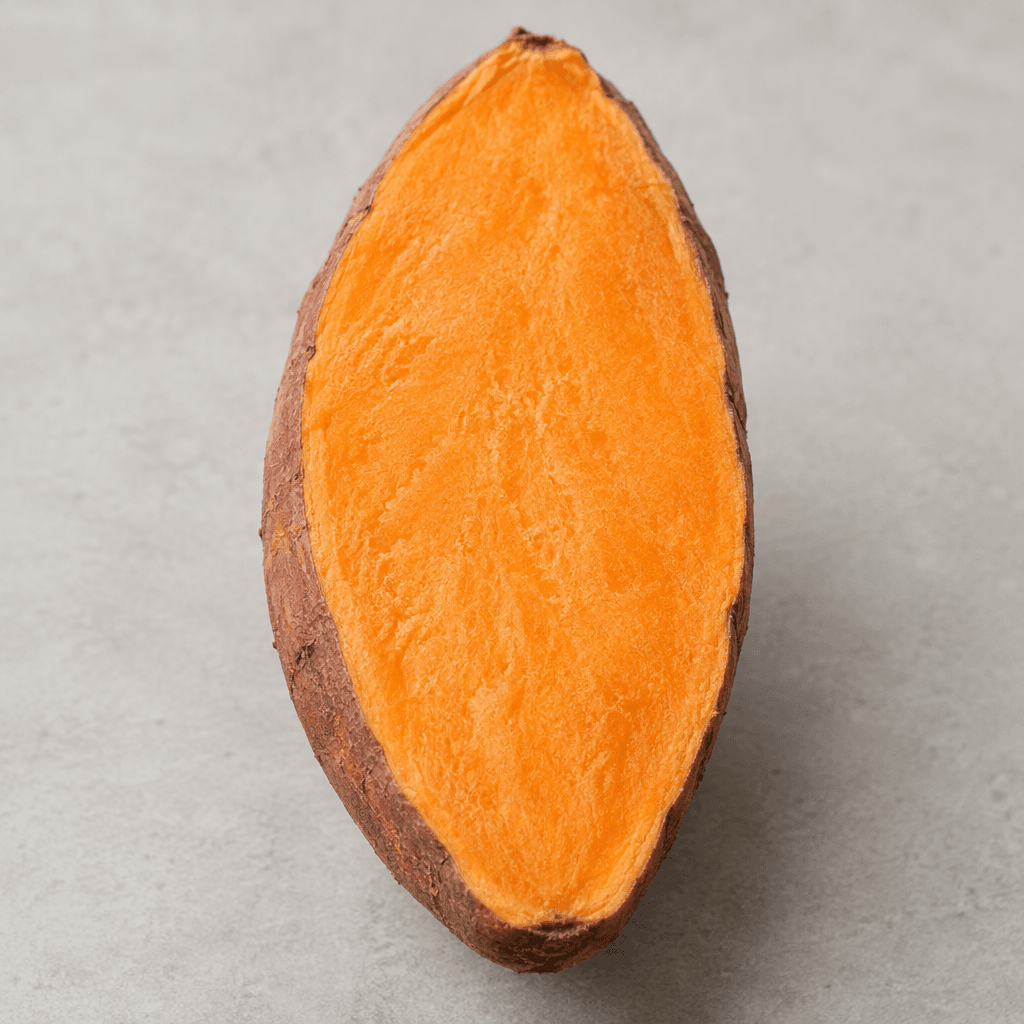
Half sweet potato Calories
Source of beta-carotene, fiber, and vitamin C
In season: Autumn · Winter
CALORIES · 100 G
GI
POTASSIUM · 100 G
FIBER · 100 G
Quick answer
1 piece (half) of Half sweet potato (65 g) has 56 calories. That works out to 86 calories per 100 g. It contains 13.1 g of carbs, 1 g of protein, 0.1 g of fat and 2 g of fiber. Its 460.9 µg of Vitamin A covers 51% of the Daily Value. Its glycemic index is 61 (medium), so it raises blood sugar at a moderate pace.
Half sweet potato Nutrition Facts
Selected: 1 piece (half) · 65 g
56
KCAL / 65G
Carbs
13.1g
· 5% DV
Protein
1g
· 2% DV
Fat
0.1g
· 0% DV
Fiber
2g
· 7% DV
DV is the share of the daily value covered, on a 2,000 kcal reference diet.
Calories come from: Carbs 91% · Protein 7% · Fat 2%
Half sweet potato nutrition facts table · 1 piece (half) (65 g)
| Nutrient | Amount | % DV |
|---|---|---|
| Calories | 56 kcal | |
| Total fat | 0.1 g | 0% |
| Saturated fat | 0.01 g | 0% |
| Trans fat | 0 g | |
| Sodium | 36 mg | 2% |
| Total carbohydrate | 13.1 g | 5% |
| Fiber | 2 g | 7% |
| Protein | 1 g | 2% |
Calories: Calories measure energy. Average daily need is 2,000 kcal. Excess calories are stored as fat, too few cause weight loss.
Carbs: Your body's primary energy source. The brain runs exclusively on carbs. Daily need: 275g.
Protein: Essential for muscle repair and cell growth. Daily need: 50g. Keeps you full and boosts metabolism.
Fat: Needed for hormone production and vitamin absorption. Daily need: 78g. Limit saturated fats, choose unsaturated.
Fiber: Critical for digestive health and satiety. Daily need: 28g. Stabilizes blood sugar, lowers cholesterol.

Log this food in EatBetter
100,000+ people use it
- Get your daily calorie target
- Snap your meal, log it in seconds
- See every vitamin and mineral

📸 Scan the code to get the app free.

How Many Calories in ½ Half sweet potato?
| Serving | Amount | Calories |
|---|---|---|
| 1 piece (half) | 65 g | 56 kcal |
| 1 slice (thin) | 30 g | 26 kcal |
| 1 slice (thick) | 50 g | 43 kcal |
| 100 g | 100 g | 86 kcal |
| 1 serving (medium) | 100 g | 86 kcal |
| 1 piece (whole) | 130 g | 112 kcal |
| 1 serving (large) | 150 g | 129 kcal |
| 1 cup (chopped) | 200 g | 172 kcal |
Calculated from 86 calories per 100 g.
Frequently Asked Questions About Half sweet potato
How do you bake half a sweet potato?
Scrub half a sweet potato, pat it dry, and place it cut-side down on a baking tray. Bake until a fork slides easily into the flesh. The cooking time varies with the piece’s size and your oven, so check its tenderness rather than relying on a fixed time.
Is half a sweet potato the same as half a yam?
No. In many grocery stores, the orange-fleshed vegetable called a yam is actually a sweet potato. True yams are a different, starchier root vegetable with rougher skin and pale flesh. The name on the produce label can vary by country and store.
Can you eat the skin of half a sweet potato?
Yes, the skin of half a sweet potato is edible. Scrub it well under running water before cooking and trim away any damaged spots. Baking or roasting softens the skin; if you dislike its texture, you can scoop out the flesh after cooking.
How should you store half a cut sweet potato?
Wrap half a cut sweet potato tightly or put it in an airtight container and refrigerate it promptly. Covering the cut surface helps limit drying and discoloration. Discard it if it becomes moldy, slimy, or develops an unpleasant smell.
Can you microwave half a sweet potato?
Yes. Pierce the skin of half a sweet potato several times with a fork, place it on a microwave-safe plate, and cook until the flesh is tender. Turn it partway through if needed, and let it stand briefly before cutting because steam can escape.
Why is the inside of half a sweet potato orange?
The orange color in half a sweet potato comes from beta-carotene, a natural pigment that the body can convert to vitamin A. Color intensity varies among varieties and is not, by itself, a sign that the sweet potato has spoiled.
Can you freeze half a sweet potato?
Yes, but cooked half a sweet potato generally freezes better than a raw one. Let it cool, wrap it well or use an airtight freezer container, and reheat it after thawing. Freezing it raw can leave the texture less pleasant.
Does half a sweet potato raise blood sugar?
Yes, sweet potato can raise blood sugar because it contains digestible carbohydrates. The effect varies with portion size, preparation, and what you eat alongside it; pairing it with protein and other high-fiber foods can make a meal more balanced.
Can you eat half a sweet potato raw?
Yes, half a sweet potato can be eaten raw, but it is firm and starchy, so many people find it easier to digest and more enjoyable cooked. Wash it well, then slice or grate it thinly if you want to try it raw.
Why does half a sweet potato sometimes leak white liquid when cut?
A small amount of white, milky liquid on half a sweet potato is usually natural starch and sap, not spoilage. It may appear more noticeably in some varieties. Wipe it away and cook the sweet potato as usual if the flesh is otherwise firm and smells fresh.
Half sweet potato Vitamins & Minerals
Vitamins
Vitamin A
460.85µg · 51% DV
B5
0.52mg · 10% DV
B6
0.14mg · 8% DV
Biotin
1.56µg · 5% DV
Minerals
Copper
0.1mg · 11% DV
Manganese
0.17mg · 7% DV
Potassium ⭐
219mg · 6% DV
Phosphorus
31mg · 4% DV
Sodium
36mg · 2% DV
Half sweet potato Glycemic Index
GLYCEMIC INDEX
GLYCEMIC LOAD
Accounts for portion size — a more realistic measure than GI alone.
How to Burn Off Half sweet potato
To burn the 56 calories in 1 piece (half) (65 g):
🚶
Walking (5 km/h)
🏃
Running (8 km/h)
🚴
Cycling
🏊
Swimming
Times are calculated with the MET equation for a 70 kg adult. Actual burn varies with your weight, age and pace.
What is Half sweet potato?
A half sweet potato is one lengthwise portion of the orange-fleshed root, which is botanically distinct from the familiar white potato. Sweet potatoes are widely eaten in many parts of the world, though they are less of an everyday staple in some places.
Once cooked, the flesh is soft and dense, with a gentle sweetness. Roast or bake it in its skin, mash it, or serve it as a side with vegetables, fish or beans. It brings fibre and beta-carotene to a meal, along with vitamin C. For a filling, balanced plate, pair it with a source of protein; roasting with just a little oil keeps the preparation simple.
How Nutritious Is Half sweet potato?
Nutrient density
High
How many vitamins, minerals and how much fiber this food carries per calorie. A high score means a lot of nutrition for few calories.
Satiety score
Medium
An EatBetter score computed from fiber, protein and calorie density. A high score means staying full longer on the same calories.
Both scores are calculated per 100 g and do not change with the selected portion. The satiety score is EatBetter's own calculation, not a clinical measure.
Is Half sweet potato Processed?
NOVA 1
Unprocessed
1. Unprocessed
2. Minimally Processed
3. Processed
4. Ultra-Processed
NOVA classifies foods into 4 groups by industrial processing. NOVA 1 (unprocessed) is the healthiest.
Does Half sweet potato Contain Allergens?
No known major allergens
Which Diets Is Half sweet potato Good For?
Vegan
✓ Suitable
Vegetarian
✓ Suitable
Gluten-Free
✓ Suitable
Dairy-Free
— Not suitable
Mediterranean
✓ Suitable
Paleo
✓ Suitable
Whole30
— Not suitable
DASH
— Not suitable
Keto
— Not suitable
Low FODMAP
— Not suitable
Half sweet potato Fat Profile
SATURATED
0.01g
MONOUNSATURATED
0.01g
POLYUNSATURATED
0.01g
Omega 6:3 ratio 1:1
Below the ideal 4:1 — a good omega balance.
Compare Half sweet potato
Foods Similar to Half sweet potato
Have another question about Half sweet potato?
Ask the AI nutrition coach — calories, portions, alternatives and more, answered in seconds in the app.

Scan calories with your camera
Instant AI nutrition analysis

Nutrition data compiled from USDA FoodData Central and scientific sources.