

Ready & Packaged Foods
All →Vegetables & Legumes
All →Desserts & Confectionery
All →Meat & Protein
All →Grains & Bakery
All →Beverages
All →Milk & Dairy
All →

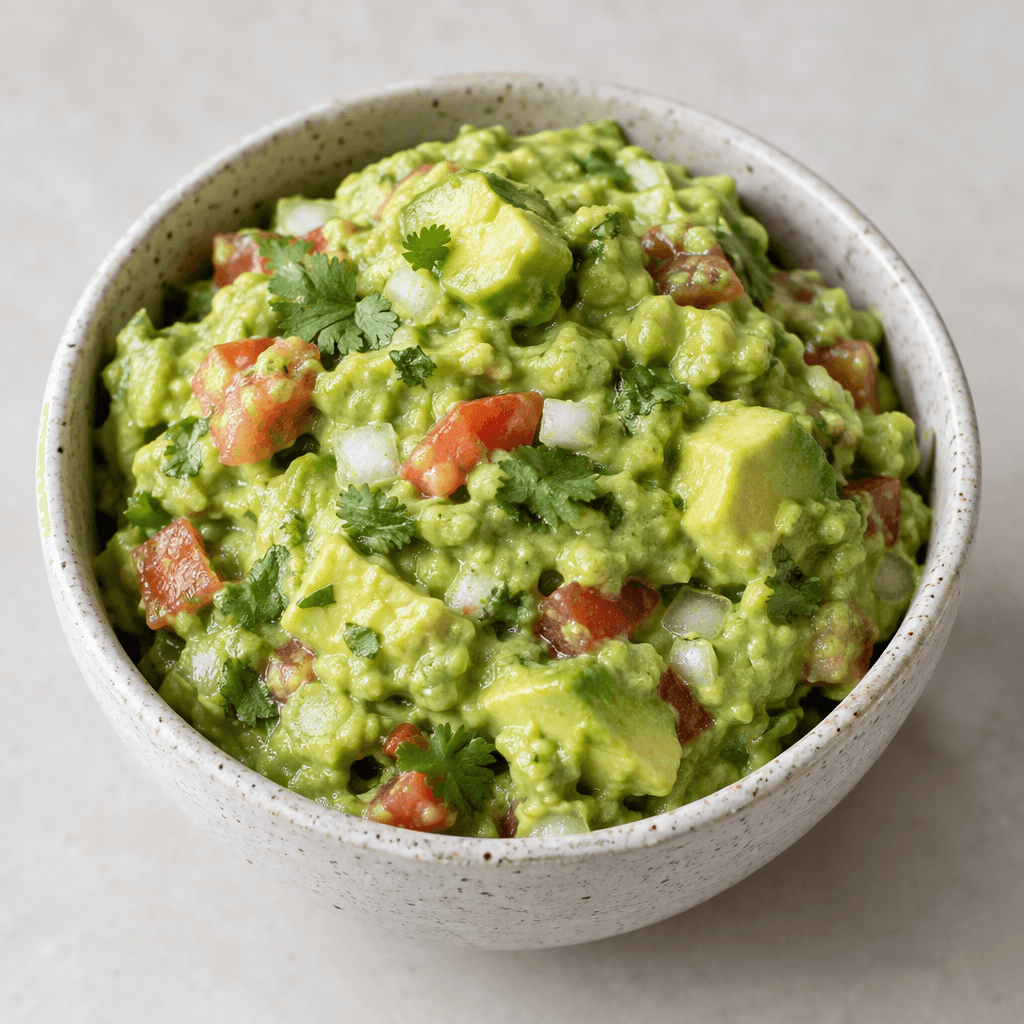
Guacamole Calories
Mexican dip made from avocado, tomato, onion, lime juice, and spices
In season: Spring · Summer · Autumn · Winter
CALORIES
GI
POTASSIUM
FIBER
Quick answer
2 tablespoon (medium) of Guacamole (30 g) has 42 calories. That works out to 140 calories per 100 g. It contains 2.4 g of carbs, 0.6 g of protein, 3.3 g of fat and 1.7 g of fiber. Its 0.3 mg of B5 covers 7% of the Daily Value. Its glycemic index is 15 (low), so it raises blood sugar slowly.
What is Guacamole?
Guacamole is a Mexican dip made by mashing avocado with tomato, onion, lime juice and seasonings. It can be left chunky or mashed until creamy, and fresh herbs such as cilantro are often added. Its rich, mellow avocado flavour is balanced by the lime’s tang and the crisp bite of onion.
It is commonly served with tortilla chips, spooned into tacos and burritos, or spread on toast. Avocado makes it a source of fibre and a relatively fat-rich dip. For a lighter snack, serve guacamole with sliced vegetables or use a modest spread on toast; a squeeze of lime just before serving keeps the flavour bright.
Guacamole Nutrition Facts
Selected: 100 g
140
KCAL / 100G
Carbs
8g
· 3% DV
Protein
2g
· 4% DV
Fat
11g
· 14% DV
Fiber
5.5g
· 20% DV
DV is the share of the daily value covered, on a 2,000 kcal reference diet.
Calories come from: Carbs 23% · Protein 6% · Fat 71%

Log this food in EatBetter
100,000+ people use it
- Get your daily calorie target
- Snap your meal, log it in seconds
- See every vitamin and mineral

📸 Scan the code to get the app free.

Guacamole Vitamins & Minerals
Vitamins
B5
1.1mg · 22% DV
Folate
60µg · 15% DV
Vitamin E
2.1mg · 14% DV
B6
0.22mg · 13% DV
Minerals
Potassium ⭐
370mg · 11% DV
Sodium
220mg · 10% DV
Magnesium
29mg · 7% DV
Copper
0mg · 0% DV
How Nutritious Is Guacamole?
Nutrient density
High
How many vitamins, minerals and how much fiber this food carries per calorie. A high score means a lot of nutrition for few calories.
Satiety score
Medium
An EatBetter score computed from fiber, protein and calorie density. A high score means staying full longer on the same calories.
Both scores are calculated per 100 g and do not change with the selected portion. The satiety score is EatBetter's own calculation, not a clinical measure.
Guacamole Glycemic Index
GLYCEMIC INDEX
GLYCEMIC LOAD
Accounts for portion size — a more realistic measure than GI alone.
How to Burn Off Guacamole
To burn the 140 calories in 100 g:
🚶
Walking (5 km/h)
🏃
Running (8 km/h)
🚴
Cycling
🏊
Swimming
Times are calculated with the MET equation for a 70 kg adult. Actual burn varies with your weight, age and pace.
Is Guacamole Processed?
NOVA 2
Minimally Processed
1. Unprocessed
2. Minimally Processed
3. Processed
4. Ultra-Processed
NOVA classifies foods into 4 groups by industrial processing. NOVA 1 (unprocessed) is the healthiest.
Does Guacamole Contain Allergens?
No known major allergens
Which Diets Is Guacamole Good For?
Vegan
✓ Suitable
Vegetarian
✓ Suitable
Gluten-Free
✓ Suitable
Dairy-Free
— Not suitable
Mediterranean
✓ Suitable
Paleo
✓ Suitable
Whole30
— Not suitable
DASH
— Not suitable
Keto
— Not suitable
Low FODMAP
— Not suitable
Guacamole Fat Profile
SATURATED
1.8g
MONOUNSATURATED
7.1g
POLYUNSATURATED
1.5g
Omega 6:3 ratio 16.3:1
Above the ideal 4:1 (16.3:1).
Compare Guacamole
Foods Similar to Guacamole
Frequently Asked Questions About Guacamole
What is guacamole made of?
Guacamole is a Mexican avocado dip, usually made by mashing ripe avocado with lime juice, salt, and seasonings. Many versions also include tomato, onion, cilantro, or chile; the ingredients and texture vary by recipe.
How do you make guacamole?
Mash ripe avocados with a fork, then fold in chopped onion, tomato, lime juice, salt, and any desired cilantro or chile. Leave some avocado pieces intact for a chunky texture, and taste before adding more lime or salt.
What do you eat guacamole with?
Guacamole is commonly served with tortilla chips, tacos, nachos, burritos, and quesadillas. It also works as a spread in sandwiches and wraps or as a dip for sliced vegetables such as bell peppers and cucumbers.
How do you keep guacamole from turning brown?
Add lime juice and press plastic wrap directly onto the surface of the guacamole before refrigerating it in a sealed container. This limits contact with air, which causes the avocado to brown; lime juice alone cannot prevent browning indefinitely.
How long does guacamole last in the fridge?
Fresh guacamole is best eaten within one to two days when kept in a sealed container in the refrigerator. A brown surface can be scraped off if the dip still smells fresh, but discard it if you see mold or notice an off smell.
Can you freeze guacamole?
Yes, guacamole can be frozen, though thawed avocado may be softer and wetter. For a better texture, freeze mashed avocado with lime juice before adding tomato or onion, then thaw it in the refrigerator and stir before serving.
Can you make guacamole without cilantro?
Yes, guacamole works well without cilantro. Leave it out or replace it with a small amount of chopped parsley or green onion; the avocado, lime, salt, and onion still provide a flavorful dip.
Why does my guacamole taste bitter?
Guacamole can taste bitter if the avocado is underripe, bruised, or overmixed, or if too much lime zest or a bitter ingredient was added. Use a ripe avocado, remove any discolored flesh, and balance the flavor with salt and a little more avocado.
Can you make guacamole ahead of time?
Yes, you can prepare guacamole ahead, but it tastes freshest soon after mixing. To reduce browning, add lime juice, press wrap onto the surface, and refrigerate it; for the best texture, stir in delicate additions like tomato just before serving.
Is guacamole good for weight loss?
Guacamole can fit into a weight-loss eating pattern because its fiber and fat may make a snack satisfying. Portions can add up quickly, especially with chips, so serve it with vegetables or use a modest amount as a meal topping.
Have another question about Guacamole?
Ask the AI nutrition coach — calories, portions, alternatives and more, answered in seconds in the app.

Scan calories with your camera
Instant AI nutrition analysis

Nutrition data compiled from USDA FoodData Central and scientific sources.