

Ready & Packaged Foods
All →Vegetables & Legumes
All →Desserts & Confectionery
All →Meat & Protein
All →Grains & Bakery
All →Beverages
All →Milk & Dairy
All →

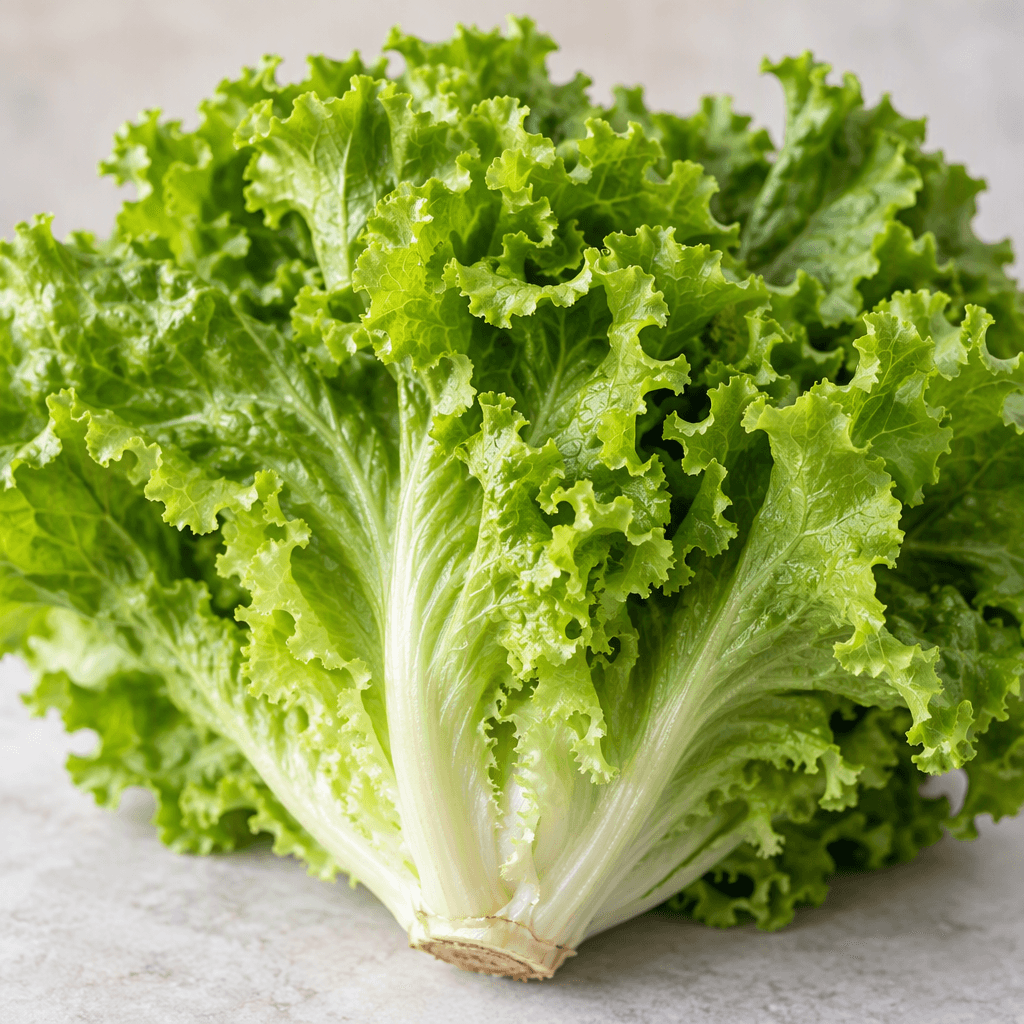
Green leaf lettuce Calories
Low calorie, high water and fiber, good source of folate and vitamin K
In season: Spring · Summer · Autumn
CALORIES · 100 G
GI
POTASSIUM · 100 G
FIBER · 100 G
Quick answer
1 cup (medium) of Green leaf lettuce (36 g) has 5 calories. That works out to 15 calories per 100 g. It contains 1 g of carbs, 0.5 g of protein, 0.1 g of fat and 0.5 g of fiber. Its 45.4 µg of Vitamin K covers 38% of the Daily Value. Its glycemic index is 15 (low), so it raises blood sugar slowly.
Green leaf lettuce Nutrition Facts
Selected: 1 cup (medium) · 36 g
5
KCAL / 36G
Carbs
1g
· 0% DV
Protein
0.5g
· 1% DV
Fat
0.1g
· 0% DV
Fiber
0.5g
· 2% DV
DV is the share of the daily value covered, on a 2,000 kcal reference diet.
Calories come from: Carbs 58% · Protein 29% · Fat 13%
Green leaf lettuce nutrition facts table · 1 cup (medium) (36 g)
| Nutrient | Amount | % DV |
|---|---|---|
| Calories | 5 kcal | |
| Total fat | 0.1 g | 0% |
| Saturated fat | 0.01 g | 0% |
| Trans fat | 0 g | |
| Sodium | 10 mg | 0% |
| Total carbohydrate | 1 g | 0% |
| Fiber | 0.5 g | 2% |
| Protein | 0.5 g | 1% |
Calories: Calories measure energy. Average daily need is 2,000 kcal. Excess calories are stored as fat, too few cause weight loss.
Carbs: Your body's primary energy source. The brain runs exclusively on carbs. Daily need: 275g.
Protein: Essential for muscle repair and cell growth. Daily need: 50g. Keeps you full and boosts metabolism.
Fat: Needed for hormone production and vitamin absorption. Daily need: 78g. Limit saturated fats, choose unsaturated.
Fiber: Critical for digestive health and satiety. Daily need: 28g. Stabilizes blood sugar, lowers cholesterol.

Log this food in EatBetter
100,000+ people use it
- Get your daily calorie target
- Snap your meal, log it in seconds
- See every vitamin and mineral

📸 Scan the code to get the app free.

How Many Calories in 1 Cup of Green leaf lettuce?
| Serving | Amount | Calories |
|---|---|---|
| 1 cup (medium) | 36 g | 5 kcal |
| 1 piece (small) | 15 g | 2 kcal |
| 1 cup (small) | 20 g | 3 kcal |
| 1 piece (medium) | 25 g | 4 kcal |
| 1 piece (large) | 40 g | 6 kcal |
| 1 cup (large) | 50 g | 8 kcal |
| 2 cup (large) | 72 g | 11 kcal |
| 100 g | 100 g | 15 kcal |
Calculated from 15 calories per 100 g.
Frequently Asked Questions About Green leaf lettuce
How do you store green leaf lettuce so it stays fresh?
Store green leaf lettuce in the refrigerator, dry and loosely wrapped or in a container with some airflow. A clean paper towel can absorb excess moisture. Keep the leaves away from wet produce, since trapped moisture makes them wilt and spoil sooner.
Should you wash green leaf lettuce before eating it?
Yes, wash green leaf lettuce before eating it, even if the leaves look clean. Separate the leaves and rinse them under cool running water, checking the ruffled edges for grit. Dry them well so salad dressing clings and the leaves stay crisp.
Can you freeze green leaf lettuce?
Yes, but freezing makes green leaf lettuce limp and watery when thawed, so it will not work well in salads or sandwiches. If you freeze it, save it for cooked dishes such as soup, where the change in texture matters less.
Is green leaf lettuce the same as romaine lettuce?
No. Green leaf lettuce grows in loose, ruffled leaves, while romaine forms a more upright head with long, sturdy leaves and a pronounced central rib. Both work in salads, but romaine holds its shape better in wraps and grilled dishes.
Can you eat the outer leaves of green leaf lettuce?
Yes, the outer leaves of green leaf lettuce are edible when they are fresh and undamaged. They may be tougher than the inner leaves, so wash them carefully and use them in sandwiches, soups, or cooked dishes if you prefer a softer texture.
How do you use green leaf lettuce in a sandwich or wrap?
Green leaf lettuce works well in sandwiches and wraps because its broad leaves add a crisp layer. Pat the leaves dry first, then place them between the bread and wetter fillings to help keep the bread from getting soggy.
Can you cook green leaf lettuce?
Yes, green leaf lettuce can be cooked, though it wilts quickly. Stir it into a soup near the end of cooking or briefly sauté it with other vegetables. Avoid long cooking if you want the leaves to keep some texture.
How can you tell if green leaf lettuce has gone bad?
Green leaf lettuce has likely spoiled if its leaves are slimy, mushy, foul-smelling, or extensively discolored. Remove a few wilted leaves only if the rest remains fresh and clean; discard the lettuce if the spoilage affects the bunch.
Can green leaf lettuce replace iceberg lettuce in a salad?
Yes, green leaf lettuce can replace iceberg lettuce in most salads. Its leaves are softer and more ruffled, while iceberg is crunchier and more compact, so add the green leaf lettuce just before serving to keep it from wilting under the dressing.
Why does green leaf lettuce turn brown after cutting?
Green leaf lettuce can turn brown at cut edges when its tissues react with air and handling damages the leaves. Use a clean knife, keep cut lettuce covered and chilled, and trim away browned edges; browning alone does not always mean the whole bunch has spoiled.
Green leaf lettuce Vitamins & Minerals
Vitamins
Vitamin K
45.36µg · 38% DV
Vitamin A
133.2µg · 15% DV
Vitamin C
3.31mg · 4% DV
Folate
13.68µg · 3% DV
Minerals
Manganese
0.09mg · 4% DV
Potassium ⭐
70mg · 2% DV
Iron
0.31mg · 2% DV
Phosphorus
10mg · 1% DV
Sodium
10mg · 0% DV
Green leaf lettuce Glycemic Index
GLYCEMIC INDEX
GLYCEMIC LOAD
Accounts for portion size — a more realistic measure than GI alone.
How to Burn Off Green leaf lettuce
To burn the 5 calories in 1 cup (medium) (36 g):
🚶
Walking (5 km/h)
🏃
Running (8 km/h)
🚴
Cycling
🏊
Swimming
Times are calculated with the MET equation for a 70 kg adult. Actual burn varies with your weight, age and pace.
What is Green leaf lettuce?
Green leaf lettuce is a loose-leaf variety with broad, ruffled leaves and tender, pale ribs. It is usually eaten raw, torn into salads or added to sandwiches and wraps. In Turkey, it commonly appears alongside main dishes in a simple salad, and its large leaves can also be used to wrap a savoury filling.
Its crisp, delicate texture and mild, fresh taste pair easily with tomatoes, cucumber, lemon and olive oil. Mostly water, it is low in calories and provides fibre, folate and vitamin K; 100 g contains 15 calories. Wash and dry the leaves well before serving so dressing clings to them, or add beans or other pulses when you want a more substantial salad.
How Nutritious Is Green leaf lettuce?
Nutrient density
High
How many vitamins, minerals and how much fiber this food carries per calorie. A high score means a lot of nutrition for few calories.
Satiety score
Medium
An EatBetter score computed from fiber, protein and calorie density. A high score means staying full longer on the same calories.
Both scores are calculated per 100 g and do not change with the selected portion. The satiety score is EatBetter's own calculation, not a clinical measure.
Is Green leaf lettuce Processed?
NOVA 1
Unprocessed
1. Unprocessed
2. Minimally Processed
3. Processed
4. Ultra-Processed
NOVA classifies foods into 4 groups by industrial processing. NOVA 1 (unprocessed) is the healthiest.
Does Green leaf lettuce Contain Allergens?
No known major allergens
Which Diets Is Green leaf lettuce Good For?
Vegan
✓ Suitable
Vegetarian
✓ Suitable
Gluten-Free
✓ Suitable
Dairy-Free
— Not suitable
Mediterranean
✓ Suitable
Paleo
✓ Suitable
Whole30
— Not suitable
DASH
— Not suitable
Keto
— Not suitable
Low FODMAP
— Not suitable
Green leaf lettuce Fat Profile
SATURATED
0.01g
MONOUNSATURATED
0g
POLYUNSATURATED
0.02g
Omega 6:3 ratio 1:1
Below the ideal 4:1 — a good omega balance.
Compare Green leaf lettuce
Foods Similar to Green leaf lettuce
Have another question about Green leaf lettuce?
Ask the AI nutrition coach — calories, portions, alternatives and more, answered in seconds in the app.

Scan calories with your camera
Instant AI nutrition analysis

Nutrition data compiled from USDA FoodData Central and scientific sources.