

Ready & Packaged Foods
All →Vegetables & Legumes
All →Desserts & Confectionery
All →Meat & Protein
All →Grains & Bakery
All →Beverages
All →Milk & Dairy
All →

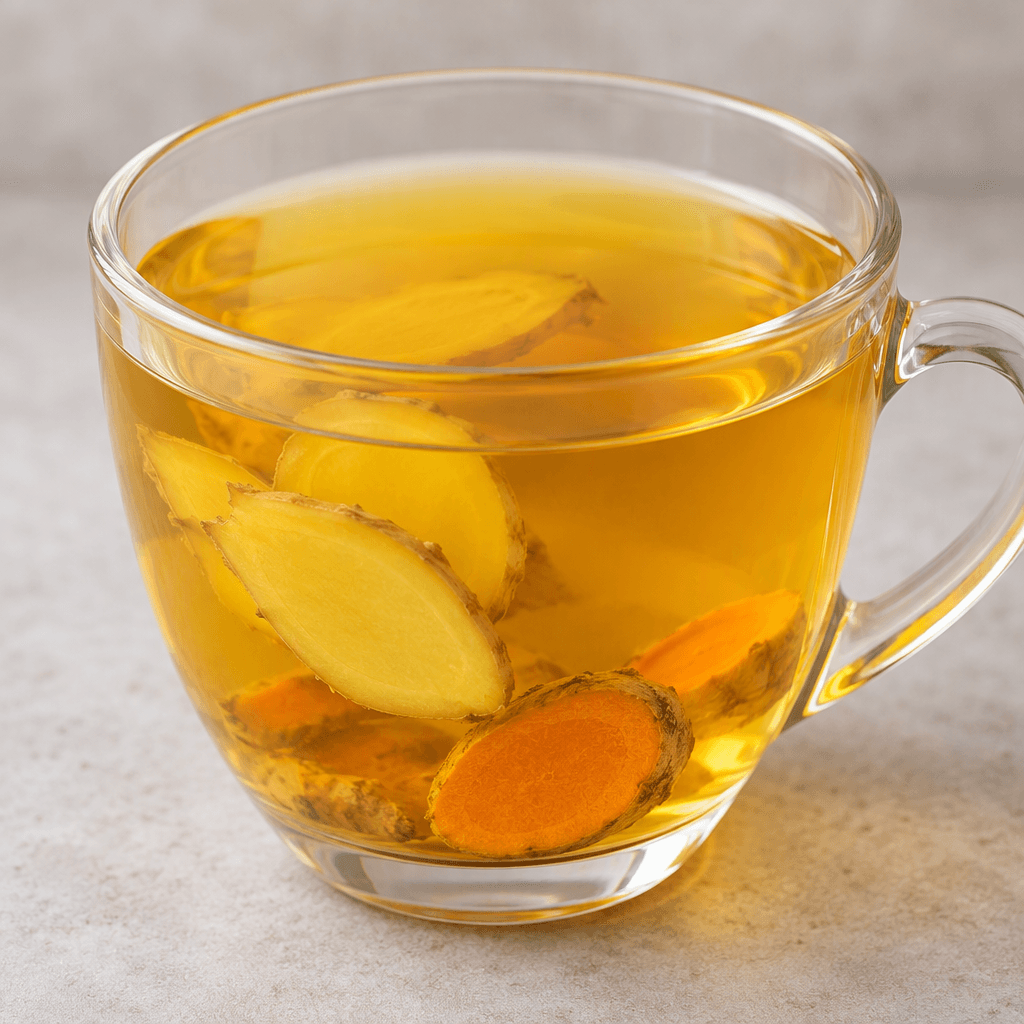
Ginger turmeric tea Calories
Herbal tea made from ginger and turmeric
In season: Winter · Autumn · Spring
CALORIES
GI
POTASSIUM
FIBER
Quick answer
1 cup (medium) of Ginger turmeric tea (240 g) has 5 calories. That works out to 2 calories per 100 g. It contains 1 g of carbs, 0.2 g of protein, 0 g of fat and 0.2 g of fiber. Its glycemic index is 0 (low), so it raises blood sugar slowly.
What is Ginger turmeric tea?
Ginger turmeric tea is an infusion made by steeping fresh or dried ginger and turmeric in hot water. Drinks made with these roots have a long history in South Asia, and variations are now enjoyed around the world, whether brewed at home or ordered from a café.
The ginger brings a sharp, warming aroma, while turmeric adds an earthy note and golden colour. It is usually served hot, sometimes with lemon or a little honey, and can be enjoyed at breakfast or as an afternoon drink. Unsweetened, it is mostly water and very low in energy. For a lighter cup, leave out the honey; sliced fresh roots are easy to steep and strain.
Ginger turmeric tea Nutrition Facts
Selected: 100 g
2
KCAL / 100G
Carbs
0.4g
· 0% DV
Protein
0.1g
· 0% DV
Fat
0g
· 0% DV
Fiber
0.1g
· 0% DV
DV is the share of the daily value covered, on a 2,000 kcal reference diet.
Calories come from: Carbs 80% · Protein 20% · Fat 0%
Ginger turmeric tea Vitamins & Minerals
Vitamins
Vitamin A
0.5µg · 0% DV
B1
0mg · 0% DV
B2
0mg · 0% DV
B3
0.01mg · 0% DV
Minerals
Calcium
2mg · 0% DV
Iron
0mg · 0% DV
Magnesium
1mg · 0% DV
Zinc
0mg · 0% DV
How Nutritious Is Ginger turmeric tea?
Nutrient density
Low
How many vitamins, minerals and how much fiber this food carries per calorie. A high score means a lot of nutrition for few calories.
Satiety score
Medium
An EatBetter score computed from fiber, protein and calorie density. A high score means staying full longer on the same calories.
Both scores are calculated per 100 g and do not change with the selected portion. The satiety score is EatBetter's own calculation, not a clinical measure.
Ginger turmeric tea Glycemic Index
GLYCEMIC INDEX
GLYCEMIC LOAD
Accounts for portion size — a more realistic measure than GI alone.
How to Burn Off Ginger turmeric tea
To burn the 2 calories in 100 g:
🚶
Walking (5 km/h)
🏃
Running (8 km/h)
🚴
Cycling
🏊
Swimming
Times are calculated with the MET equation for a 70 kg adult. Actual burn varies with your weight, age and pace.
Is Ginger turmeric tea Processed?
NOVA 2
Minimally Processed
1. Unprocessed
2. Minimally Processed
3. Processed
4. Ultra-Processed
NOVA classifies foods into 4 groups by industrial processing. NOVA 1 (unprocessed) is the healthiest.
Does Ginger turmeric tea Contain Allergens?
No known major allergens
Which Diets Is Ginger turmeric tea Good For?
Vegan
✓ Suitable
Vegetarian
✓ Suitable
Gluten-Free
✓ Suitable
Dairy-Free
— Not suitable
Mediterranean
✓ Suitable
Paleo
✓ Suitable
Whole30
— Not suitable
DASH
— Not suitable
Keto
— Not suitable
Low FODMAP
— Not suitable
Ginger turmeric tea Fat Profile
SATURATED
0g
MONOUNSATURATED
0g
POLYUNSATURATED
0g
Compare Ginger turmeric tea
Foods Similar to Ginger turmeric tea
Frequently Asked Questions About Ginger turmeric tea
How do you make ginger turmeric tea?
Make ginger turmeric tea by steeping sliced or grated fresh ginger and turmeric in hot water, then straining it. Ground spices also work. Add lemon or honey if you like, and adjust the strength to suit your taste.
What does ginger turmeric tea taste like?
Ginger turmeric tea tastes warm, earthy, and peppery, with a sharp note from the ginger. Lemon adds brightness, while a little honey softens the spice. Using more turmeric can make the earthy flavor more pronounced.
What are the benefits of ginger turmeric tea?
Ginger turmeric tea is a warming, caffeine-free drink that helps you take in fluids. Ginger may ease nausea for some people, but the tea is not a treatment, and the amount of turmeric in a cup is not equivalent to a concentrated supplement.
Can ginger turmeric tea help with nausea?
Ginger turmeric tea may help ease mild nausea for some people, since ginger has evidence of benefit for certain types of nausea. The tea may not suit everyone, and persistent or severe nausea needs more than a home drink.
Can you drink ginger turmeric tea every day?
Yes, most healthy adults can include ginger turmeric tea in a daily routine. Strong tea may irritate the stomach, so reduce the strength or stop if it causes discomfort. Concentrated supplements are not the same as an ordinary cup of tea.
Is ginger turmeric tea good before bed?
Yes, ginger turmeric tea contains no caffeine, so it is a reasonable evening drink. Its spicy ingredients can trigger heartburn in some people, though; if that happens to you, avoid drinking it close to bedtime.
Does black pepper make ginger turmeric tea more effective?
Black pepper adds piperine, which can increase absorption of some turmeric compounds. That does not mean a pinch makes the tea a proven treatment, and the effect in a brewed drink is not well established.
Does ginger turmeric tea help a cold?
Ginger turmeric tea does not cure a cold, but a warm drink can soothe an irritated throat and contribute to fluid intake. Seek medical advice if symptoms are severe, worsening, or not resolving.
How long does homemade ginger turmeric tea keep in the fridge?
Homemade ginger turmeric tea is best enjoyed fresh. If you have leftovers, cool them promptly, store them covered in the refrigerator, and use them soon; discard the tea if its smell, appearance, or taste changes.
Can you drink ginger turmeric tea while taking blood thinners?
Ask your doctor or pharmacist before making ginger turmeric tea a regular habit while taking blood thinners. Ginger and turmeric may affect bleeding risk, particularly in concentrated forms, so your medication and personal circumstances matter.
Have another question about Ginger turmeric tea?
Ask the AI nutrition coach — calories, portions, alternatives and more, answered in seconds in the app.

Scan calories with your camera
Instant AI nutrition analysis

Nutrition data compiled from USDA FoodData Central and scientific sources.