

Ready & Packaged Foods
All →Vegetables & Legumes
All →Desserts & Confectionery
All →Meat & Protein
All →Grains & Bakery
All →Beverages
All →Milk & Dairy
All →

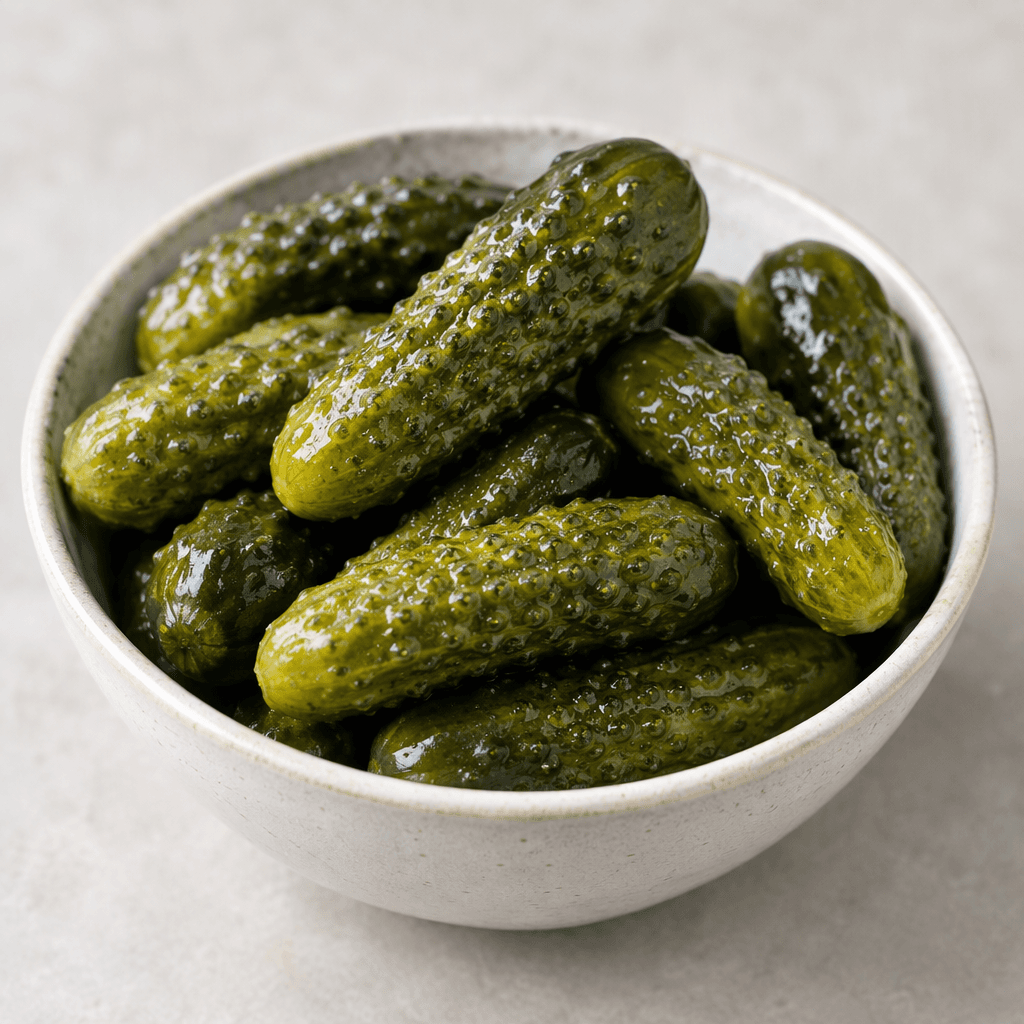
Gherkin Pickle Calories
Low calorie, probiotic source, salty and tangy
In season: Summer · Autumn · Winter
CALORIES
GI
POTASSIUM
FIBER
Quick answer
4 piece (medium) of Gherkin Pickle (40 g) has 5 calories. That works out to 12 calories per 100 g. It contains 0.9 g of carbs, 0.2 g of protein, 0.1 g of fat and 0.5 g of fiber. Its 320 mg of Sodium covers 14% of the Daily Value. Its glycemic index is 15 (low), so it raises blood sugar slowly.
What is Gherkin Pickle?
A gherkin pickle is a small cucumber preserved in brine or vinegar, often with seasonings such as dill, garlic or spices. It has a crisp bite and a sharp, salty-sour flavour that cuts through richer foods. Serve it alongside sandwiches, burgers, cold meats or a cheeseboard, or chop it into salads and sauces; in many households it is also a familiar accompaniment to a simple meal. It is low in calories, though the brine can make it quite salty. Naturally fermented versions may contain live cultures, while vinegar-pickled ones may not. If you prefer a milder taste, briefly rinse it before serving.
Gherkin Pickle Nutrition Facts
Selected: 100 g
12
KCAL / 100G
Carbs
2.2g
· 1% DV
Protein
0.5g
· 1% DV
Fat
0.2g
· 0% DV
Fiber
1.2g
· 4% DV
DV is the share of the daily value covered, on a 2,000 kcal reference diet.
Calories come from: Carbs 70% · Protein 16% · Fat 14%
Gherkin Pickle Vitamins & Minerals
Vitamins
Vitamin K
16µg · 13% DV
B5
0.2mg · 4% DV
B1
0.02mg · 2% DV
B2
0.02mg · 2% DV
Minerals
Sodium
800mg · 35% DV
Phosphorus
20mg · 3% DV
Potassium ⭐
110mg · 3% DV
Calcium
16mg · 2% DV
How Nutritious Is Gherkin Pickle?
Nutrient density
Medium
How many vitamins, minerals and how much fiber this food carries per calorie. A high score means a lot of nutrition for few calories.
Satiety score
Medium
An EatBetter score computed from fiber, protein and calorie density. A high score means staying full longer on the same calories.
Both scores are calculated per 100 g and do not change with the selected portion. The satiety score is EatBetter's own calculation, not a clinical measure.
Gherkin Pickle Glycemic Index
GLYCEMIC INDEX
GLYCEMIC LOAD
Accounts for portion size — a more realistic measure than GI alone.
How to Burn Off Gherkin Pickle
To burn the 12 calories in 100 g:
🚶
Walking (5 km/h)
🏃
Running (8 km/h)
🚴
Cycling
🏊
Swimming
Times are calculated with the MET equation for a 70 kg adult. Actual burn varies with your weight, age and pace.
Is Gherkin Pickle Processed?
NOVA 3
Processed
1. Unprocessed
2. Minimally Processed
3. Processed
4. Ultra-Processed
NOVA classifies foods into 4 groups by industrial processing. NOVA 1 (unprocessed) is the healthiest.
Does Gherkin Pickle Contain Allergens?
No known major allergens
Which Diets Is Gherkin Pickle Good For?
Vegan
✓ Suitable
Vegetarian
✓ Suitable
Gluten-Free
✓ Suitable
Dairy-Free
— Not suitable
Mediterranean
✓ Suitable
Paleo
✓ Suitable
Whole30
— Not suitable
DASH
— Not suitable
Keto
— Not suitable
Low FODMAP
— Not suitable
Gherkin Pickle Fat Profile
SATURATED
0.03g
MONOUNSATURATED
0.01g
POLYUNSATURATED
0.03g
Omega 6:3 ratio 2:1
Below the ideal 4:1 — a good omega balance.
Compare Gherkin Pickle
Foods Similar to Gherkin Pickle
Frequently Asked Questions About Gherkin Pickle
What is a gherkin pickle?
A gherkin pickle is a small cucumber preserved in brine or vinegar, often with spices. The word “gherkin” can refer to the small cucumber itself, while “pickle” describes the preserved food; recipes may be fermented or vinegar-based.
How is a gherkin pickle made?
A gherkin pickle is made by soaking small cucumbers in salty brine or a vinegar-based solution. Garlic, dill, mustard seed, and other spices are common additions, and the recipe determines whether the cucumbers ferment or are simply pickled in vinegar.
Are gherkin pickles fermented or made with vinegar?
Gherkin pickles can be fermented in salt brine or preserved directly in vinegar. Naturally fermented versions develop through lactic acid fermentation, while vinegar pickles get their acidity from added vinegar; some products are also heat-treated.
Do gherkin pickles contain probiotics?
Gherkin pickles may contain live bacteria when they are naturally fermented and unpasteurized. Vinegar-pickled or pasteurized gherkin pickles generally do not provide the same live cultures, so the preparation method matters.
What is the difference between a gherkin pickle and a dill pickle?
A gherkin pickle is defined by its small cucumber, while a dill pickle is defined by its dill-seasoned flavor. A gherkin pickle can be flavored with dill, but dill pickles can also be made from larger cucumbers.
Why are my gherkin pickles soft instead of crunchy?
Gherkin pickles can turn soft if the cucumbers were overripe, the brine was unsuitable, or they were stored too warm or too long. Starting with firm, small cucumbers and keeping them submerged in brine helps preserve their crunch.
How should you store a gherkin pickle after opening?
Store an opened gherkin pickle in the refrigerator, with the cucumbers covered by their brine. Use a clean utensil to remove them, and discard the product if you notice mold, an unusual smell, or other signs of spoilage.
How long does a gherkin pickle last after opening?
There is no single safe shelf life for every opened gherkin pickle; it varies with the recipe and packaging. Keep it refrigerated and follow the storage directions and use-by guidance on the jar, rather than relying on a fixed time.
Can you freeze a gherkin pickle?
Yes, you can freeze a gherkin pickle, but thawing usually makes it softer and less crisp. Refrigeration is a better choice when you want to preserve its usual texture; frozen gherkin pickles work better chopped into cooked dishes.
Should you rinse a gherkin pickle before eating it?
No, a gherkin pickle does not need rinsing before you eat it; simply drain it from the brine. A quick rinse can reduce some surface salt, but it also washes away some of the pickle’s seasoning and tang.
Have another question about Gherkin Pickle?
Ask the AI nutrition coach — calories, portions, alternatives and more, answered in seconds in the app.

Scan calories with your camera
Instant AI nutrition analysis

Nutrition data compiled from USDA FoodData Central and scientific sources.