

Ready & Packaged Foods
All →Vegetables & Legumes
All →Desserts & Confectionery
All →Meat & Protein
All →Grains & Bakery
All →Beverages
All →Milk & Dairy
All →

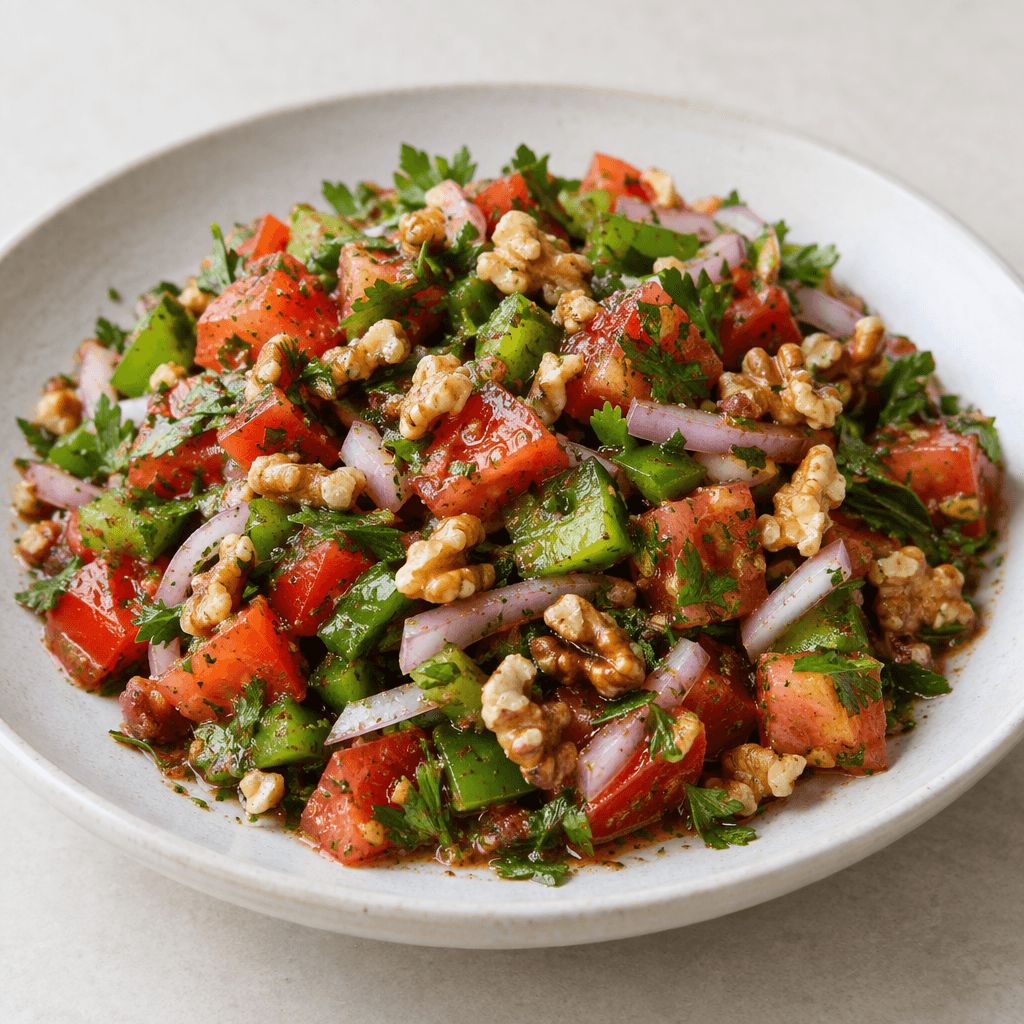
Gavurdağı Salad Calories
Fresh salad with tomatoes, cucumber, walnuts, pomegranate molasses, olive oil
In season: Spring · Summer · Autumn
CALORIES
GI
POTASSIUM
FIBER
Quick answer
1 serving (medium) of Gavurdağı Salad (180 g) has 198 calories. That works out to 110 calories per 100 g. It contains 15.3 g of carbs, 4 g of protein, 13 g of fat and 4.7 g of fiber. Its 576 µg of Vitamin A covers 64% of the Daily Value. Its glycemic index is 30 (low), so it raises blood sugar slowly.
What is Gavurdağı Salad?
Gavurdağı Salad comes from Gaziantep in southeastern Turkey. It combines very finely chopped tomatoes, cucumber, peppers, onion and parsley with pieces of walnut, usually dressed with olive oil, pomegranate molasses and seasonings. The fine cut lets the tart-sweet dressing coat each bite, while the walnuts add crunch.
In Turkey it is a familiar side for kebabs and other grilled foods, and may also appear among meze. It works just as well alongside flatbread or a simple lentil dish. Mostly vegetables, it gets extra richness from the walnuts and oil; at about 110 calories per 100 g, it is still a relatively light accompaniment. Use a little less oil or molasses if you prefer a lighter, less sweet dressing.
Gavurdağı Salad Nutrition Facts
Selected: 100 g
110
KCAL / 100G
Carbs
8.5g
· 3% DV
Protein
2.2g
· 4% DV
Fat
7.2g
· 9% DV
Fiber
2.6g
· 9% DV
DV is the share of the daily value covered, on a 2,000 kcal reference diet.
Calories come from: Carbs 32% · Protein 8% · Fat 60%
Gavurdağı Salad Vitamins & Minerals
Vitamins
Vitamin A
320µg · 36% DV
Vitamin C
16mg · 18% DV
Vitamin K
18µg · 15% DV
Folate
32µg · 8% DV
Minerals
Zinc
1mg · 9% DV
Potassium ⭐
260mg · 8% DV
Phosphorus
48mg · 7% DV
Iron
1mg · 6% DV
How Nutritious Is Gavurdağı Salad?
Nutrient density
High
How many vitamins, minerals and how much fiber this food carries per calorie. A high score means a lot of nutrition for few calories.
Satiety score
Medium
An EatBetter score computed from fiber, protein and calorie density. A high score means staying full longer on the same calories.
Both scores are calculated per 100 g and do not change with the selected portion. The satiety score is EatBetter's own calculation, not a clinical measure.
Gavurdağı Salad Glycemic Index
GLYCEMIC INDEX
GLYCEMIC LOAD
Accounts for portion size — a more realistic measure than GI alone.
How to Burn Off Gavurdağı Salad
To burn the 110 calories in 100 g:
🚶
Walking (5 km/h)
🏃
Running (8 km/h)
🚴
Cycling
🏊
Swimming
Times are calculated with the MET equation for a 70 kg adult. Actual burn varies with your weight, age and pace.
Is Gavurdağı Salad Processed?
NOVA 2
Minimally Processed
1. Unprocessed
2. Minimally Processed
3. Processed
4. Ultra-Processed
NOVA classifies foods into 4 groups by industrial processing. NOVA 1 (unprocessed) is the healthiest.
Does Gavurdağı Salad Contain Allergens?
Contains these allergens:
Which Diets Is Gavurdağı Salad Good For?
Vegan
✓ Suitable
Vegetarian
✓ Suitable
Gluten-Free
✓ Suitable
Dairy-Free
— Not suitable
Mediterranean
✓ Suitable
Paleo
— Not suitable
Whole30
— Not suitable
DASH
— Not suitable
Keto
— Not suitable
Low FODMAP
— Not suitable
Gavurdağı Salad Fat Profile
SATURATED
0.9g
MONOUNSATURATED
4.2g
POLYUNSATURATED
2.8g
Omega 6:3 ratio 11.9:1
Above the ideal 4:1 (11.9:1).
Compare Gavurdağı Salad
Foods Similar to Gavurdağı Salad
Frequently Asked Questions About Gavurdağı Salad
What is Gavurdağı Salad made of?
Gavurdağı Salad is made with finely chopped tomatoes, cucumber, green pepper, onion and parsley, mixed with walnuts, olive oil and pomegranate molasses. Recipes vary, but the generous use of chopped walnuts and the tangy dressing give it its distinctive character.
How do you make Gavurdağı Salad?
To make Gavurdağı Salad, finely chop the vegetables and parsley, then toss them with olive oil, pomegranate molasses and salt. Fold in roughly chopped walnuts just before serving so they stay crisp and the vegetables do not become soggy.
Where does Gavurdağı Salad come from?
Gavurdağı Salad is associated with Gaziantep and southeastern Turkish cuisine. Its name refers to the Gavur Mountains in the region, and the salad is commonly served alongside local grilled meats and other savory dishes.
What is the difference between Gavurdağı Salad and Turkish shepherd salad?
Gavurdağı Salad is typically chopped more finely than Turkish shepherd salad and includes walnuts and pomegranate molasses. Shepherd salad usually has larger pieces of vegetables and a simpler lemon or vinegar dressing, without walnuts as a defining ingredient.
Can you make Gavurdağı Salad without pomegranate molasses?
Yes, you can make Gavurdağı Salad without pomegranate molasses, though it will lose some of its characteristic sweet-tart flavor. A little lemon juice can add acidity, but it will taste sharper and less rich than the traditional dressing.
Should the walnuts in Gavurdağı Salad be toasted?
No, Gavurdağı Salad is commonly made with raw walnuts, which add a mild, fresh crunch. You can toast them briefly for a deeper nutty flavor, but let them cool before mixing them into the salad.
What do you serve with Gavurdağı Salad?
Gavurdağı Salad is often served with kebabs, grilled meat and flatbread. Its bright, tangy dressing and crunchy walnuts make it a good contrast to rich, savory mains, and it can also be served as part of a Turkish meze spread.
Can Gavurdağı Salad be made ahead of time?
You can prepare Gavurdağı Salad ahead, but chopped vegetables release liquid as they sit. For the freshest texture, refrigerate the chopped vegetables separately from the dressing and walnuts, then combine everything shortly before serving.
Is Gavurdağı Salad spicy?
Gavurdağı Salad is not necessarily spicy; its heat depends on the green pepper used. Choose a mild pepper for a gentle flavor or add a small amount of hot pepper if you want the salad to have a kick.
Why is Gavurdağı Salad chopped so finely?
Gavurdağı Salad is finely chopped so the vegetables, dressing and walnut pieces come together in each bite. The small pieces also help the tangy dressing coat the ingredients evenly, but the vegetables should still retain their texture rather than turn mushy.
Have another question about Gavurdağı Salad?
Ask the AI nutrition coach — calories, portions, alternatives and more, answered in seconds in the app.

Scan calories with your camera
Instant AI nutrition analysis

Nutrition data compiled from USDA FoodData Central and scientific sources.