

Ready & Packaged Foods
All →Vegetables & Legumes
All →Desserts & Confectionery
All →Meat & Protein
All →Grains & Bakery
All →Beverages
All →Milk & Dairy
All →

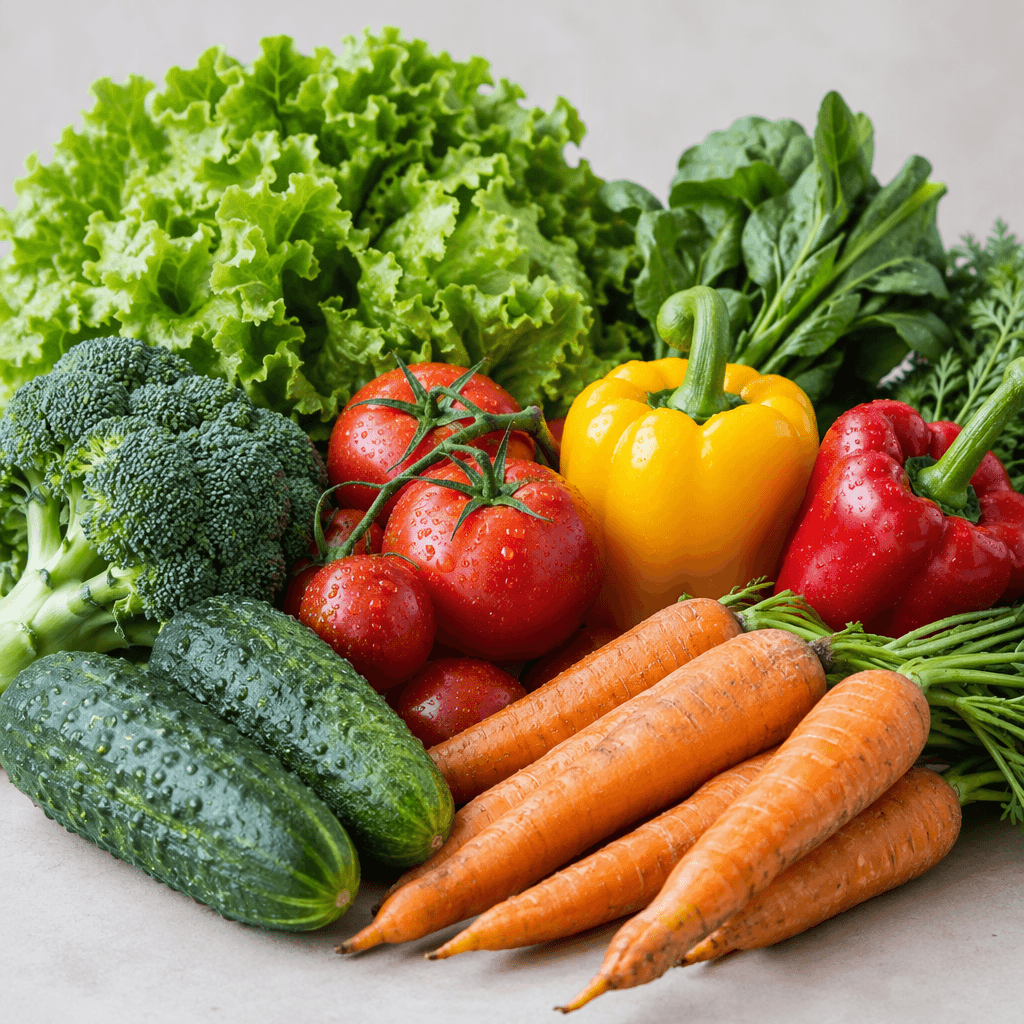
Fresh vegetables Calories
Rich in vitamins and minerals, low calorie
In season: Spring · Summer · Autumn · Winter
CALORIES · 100 G
GI
POTASSIUM · 100 G
FIBER · 100 G
Quick answer
1 cup (medium) of Fresh vegetables (85 g) has 27 calories. That works out to 32 calories per 100 g. It contains 5.3 g of carbs, 1.4 g of protein, 0.3 g of fat and 2.1 g of fiber. Its 357 µg of Vitamin A covers 40% of the Daily Value. Its glycemic index is 20 (low), so it raises blood sugar slowly.
Fresh vegetables Nutrition Facts
Selected: 1 cup (medium) · 85 g
27
KCAL / 85G
Carbs
5.3g
· 2% DV
Protein
1.4g
· 3% DV
Fat
0.3g
· 0% DV
Fiber
2.1g
· 8% DV
DV is the share of the daily value covered, on a 2,000 kcal reference diet.
Calories come from: Carbs 72% · Protein 19% · Fat 9%
Fresh vegetables nutrition facts table · 1 cup (medium) (85 g)
| Nutrient | Amount | % DV |
|---|---|---|
| Calories | 27 kcal | |
| Total fat | 0.3 g | 0% |
| Saturated fat | 0.04 g | 0% |
| Trans fat | 0 g | |
| Sodium | 15 mg | 1% |
| Total carbohydrate | 5.3 g | 2% |
| Fiber | 2.1 g | 8% |
| Protein | 1.4 g | 3% |
Calories: Calories measure energy. Average daily need is 2,000 kcal. Excess calories are stored as fat, too few cause weight loss.
Carbs: Your body's primary energy source. The brain runs exclusively on carbs. Daily need: 275g.
Protein: Essential for muscle repair and cell growth. Daily need: 50g. Keeps you full and boosts metabolism.
Fat: Needed for hormone production and vitamin absorption. Daily need: 78g. Limit saturated fats, choose unsaturated.
Fiber: Critical for digestive health and satiety. Daily need: 28g. Stabilizes blood sugar, lowers cholesterol.

Log this food in EatBetter
100,000+ people use it
- Get your daily calorie target
- Snap your meal, log it in seconds
- See every vitamin and mineral

📸 Scan the code to get the app free.

How Many Calories in 1 Cup of Fresh vegetables?
| Serving | Amount | Calories |
|---|---|---|
| 1 cup (medium) | 85 g | 27 kcal |
| 1 g | 1 g | 0 kcal |
| 1 cup (chopped) | 40 g | 13 kcal |
| 1 cup (small) | 50 g | 16 kcal |
| 1 piece (medium) | 60 g | 19 kcal |
| 1 serving (small) | 60 g | 19 kcal |
| 100 g | 100 g | 32 kcal |
| 1 piece (large) | 100 g | 32 kcal |
| 1 cup (large) | 120 g | 38 kcal |
| 1 serving (large) | 150 g | 48 kcal |
Calculated from 32 calories per 100 g.
Frequently Asked Questions About Fresh vegetables
How should you store fresh vegetables so they last longer?
Store fresh vegetables in the refrigerator’s crisper, separating items that need different humidity levels. Keep most vegetables dry until use, and place leafy greens in a container with a dry paper towel to absorb excess moisture.
Should you wash fresh vegetables before storing them?
Usually, no. Washing fresh vegetables before storage can leave moisture that speeds spoilage; wash them under running water just before preparing or eating. If you do wash them ahead, dry them thoroughly before refrigerating.
Can you freeze fresh vegetables without blanching them?
Some fresh vegetables can be frozen without blanching, but many keep their color, texture, and flavor better after a brief blanch and quick chill. Leafy salad greens, cucumbers, and other watery vegetables generally become limp when frozen.
How do you keep fresh vegetables crisp in the refrigerator?
Keep fresh vegetables cold, limit moisture on their surfaces, and avoid packing them tightly. For lettuce and herbs, wrap clean, dry leaves loosely in a paper towel and store them in a container or bag that is not completely airtight.
Is it better to eat fresh vegetables raw or cooked?
Both raw and cooked fresh vegetables can be nutritious. Cooking softens some vegetables and makes certain nutrients easier to absorb, while brief cooking helps preserve more heat-sensitive vitamins than prolonged boiling.
Can fresh vegetables be stored next to fruit?
Some fresh vegetables are better stored away from ripening fruit. Apples, bananas, and pears release ethylene, which can make vegetables such as broccoli, leafy greens, and cucumbers yellow or spoil sooner.
Do fresh vegetables need to be washed with soap?
No. Rinse fresh vegetables thoroughly under clean running water; soap and household detergents are not intended for food and may leave residues. Scrub firm vegetables such as carrots with a clean produce brush.
Which fresh vegetables are best for roasting together?
Fresh vegetables with similar cooking times roast well together. Pair firm vegetables such as carrots and potatoes, or add quicker-cooking zucchini and peppers later so they do not become mushy before the firmer pieces are tender.
Can fresh vegetables be eaten after their best-before date?
Fresh vegetables are generally judged by their condition rather than a printed date. Discard any with mold, sliminess, a sour smell, or extensive decay; trim minor bruises or wilted edges only if the rest is still fresh and sound.
Are fresh vegetables a good choice for people with diabetes?
Yes, non-starchy fresh vegetables can fit well into a diabetes-friendly eating pattern, and their fiber can support steadier blood glucose after meals. Starchy vegetables may affect glucose differently, so follow the portions in your personal care plan.
Fresh vegetables Vitamins & Minerals
Vitamins
Vitamin A
357µg · 40% DV
Vitamin K
27.2µg · 23% DV
Vitamin C
18.7mg · 21% DV
Folate
32.3µg · 8% DV
Minerals
Copper
0.05mg · 6% DV
Potassium ⭐
187mg · 6% DV
Manganese
0.11mg · 5% DV
Phosphorus
27mg · 4% DV
Sodium
15mg · 1% DV
Fresh vegetables Glycemic Index
GLYCEMIC INDEX
GLYCEMIC LOAD
Accounts for portion size — a more realistic measure than GI alone.
How to Burn Off Fresh vegetables
To burn the 27 calories in 1 cup (medium) (85 g):
🚶
Walking (5 km/h)
🏃
Running (8 km/h)
🚴
Cycling
🏊
Swimming
Times are calculated with the MET equation for a 70 kg adult. Actual burn varies with your weight, age and pace.
What is Fresh vegetables?
Fresh vegetables include produce such as tomatoes, cucumbers, leafy greens, peppers and seasonal roots. They can be eaten raw, cooked as a side, or added to soups, stews and other dishes. Across the English-speaking world, they often appear in salads and sandwiches, or are served simply alongside a main course; the choice changes with local seasons and cooking traditions.
They provide a mix of fibre, vitamins and minerals while generally being low in calories: a 100 g portion has 32 calories. For an easy meal, combine a few colours in a salad, or roast vegetables with a little oil and herbs. Choosing what is in season is a practical way to add variety to everyday meals.
How Nutritious Is Fresh vegetables?
Nutrient density
Very high
How many vitamins, minerals and how much fiber this food carries per calorie. A high score means a lot of nutrition for few calories.
Satiety score
Medium
An EatBetter score computed from fiber, protein and calorie density. A high score means staying full longer on the same calories.
Both scores are calculated per 100 g and do not change with the selected portion. The satiety score is EatBetter's own calculation, not a clinical measure.
Is Fresh vegetables Processed?
NOVA 1
Unprocessed
1. Unprocessed
2. Minimally Processed
3. Processed
4. Ultra-Processed
NOVA classifies foods into 4 groups by industrial processing. NOVA 1 (unprocessed) is the healthiest.
Does Fresh vegetables Contain Allergens?
No known major allergens
Which Diets Is Fresh vegetables Good For?
Vegan
✓ Suitable
Vegetarian
✓ Suitable
Gluten-Free
✓ Suitable
Dairy-Free
— Not suitable
Mediterranean
✓ Suitable
Paleo
✓ Suitable
Whole30
— Not suitable
DASH
— Not suitable
Keto
✓ Suitable
Low FODMAP
— Not suitable
Fresh vegetables Fat Profile
SATURATED
0.04g
MONOUNSATURATED
0.03g
POLYUNSATURATED
0.07g
Omega 6:3 ratio 1.5:1
Below the ideal 4:1 — a good omega balance.
Compare Fresh vegetables
Foods Similar to Fresh vegetables
Have another question about Fresh vegetables?
Ask the AI nutrition coach — calories, portions, alternatives and more, answered in seconds in the app.

Scan calories with your camera
Instant AI nutrition analysis

Nutrition data compiled from USDA FoodData Central and scientific sources.