

Ready & Packaged Foods
All →Vegetables & Legumes
All →Desserts & Confectionery
All →Meat & Protein
All →Grains & Bakery
All →Beverages
All →Milk & Dairy
All →

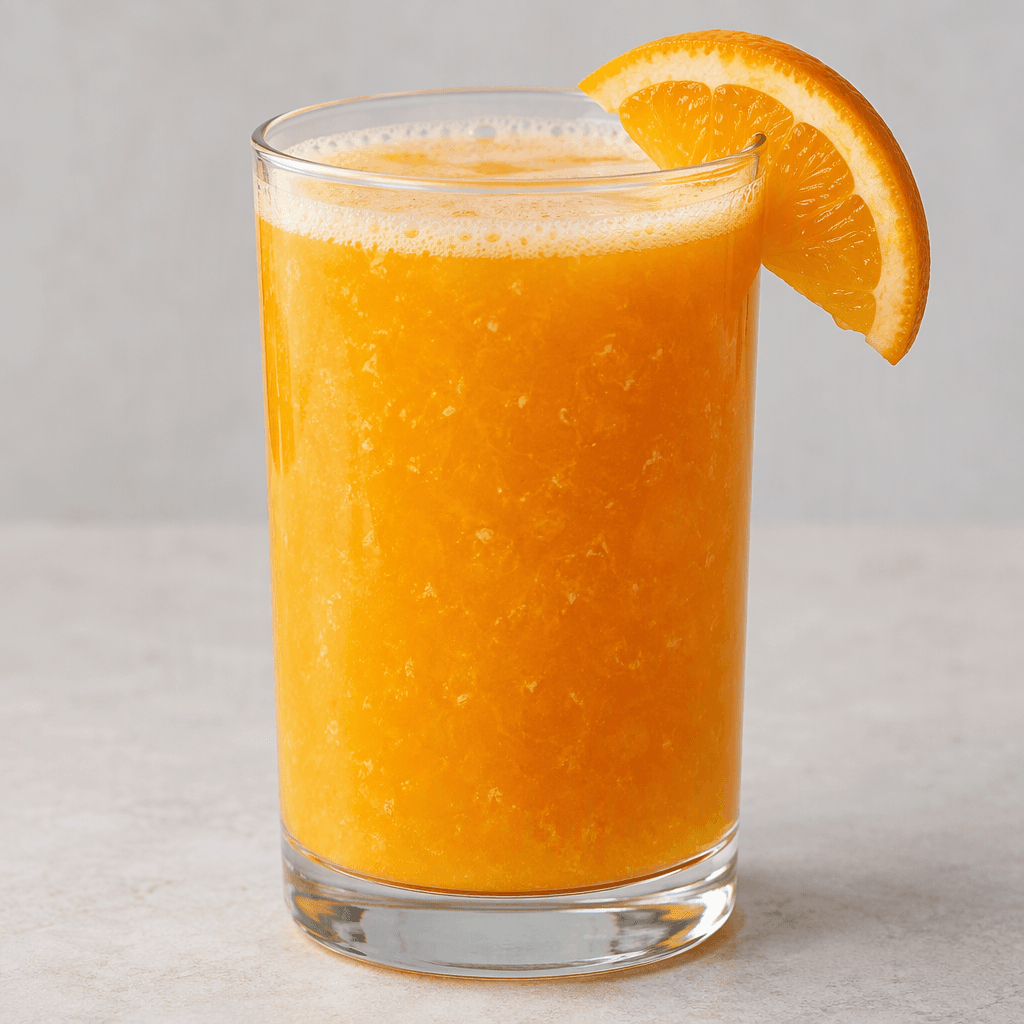
Fresh orange juice Calories
Rich in vitamin C, refreshing, contains natural sugars
In season: Winter · Spring
CALORIES
GI
POTASSIUM
FIBER
Quick answer
1 cup (medium) of Fresh orange juice (200 g) has 90 calories. That works out to 45 calories per 100 g. It contains 20.8 g of carbs, 1.4 g of protein, 0.4 g of fat and 0.4 g of fiber. Its 100 mg of Vitamin C covers 111% of the Daily Value. Its glycemic index is 50 (medium), so it raises blood sugar at a moderate pace.
What is Fresh orange juice?
Made by squeezing ripe oranges, fresh orange juice may be served with the fine pulp left in or strained out. At home, you can adjust how much pulp stays in the glass; freshly squeezed juice is often cloudy and lightly foamy, with a bright citrus aroma.
Its flavour balances sweetness and tartness, and it is commonly poured at breakfast or served chilled as a refreshing drink. In many places it accompanies toast, eggs or other breakfast foods, while cafés and juice bars offer it throughout the day. It provides vitamin C and natural sugars, but has very little fibre compared with a whole orange. Pair it with a more filling breakfast, or keep the pulp for a slightly fuller texture.
Fresh orange juice Nutrition Facts
Selected: 100 g
45
KCAL / 100G
Carbs
10.4g
· 4% DV
Protein
0.7g
· 1% DV
Fat
0.2g
· 0% DV
Fiber
0.2g
· 1% DV
DV is the share of the daily value covered, on a 2,000 kcal reference diet.
Calories come from: Carbs 90% · Protein 6% · Fat 4%
Fresh orange juice Vitamins & Minerals
Vitamins
Vitamin C
50mg · 56% DV
B1
0.09mg · 8% DV
Folate
30µg · 8% DV
B5
0.2mg · 4% DV
Minerals
Potassium ⭐
200mg · 6% DV
Magnesium
10mg · 2% DV
Phosphorus
17mg · 2% DV
Calcium
11mg · 1% DV
How Nutritious Is Fresh orange juice?
Nutrient density
High
How many vitamins, minerals and how much fiber this food carries per calorie. A high score means a lot of nutrition for few calories.
Satiety score
Medium
An EatBetter score computed from fiber, protein and calorie density. A high score means staying full longer on the same calories.
Both scores are calculated per 100 g and do not change with the selected portion. The satiety score is EatBetter's own calculation, not a clinical measure.
Fresh orange juice Glycemic Index
GLYCEMIC INDEX
GLYCEMIC LOAD
Accounts for portion size — a more realistic measure than GI alone.
How to Burn Off Fresh orange juice
To burn the 45 calories in 100 g:
🚶
Walking (5 km/h)
🏃
Running (8 km/h)
🚴
Cycling
🏊
Swimming
Times are calculated with the MET equation for a 70 kg adult. Actual burn varies with your weight, age and pace.
Is Fresh orange juice Processed?
NOVA 2
Minimally Processed
1. Unprocessed
2. Minimally Processed
3. Processed
4. Ultra-Processed
NOVA classifies foods into 4 groups by industrial processing. NOVA 1 (unprocessed) is the healthiest.
Does Fresh orange juice Contain Allergens?
No known major allergens
Which Diets Is Fresh orange juice Good For?
Vegan
✓ Suitable
Vegetarian
✓ Suitable
Gluten-Free
✓ Suitable
Dairy-Free
— Not suitable
Mediterranean
✓ Suitable
Paleo
— Not suitable
Whole30
— Not suitable
DASH
— Not suitable
Keto
— Not suitable
Low FODMAP
— Not suitable
Fresh orange juice Fat Profile
SATURATED
0.03g
MONOUNSATURATED
0.04g
POLYUNSATURATED
0.05g
Omega 6:3 ratio 2:1
Below the ideal 4:1 — a good omega balance.
Compare Fresh orange juice
Foods Similar to Fresh orange juice
Frequently Asked Questions About Fresh orange juice
Is fresh orange juice healthier than eating a whole orange?
A whole orange is usually more filling because it takes longer to eat and retains more fiber. Fresh orange juice still provides vitamin C, but it is easier to drink several oranges’ worth quickly.
Is fresh orange juice better than bottled orange juice?
Fresh orange juice is minimally processed and has a just-squeezed taste, while bottled juice varies by product and may be pasteurized or made from concentrate. Fresh juice also spoils sooner and should be refrigerated.
Can fresh orange juice cure a cold?
No, fresh orange juice cannot cure a cold. It provides vitamin C and fluid, but it does not eliminate the virus or replace rest and other appropriate care.
Why does fresh orange juice taste bitter?
Fresh orange juice can taste bitter when pith or seeds get crushed during squeezing, or when the oranges are underripe. Avoid pressing the peel too hard, and remove seeds before juicing.
How long can fresh orange juice sit out?
Fresh orange juice should not be left at room temperature for extended periods. Refrigerate it promptly in a covered container, and discard it if it has been left out for several hours or smells or tastes off.
Can you freeze fresh orange juice?
Yes, fresh orange juice freezes well. Leave room in the container for expansion, then thaw it in the refrigerator and shake or stir it before drinking because the pulp may separate.
Does fresh orange juice need to be refrigerated?
Yes, fresh orange juice should be refrigerated because it is unpasteurized and spoils faster than shelf-stable juice. Keep it covered and cold, and drink it soon after squeezing.
Can fresh orange juice irritate acid reflux?
Yes, fresh orange juice can worsen reflux or heartburn in some people because it is acidic. If it triggers symptoms, avoid drinking it on an empty stomach or close to bedtime.
Can pregnant people drink fresh orange juice?
Yes, freshly squeezed juice made at home from washed oranges can be part of pregnancy meals. Avoid unpasteurized juice from uncertain sources, since harmful bacteria can be a concern during pregnancy.
Why does fresh orange juice separate after squeezing?
Fresh orange juice separates because pulp and other orange particles settle when the juice stands. This is normal; stir or shake it before drinking to redistribute the pulp.
Have another question about Fresh orange juice?
Ask the AI nutrition coach — calories, portions, alternatives and more, answered in seconds in the app.

Scan calories with your camera
Instant AI nutrition analysis

Nutrition data compiled from USDA FoodData Central and scientific sources.