

Ready & Packaged Foods
All →Vegetables & Legumes
All →Desserts & Confectionery
All →Meat & Protein
All →Grains & Bakery
All →Beverages
All →Milk & Dairy
All →

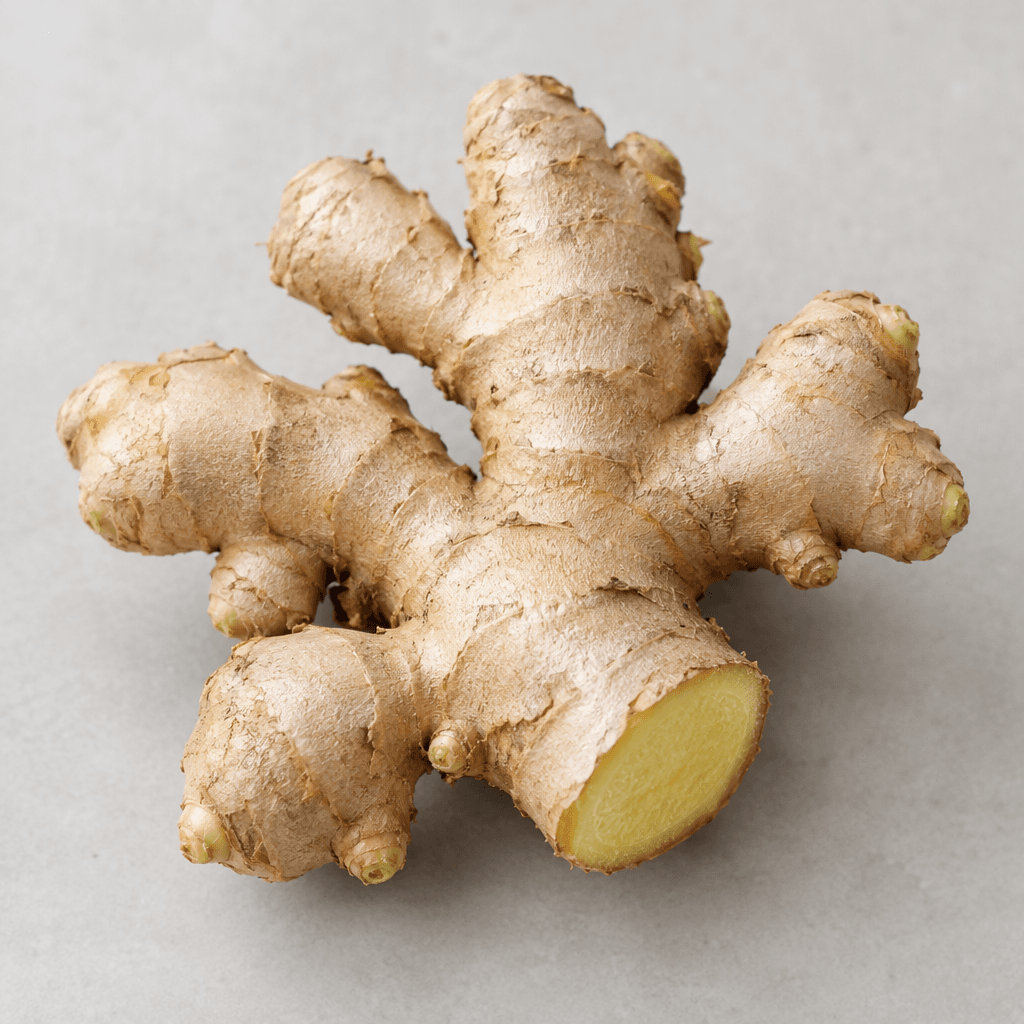
Fresh Ginger Calories
Anti-inflammatory, digestive aid, antioxidant
In season: Spring · Summer · Autumn · Winter
CALORIES
GI
POTASSIUM
FIBER
Quick answer
1 piece (small) of Fresh Ginger (20 g) has 16 calories. That works out to 80 calories per 100 g. It contains 3.6 g of carbs, 0.4 g of protein, 0.2 g of fat and 0.4 g of fiber. Its 0 mg of Copper covers 5% of the Daily Value. Its glycemic index is 15 (low), so it raises blood sugar slowly.
What is Fresh Ginger?
Fresh ginger is the knobbly underground stem of a tropical plant, with thin tan skin and pale, aromatic flesh. Thought to originate in Southeast Asia, it is now used in kitchens around the world. Peel and grate it, slice it into hot drinks, or leave the skin on when it is clean and tender. Its flavour is warming and peppery, with a bright, citrus-like edge; the texture can be juicy but fibrous. In many cuisines, it goes into stir-fries, soups, marinades and tea, while in English-speaking homes it pairs easily with lemon, garlic or honey in drinks and cooking. Ginger contains some fibre, but is usually eaten in small amounts, mainly for its punchy aroma. Start with a little in a sauce or tea, then add more to suit your taste.
Fresh Ginger Nutrition Facts
Selected: 100 g
80
KCAL / 100G
Carbs
17.8g
· 6% DV
Protein
1.8g
· 4% DV
Fat
0.8g
· 1% DV
Fiber
2g
· 7% DV
DV is the share of the daily value covered, on a 2,000 kcal reference diet.
Calories come from: Carbs 83% · Protein 8% · Fat 9%
Fresh Ginger Vitamins & Minerals
Vitamins
B6
0.16mg · 9% DV
Vitamin C
5mg · 6% DV
B3
0.75mg · 5% DV
B5
0.2mg · 4% DV
Minerals
Potassium ⭐
415mg · 12% DV
Magnesium
43mg · 10% DV
Iron
1mg · 6% DV
Phosphorus
34mg · 5% DV
How Nutritious Is Fresh Ginger?
Nutrient density
High
How many vitamins, minerals and how much fiber this food carries per calorie. A high score means a lot of nutrition for few calories.
Satiety score
Medium
An EatBetter score computed from fiber, protein and calorie density. A high score means staying full longer on the same calories.
Both scores are calculated per 100 g and do not change with the selected portion. The satiety score is EatBetter's own calculation, not a clinical measure.
Fresh Ginger Glycemic Index
GLYCEMIC INDEX
GLYCEMIC LOAD
Accounts for portion size — a more realistic measure than GI alone.
How to Burn Off Fresh Ginger
To burn the 80 calories in 100 g:
🚶
Walking (5 km/h)
🏃
Running (8 km/h)
🚴
Cycling
🏊
Swimming
Times are calculated with the MET equation for a 70 kg adult. Actual burn varies with your weight, age and pace.
Is Fresh Ginger Processed?
NOVA 1
Unprocessed
1. Unprocessed
2. Minimally Processed
3. Processed
4. Ultra-Processed
NOVA classifies foods into 4 groups by industrial processing. NOVA 1 (unprocessed) is the healthiest.
Does Fresh Ginger Contain Allergens?
No known major allergens
Which Diets Is Fresh Ginger Good For?
Vegan
✓ Suitable
Vegetarian
✓ Suitable
Gluten-Free
✓ Suitable
Dairy-Free
— Not suitable
Mediterranean
✓ Suitable
Paleo
✓ Suitable
Whole30
— Not suitable
DASH
— Not suitable
Keto
✓ Suitable
Low FODMAP
— Not suitable
Fresh Ginger Fat Profile
SATURATED
0.2g
MONOUNSATURATED
0.2g
POLYUNSATURATED
0.12g
Omega 6:3 ratio 5.5:1
Above the ideal 4:1 (5.5:1).
Compare Fresh Ginger
Foods Similar to Fresh Ginger
Frequently Asked Questions About Fresh Ginger
What are the benefits of fresh ginger?
Fresh ginger adds a pungent flavor and contains gingerols, plant compounds studied for their antioxidant and anti-inflammatory effects. It may also ease some types of nausea, but it is a food ingredient, not a cure or substitute for medical care.
How do you make fresh ginger tea?
Slice or grate fresh ginger and steep it in hot water; simmer it briefly for a stronger, sharper drink. Strain before serving, and add lemon or honey if you like. Leaving the peel on is fine after washing the root well.
Do you need to peel fresh ginger?
No, peeling fresh ginger is optional. Its thin skin can be scrubbed clean and used, especially when the root is young and smooth. Peel or trim it if the skin is dry, damaged, or difficult to clean around the knobs.
How should fresh ginger be stored?
Keep fresh ginger dry in a sealed container in the refrigerator. Once cut, cover the exposed piece and return it to the fridge promptly. Discard ginger that develops mold, a sour smell, or a soft, wet texture.
Can you freeze fresh ginger?
Yes, fresh ginger freezes well. Freeze the whole root or portion it first, then grate it straight from frozen when needed. Thawed ginger can become softer, so it is usually better in cooked dishes, sauces, or tea than in crisp raw preparations.
Can you eat fresh ginger raw?
Yes, fresh ginger can be eaten raw, grated into dressings, smoothies, or salads, or sliced thinly. Its hot, peppery flavor is strong, so start with a little. Raw ginger may irritate the mouth or stomach in sensitive people.
Is fresh ginger better than ground ginger?
Neither is universally better: fresh ginger tastes brighter and juicier, while ground ginger is more concentrated and warm-spiced. Fresh ginger works well in tea, stir-fries, and sauces; ground ginger is convenient for baking. They do not always swap in equal amounts.
How do you grate fresh ginger without wasting it?
Use a fine grater or microplane to grate fresh ginger, including the tender flesh close to the skin. A spoon can scrape away only the thin peel from knobby areas. Grate over the bowl so you keep the flavorful juice as well.
Does fresh ginger help with nausea?
Fresh ginger may ease mild nausea for some people, and it can be taken in tea or added to food. It does not treat the cause of persistent or severe symptoms. If you take medication regularly, ask your clinician whether frequent ginger use is appropriate.
Can fresh ginger cause heartburn?
Yes, fresh ginger can trigger heartburn or stomach irritation in some people, particularly when eaten in large amounts or on an empty stomach. Reduce the amount or stop using it if symptoms follow. Its concentrated, spicy flavor can also irritate the mouth.
Have another question about Fresh Ginger?
Ask the AI nutrition coach — calories, portions, alternatives and more, answered in seconds in the app.

Scan calories with your camera
Instant AI nutrition analysis

Nutrition data compiled from USDA FoodData Central and scientific sources.