

Ready & Packaged Foods
All →Vegetables & Legumes
All →Desserts & Confectionery
All →Meat & Protein
All →Grains & Bakery
All →Beverages
All →Milk & Dairy
All →

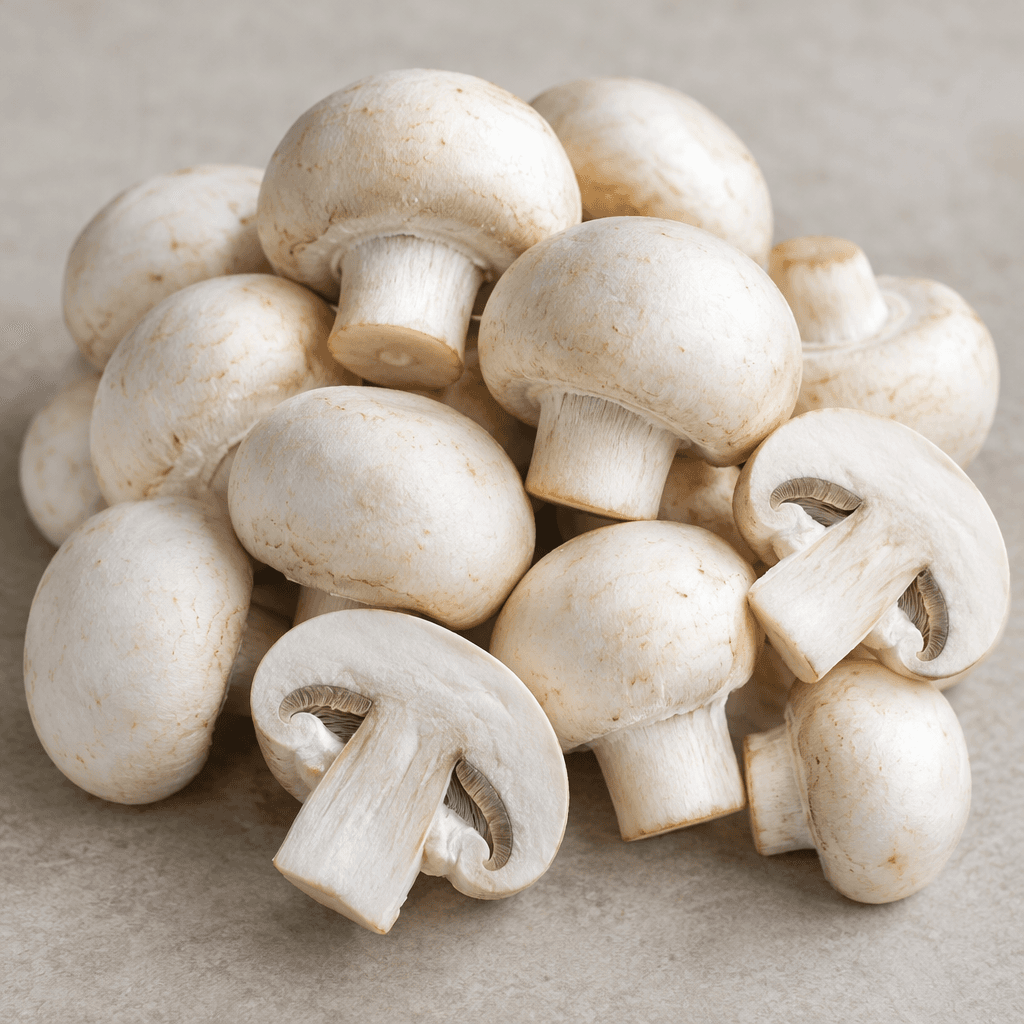
Cultivated Mushroom Calories
Low calorie, good protein source, rich in B vitamins and selenium.
In season: Spring · Summer · Autumn · Winter
CALORIES
GI
POTASSIUM
FIBER
Quick answer
1 cup (chopped) of Cultivated Mushroom (70 g) has 15 calories. That works out to 22 calories per 100 g. It contains 2.3 g of carbs, 2.2 g of protein, 0.2 g of fat and 0.7 g of fiber. Its 11.2 µg of Biotin covers 37% of the Daily Value. Its glycemic index is 15 (low), so it raises blood sugar slowly.
What is Cultivated Mushroom?
Cultivated Mushroom usually refers to the familiar white button mushroom, a farm-grown form of Agaricus bisporus. It has a mild, earthy flavour and a firm, juicy texture that softens as it cooks. In its place of origin and in kitchens around the world, it is used raw in salads or cooked in omelettes, soups, pasta, stir-fries and on pizza. It takes on the flavours of herbs, garlic and other ingredients, making it easy to use as a side or a meat-free addition to a meal. With just 22 calories per 100 g and some protein, it is a light, versatile choice; sauté it with a little oil for a simple accompaniment.
Cultivated Mushroom Nutrition Facts
Selected: 100 g
22
KCAL / 100G
Carbs
3.3g
· 1% DV
Protein
3.1g
· 6% DV
Fat
0.3g
· 0% DV
Fiber
1g
· 4% DV
DV is the share of the daily value covered, on a 2,000 kcal reference diet.
Calories come from: Carbs 47% · Protein 44% · Fat 9%
Cultivated Mushroom Vitamins & Minerals
Vitamins
Biotin
16µg · 53% DV
B2
0.4mg · 31% DV
B5
1.5mg · 30% DV
B3
3.6mg · 23% DV
Minerals
Phosphorus
120mg · 17% DV
Selenium
9µg · 16% DV
Zinc
1mg · 9% DV
Potassium ⭐
318mg · 9% DV
How Nutritious Is Cultivated Mushroom?
Nutrient density
High
How many vitamins, minerals and how much fiber this food carries per calorie. A high score means a lot of nutrition for few calories.
Satiety score
Medium
An EatBetter score computed from fiber, protein and calorie density. A high score means staying full longer on the same calories.
Both scores are calculated per 100 g and do not change with the selected portion. The satiety score is EatBetter's own calculation, not a clinical measure.
Cultivated Mushroom Glycemic Index
GLYCEMIC INDEX
GLYCEMIC LOAD
Accounts for portion size — a more realistic measure than GI alone.
How to Burn Off Cultivated Mushroom
To burn the 22 calories in 100 g:
🚶
Walking (5 km/h)
🏃
Running (8 km/h)
🚴
Cycling
🏊
Swimming
Times are calculated with the MET equation for a 70 kg adult. Actual burn varies with your weight, age and pace.
Is Cultivated Mushroom Processed?
NOVA 1
Unprocessed
1. Unprocessed
2. Minimally Processed
3. Processed
4. Ultra-Processed
NOVA classifies foods into 4 groups by industrial processing. NOVA 1 (unprocessed) is the healthiest.
Does Cultivated Mushroom Contain Allergens?
No known major allergens
Which Diets Is Cultivated Mushroom Good For?
Vegan
✓ Suitable
Vegetarian
✓ Suitable
Gluten-Free
✓ Suitable
Dairy-Free
— Not suitable
Mediterranean
✓ Suitable
Paleo
✓ Suitable
Whole30
— Not suitable
DASH
— Not suitable
Keto
— Not suitable
Low FODMAP
— Not suitable
Cultivated Mushroom Fat Profile
SATURATED
0.05g
MONOUNSATURATED
0.01g
POLYUNSATURATED
0.07g
Omega 6:3 ratio 6:1
Above the ideal 4:1 (6:1).
Compare Cultivated Mushroom
Foods Similar to Cultivated Mushroom
Frequently Asked Questions About Cultivated Mushroom
Should you wash cultivated mushrooms?
Yes, rinse cultivated mushrooms briefly under running water if they have visible dirt, then dry them well. Avoid soaking them, since they can take up water and release more liquid while cooking.
How should you store cultivated mushrooms?
Store cultivated mushrooms unwashed in the refrigerator in a breathable paper bag. Trapped moisture in a sealed plastic container can make them spoil faster; clean them just before you are ready to cook.
Can you eat cultivated mushrooms raw?
Yes, fresh cultivated mushrooms can be eaten raw; slice them thinly for salads or sandwiches. Raw mushrooms may be harder for some people to digest, so choose cooked mushrooms if they cause discomfort.
Can you freeze cultivated mushrooms?
Yes, cultivated mushrooms can be frozen, but they may become soft and watery after thawing. For a better texture, sauté them first, let them cool, and freeze them in an airtight container.
Why do cultivated mushrooms turn brown after cutting?
Cultivated mushrooms can brown when their cut surfaces react with air; this change alone does not mean they have spoiled. Cook them soon after slicing, or add a little lemon juice to slow the discoloration.
Can you eat the stems of cultivated mushrooms?
Yes, cultivated mushroom stems are edible and can be cooked along with the caps. Trim off any dried or tough ends, then slice the rest into stir-fries, soups, omelets, or other dishes.
Do cultivated mushrooms need to be peeled?
No, cultivated mushrooms do not need peeling. Their thin outer surface is edible, so simply remove any dirt and trim the dry end of the stem; peeling wastes edible mushroom without improving it.
How do you cook cultivated mushrooms without making them watery?
Cook cultivated mushrooms in a hot pan without crowding it, so moisture can evaporate instead of steaming them. Add salt near the end of cooking, since it draws water out of the mushrooms.
Are cultivated mushrooms the same as white button mushrooms?
Usually, yes: white button mushrooms are the familiar small, pale cultivated mushrooms sold whole or sliced. Brown cremini mushrooms are a closely related variety, but they have a darker cap and a deeper flavour.
How can you tell if cultivated mushrooms have gone bad?
Discard cultivated mushrooms if they have a slimy surface, a strong unpleasant smell, or widespread mold. A little darkening by itself is not a reliable sign of spoilage, so check their texture and smell too.
Have another question about Cultivated Mushroom?
Ask the AI nutrition coach — calories, portions, alternatives and more, answered in seconds in the app.

Scan calories with your camera
Instant AI nutrition analysis

Nutrition data compiled from USDA FoodData Central and scientific sources.