

Ready & Packaged Foods
All →Vegetables & Legumes
All →Desserts & Confectionery
All →Meat & Protein
All →Grains & Bakery
All →Beverages
All →Milk & Dairy
All →

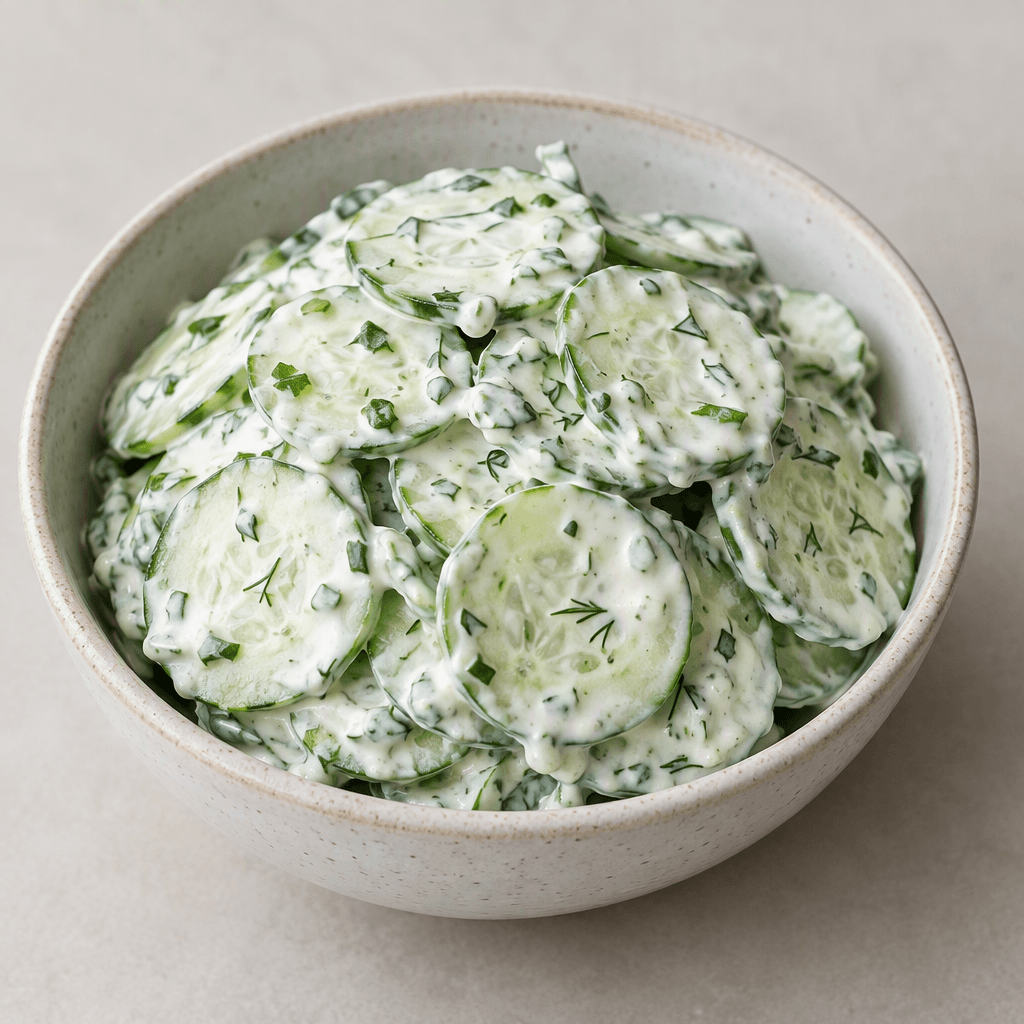
Creamy cucumber salad Calories
Refreshing creamy salad with low calories
In season: Spring · Summer
CALORIES
GI
POTASSIUM
FIBER
Quick answer
1 cup (medium) of Creamy cucumber salad (120 g) has 94 calories. That works out to 78 calories per 100 g. It contains 5.8 g of carbs, 1.9 g of protein, 7.3 g of fat and 0.8 g of fiber. Its 21.6 µg of Vitamin K covers 18% of the Daily Value. Its glycemic index is 15 (low), so it raises blood sugar slowly.
What is Creamy cucumber salad?
Creamy cucumber salad combines thinly sliced cucumbers with a smooth, tangy dressing, often made with cream or sour cream and finished with fresh herbs. Versions of this simple salad are familiar in German and Central European home cooking, with the seasoning and richness varying from one household to another.
Cool, crisp cucumber balances the soft, creamy dressing, making it a popular side for grilled foods, potatoes and other hearty meals. It also works well as a light summer side or alongside sandwiches. The cucumbers keep the dish refreshing and relatively low in calories, while the dressing contributes most of its richness. For a lighter version, replace some of the cream with plain yoghurt; add the herbs just before serving for a fresher flavour.
Creamy cucumber salad Nutrition Facts
Selected: 100 g
78
KCAL / 100G
Carbs
4.8g
· 2% DV
Protein
1.6g
· 3% DV
Fat
6.1g
· 8% DV
Fiber
0.7g
· 3% DV
DV is the share of the daily value covered, on a 2,000 kcal reference diet.
Calories come from: Carbs 24% · Protein 8% · Fat 68%
Creamy cucumber salad Vitamins & Minerals
Vitamins
Vitamin K
18µg · 15% DV
B2
0.08mg · 6% DV
Biotin
1.8µg · 6% DV
B12
0.12µg · 5% DV
Minerals
Sodium
240mg · 10% DV
Phosphorus
39mg · 6% DV
Calcium
52mg · 5% DV
Potassium ⭐
155mg · 5% DV
How Nutritious Is Creamy cucumber salad?
Nutrient density
Medium
How many vitamins, minerals and how much fiber this food carries per calorie. A high score means a lot of nutrition for few calories.
Satiety score
Medium
An EatBetter score computed from fiber, protein and calorie density. A high score means staying full longer on the same calories.
Both scores are calculated per 100 g and do not change with the selected portion. The satiety score is EatBetter's own calculation, not a clinical measure.
Creamy cucumber salad Glycemic Index
GLYCEMIC INDEX
GLYCEMIC LOAD
Accounts for portion size — a more realistic measure than GI alone.
How to Burn Off Creamy cucumber salad
To burn the 78 calories in 100 g:
🚶
Walking (5 km/h)
🏃
Running (8 km/h)
🚴
Cycling
🏊
Swimming
Times are calculated with the MET equation for a 70 kg adult. Actual burn varies with your weight, age and pace.
Is Creamy cucumber salad Processed?
NOVA 2
Minimally Processed
1. Unprocessed
2. Minimally Processed
3. Processed
4. Ultra-Processed
NOVA classifies foods into 4 groups by industrial processing. NOVA 1 (unprocessed) is the healthiest.
Does Creamy cucumber salad Contain Allergens?
Contains these allergens:
Which Diets Is Creamy cucumber salad Good For?
Vegan
— Not suitable
Vegetarian
✓ Suitable
Gluten-Free
✓ Suitable
Dairy-Free
— Not suitable
Mediterranean
✓ Suitable
Paleo
— Not suitable
Whole30
— Not suitable
DASH
— Not suitable
Keto
— Not suitable
Low FODMAP
— Not suitable
Creamy cucumber salad Fat Profile
SATURATED
3.5g
MONOUNSATURATED
1.5g
POLYUNSATURATED
0.25g
Omega 6:3 ratio 7.3:1
Above the ideal 4:1 (7.3:1).
Compare Creamy cucumber salad
Foods Similar to Creamy cucumber salad
Frequently Asked Questions About Creamy cucumber salad
How do you make creamy cucumber salad?
Creamy cucumber salad is made by tossing thinly sliced cucumbers with a dressing based on sour cream, yogurt, or a combination of the two. Dill, a little vinegar or lemon, and seasoning are common additions; chill it briefly before serving so the flavors come together.
Why does creamy cucumber salad get watery?
Creamy cucumber salad gets watery because sliced cucumbers release moisture, especially after they are salted or sit in dressing. Pat the slices dry and drain them after salting, or dress the salad shortly before serving to keep the sauce thicker.
Should you peel cucumbers for creamy cucumber salad?
You do not have to peel cucumbers for creamy cucumber salad. Leave the skin on if it is thin and tender, or peel thicker-skinned cucumbers for a softer texture. Washing the cucumbers well is important either way.
What cucumbers are best for creamy cucumber salad?
Firm cucumbers with few seeds work best for creamy cucumber salad because they stay crisp and release less water. English cucumbers are a convenient choice; if using large, seedy cucumbers, scoop out the watery center before slicing.
Can you make creamy cucumber salad with Greek yogurt instead of sour cream?
Yes, Greek yogurt can replace sour cream in creamy cucumber salad. It makes the dressing tangier and often thicker, while sour cream gives a richer, milder flavor. Thin the yogurt with a little lemon juice or water if it coats the slices too heavily.
What herbs go well in creamy cucumber salad?
Dill is the classic herb for creamy cucumber salad, especially in Central and Northern European versions. Chives, parsley, or mint also work; use a small amount of mint so it does not overpower the cucumber and creamy dressing.
Is creamy cucumber salad the same as German cucumber salad?
Not always. German Gurkensalat has both creamy versions, often made with sour cream and dill, and lighter versions dressed with vinegar, oil, and sugar. Creamy cucumber salad generally describes the dressing style rather than one fixed national recipe.
Can you make creamy cucumber salad ahead of time?
Yes, you can prepare creamy cucumber salad ahead, but keep the sliced cucumbers and dressing separate until close to serving. If already mixed, the salad will soften and release liquid as it sits, even when refrigerated.
How long does creamy cucumber salad last in the fridge?
Creamy cucumber salad is best eaten within about 1–2 days when stored covered in the refrigerator. The cucumbers gradually soften and thin the dressing, so stir before serving and discard it if it has been left out for an extended time.
Can you freeze creamy cucumber salad?
No, creamy cucumber salad does not freeze well. Cucumbers become limp and watery when thawed, and dairy-based dressing can separate, leaving the salad with a grainy texture. Make it fresh or refrigerate leftovers instead.
Have another question about Creamy cucumber salad?
Ask the AI nutrition coach — calories, portions, alternatives and more, answered in seconds in the app.

Scan calories with your camera
Instant AI nutrition analysis

Nutrition data compiled from USDA FoodData Central and scientific sources.