

Ready & Packaged Foods
All →Vegetables & Legumes
All →Desserts & Confectionery
All →Meat & Protein
All →Grains & Bakery
All →Beverages
All →Milk & Dairy
All →

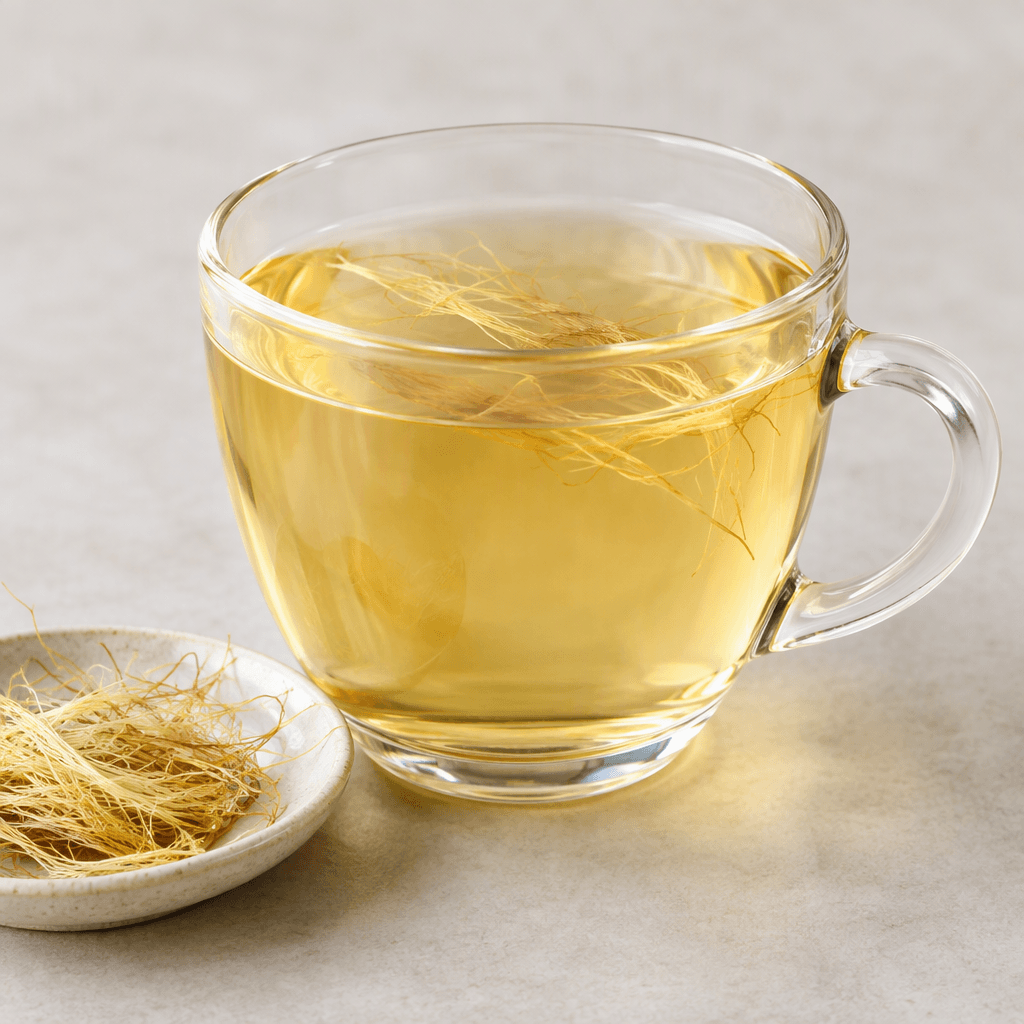
Corn silk tea Calories
Natural herbal tea, diuretic, antioxidant
In season: Summer · Autumn
CALORIES
GI
POTASSIUM
FIBER
Quick answer
1 cup (medium) of Corn silk tea (240 g) has 2 calories. That works out to 1 calories per 100 g. It contains 0.5 g of carbs, 0.2 g of protein, 0 g of fat and 0.2 g of fiber. Its glycemic index is 0 (low), so it raises blood sugar slowly.
What is Corn silk tea?
Corn silk tea is an infusion made from the fine, thread-like strands that grow around an ear of corn. The strands can be used fresh or dried, and the tea is enjoyed in herbal traditions in several parts of the world.
It brews to a pale golden colour with a mild, grassy flavour and a soft, slightly sweet finish. Drink it hot or chilled, plain or with a little lemon; it also works as a caffeine-free alternative to regular tea during the day. Its nutritional profile is mostly water, with very little energy. If you are trying it for the first time, steep a small amount briefly to see how you like its delicate taste.
Corn silk tea Nutrition Facts
Selected: 100 g
1
KCAL / 100G
Carbs
0.2g
· 0% DV
Protein
0.1g
· 0% DV
Fat
0g
· 0% DV
Fiber
0.1g
· 0% DV
DV is the share of the daily value covered, on a 2,000 kcal reference diet.
Calories come from: Carbs 67% · Protein 33% · Fat 0%
Corn silk tea Vitamins & Minerals
Vitamins
B1
0.01mg · 1% DV
B2
0.01mg · 1% DV
B6
0.01mg · 1% DV
Vitamin A
0.5µg · 0% DV
Minerals
Calcium
1mg · 0% DV
Iron
0mg · 0% DV
Magnesium
1mg · 0% DV
Zinc
0mg · 0% DV
How Nutritious Is Corn silk tea?
Nutrient density
Low
How many vitamins, minerals and how much fiber this food carries per calorie. A high score means a lot of nutrition for few calories.
Satiety score
Medium
An EatBetter score computed from fiber, protein and calorie density. A high score means staying full longer on the same calories.
Both scores are calculated per 100 g and do not change with the selected portion. The satiety score is EatBetter's own calculation, not a clinical measure.
Corn silk tea Glycemic Index
GLYCEMIC INDEX
GLYCEMIC LOAD
Accounts for portion size — a more realistic measure than GI alone.
How to Burn Off Corn silk tea
To burn the 1 calories in 100 g:
🚶
Walking (5 km/h)
🏃
Running (8 km/h)
🚴
Cycling
🏊
Swimming
Times are calculated with the MET equation for a 70 kg adult. Actual burn varies with your weight, age and pace.
Is Corn silk tea Processed?
NOVA 2
Minimally Processed
1. Unprocessed
2. Minimally Processed
3. Processed
4. Ultra-Processed
NOVA classifies foods into 4 groups by industrial processing. NOVA 1 (unprocessed) is the healthiest.
Does Corn silk tea Contain Allergens?
No known major allergens
Which Diets Is Corn silk tea Good For?
Vegan
✓ Suitable
Vegetarian
✓ Suitable
Gluten-Free
✓ Suitable
Dairy-Free
— Not suitable
Mediterranean
✓ Suitable
Paleo
✓ Suitable
Whole30
— Not suitable
DASH
— Not suitable
Keto
✓ Suitable
Low FODMAP
— Not suitable
Corn silk tea Fat Profile
SATURATED
0g
MONOUNSATURATED
0g
POLYUNSATURATED
0g
Compare Corn silk tea
Foods Similar to Corn silk tea
Frequently Asked Questions About Corn silk tea
What is corn silk tea good for?
Corn silk tea is traditionally used as a mild diuretic, but strong evidence that it treats a health condition is lacking. Its antioxidant content does not make it a proven remedy for kidney, urinary, or other diseases.
How do you make corn silk tea?
Make corn silk tea by steeping fresh or dried corn silk in hot water, then straining it before drinking. Use clean silk from an ear of corn, and add lemon if you want a brighter flavor.
Can corn silk tea help with kidney stones?
Corn silk tea has not been shown to dissolve or pass kidney stones. Its possible diuretic effect does not remove a blockage or shrink a stone, so it should not replace assessment or treatment for suspected stones.
Does corn silk tea treat a urinary tract infection?
No, corn silk tea does not treat a urinary tract infection. It may increase urination, but that does not clear the infection; symptoms such as painful urination, fever, or back pain need proper medical attention.
Does corn silk tea contain caffeine?
No, corn silk tea is naturally caffeine-free. It can be a caffeine-free hot drink, although sweetening it adds sugar; it does not provide the stimulant effect associated with coffee or caffeinated tea.
Is it safe to drink corn silk tea every day?
There is not enough evidence to establish a safe daily amount of corn silk tea for everyone. Because it may increase urination, frequent or heavy use could affect fluid balance; do not use it in place of water.
Can you drink corn silk tea while pregnant?
The safety of corn silk tea during pregnancy has not been established. Avoid using it regularly or in medicinal amounts while pregnant or breastfeeding, and ask your doctor before making it part of your routine.
Does corn silk tea lower blood sugar?
Corn silk tea has not been proven to reliably lower blood sugar in people. Do not use it to replace diabetes medication or meals; its effects alongside glucose-lowering treatment are not well established.
Can corn silk tea interact with medications?
Yes, corn silk tea may affect fluid balance and could be a concern with diuretics or blood-pressure medicines. If you take regular medication, ask your doctor or pharmacist before drinking it often.
Does corn silk tea help with hydration?
Corn silk tea contributes fluid, but its possible diuretic effect means it should not be your only source of hydration. Drink water as usual, especially if the tea makes you urinate more often.
Have another question about Corn silk tea?
Ask the AI nutrition coach — calories, portions, alternatives and more, answered in seconds in the app.

Scan calories with your camera
Instant AI nutrition analysis

Nutrition data compiled from USDA FoodData Central and scientific sources.