

Ready & Packaged Foods
All →Vegetables & Legumes
All →Desserts & Confectionery
All →Meat & Protein
All →Grains & Bakery
All →Beverages
All →Milk & Dairy
All →

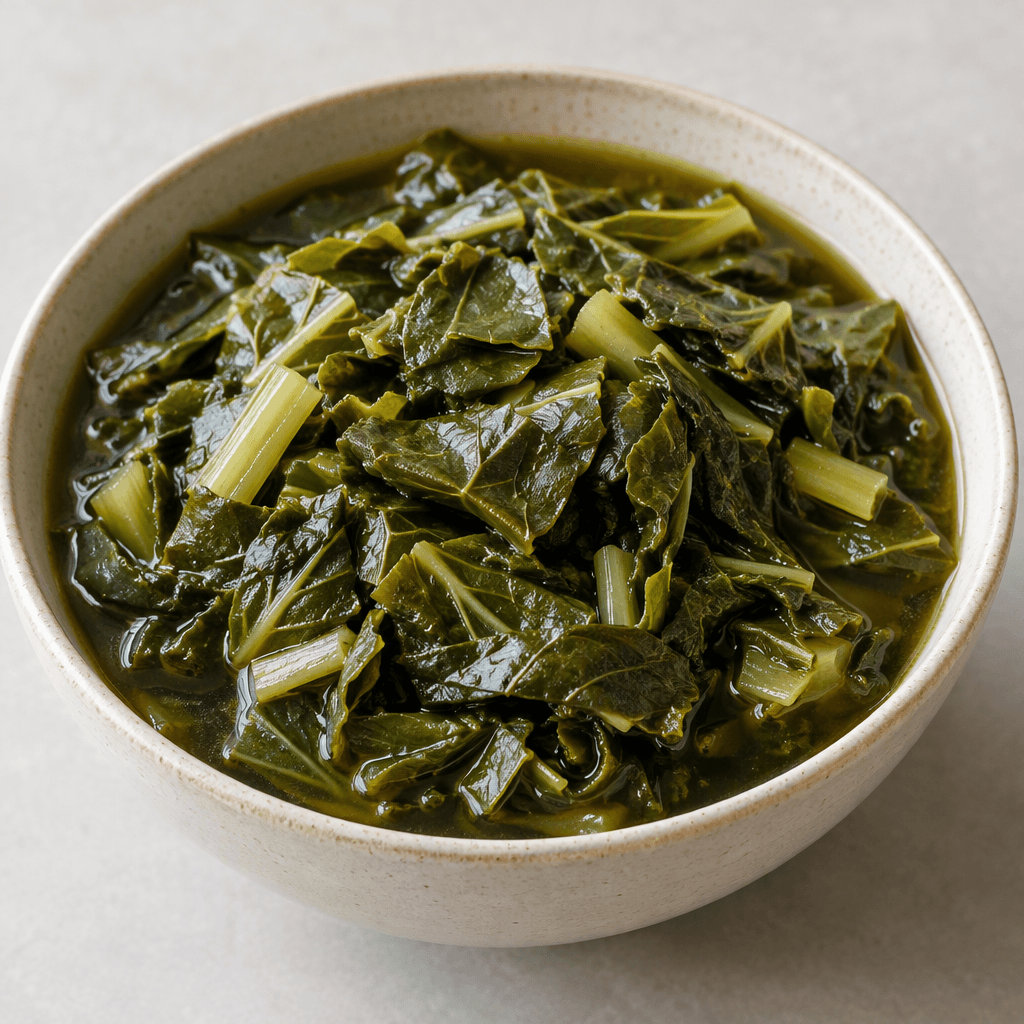
Collard Greens Stew Calories
Nutritious vegetable stew made with collard greens, olive oil, onion, carrot, potato, spices
In season: Autumn · Winter
CALORIES
GI
POTASSIUM
FIBER
Quick answer
1 serving (medium) of Collard Greens Stew (200 g) has 110 calories. That works out to 55 calories per 100 g. It contains 17.2 g of carbs, 3.4 g of protein, 3 g of fat and 5.6 g of fiber. Its 360 µg of Vitamin K covers 300% of the Daily Value. Its glycemic index is 40 (low), so it raises blood sugar slowly.
What is Collard Greens Stew?
Collard Greens Stew is a home-style vegetable dish built around chopped collard leaves, cooked with olive oil, onion, carrot, potato and spices. It is inspired by Karadeniz, or Turkey’s Black Sea region, where dark leafy greens are a familiar part of the cooking. The leaves soften in the pot, and their savoury cooking liquid is served along with them.
Enjoy it warm as a light main or alongside other dishes. Its earthy greens and tender vegetables make it comforting without being heavy; the stew also provides fibre, with 2.8 g per 100 g. For a more filling meal, serve it with bread, or keep the oil modest for a lighter bowl.
Collard Greens Stew Nutrition Facts
Selected: 100 g
55
KCAL / 100G
Carbs
8.6g
· 3% DV
Protein
1.7g
· 3% DV
Fat
1.5g
· 2% DV
Fiber
2.8g
· 10% DV
DV is the share of the daily value covered, on a 2,000 kcal reference diet.
Calories come from: Carbs 63% · Protein 12% · Fat 25%
Collard Greens Stew Vitamins & Minerals
Vitamins
Vitamin K
180µg · 150% DV
Vitamin C
24mg · 27% DV
Vitamin A
220µg · 24% DV
Folate
55µg · 14% DV
Minerals
Calcium
85mg · 9% DV
Sodium
180mg · 8% DV
Iron
1mg · 6% DV
Potassium ⭐
210mg · 6% DV
How Nutritious Is Collard Greens Stew?
Nutrient density
Very high
How many vitamins, minerals and how much fiber this food carries per calorie. A high score means a lot of nutrition for few calories.
Satiety score
Medium
An EatBetter score computed from fiber, protein and calorie density. A high score means staying full longer on the same calories.
Both scores are calculated per 100 g and do not change with the selected portion. The satiety score is EatBetter's own calculation, not a clinical measure.
Collard Greens Stew Glycemic Index
GLYCEMIC INDEX
GLYCEMIC LOAD
Accounts for portion size — a more realistic measure than GI alone.
How to Burn Off Collard Greens Stew
To burn the 55 calories in 100 g:
🚶
Walking (5 km/h)
🏃
Running (8 km/h)
🚴
Cycling
🏊
Swimming
Times are calculated with the MET equation for a 70 kg adult. Actual burn varies with your weight, age and pace.
Is Collard Greens Stew Processed?
NOVA 2
Minimally Processed
1. Unprocessed
2. Minimally Processed
3. Processed
4. Ultra-Processed
NOVA classifies foods into 4 groups by industrial processing. NOVA 1 (unprocessed) is the healthiest.
Does Collard Greens Stew Contain Allergens?
No known major allergens
Which Diets Is Collard Greens Stew Good For?
Vegan
✓ Suitable
Vegetarian
✓ Suitable
Gluten-Free
✓ Suitable
Dairy-Free
— Not suitable
Mediterranean
✓ Suitable
Paleo
✓ Suitable
Whole30
— Not suitable
DASH
— Not suitable
Keto
— Not suitable
Low FODMAP
— Not suitable
Collard Greens Stew Fat Profile
SATURATED
0.22g
MONOUNSATURATED
0.56g
POLYUNSATURATED
0.31g
Omega 6:3 ratio 2:1
Below the ideal 4:1 — a good omega balance.
Compare Collard Greens Stew
Foods Similar to Collard Greens Stew
Frequently Asked Questions About Collard Greens Stew
How do you make collard greens stew?
Collard greens stew is made by simmering chopped collards with onion, olive oil, and vegetables such as carrots and potatoes. Add water or broth and cook until the leaves and stems are tender; beans or meat are common additions in some versions.
How long should collard greens cook in a stew?
Collard greens usually need enough simmering to become tender, with timing depending on how finely they are cut and how mature the leaves are. Check the stems as well as the leaves; stems take longer, so slice them thinly or add them first.
What is the difference between collard greens stew and Southern collard greens?
Collard greens stew is a soupier, vegetable-based dish, while Southern collard greens are often braised with smoked meat and served with their pot liquor. Recipes vary, but the stew typically includes other vegetables and enough liquid to eat as a main dish.
Can you add beans to collard greens stew?
Yes, beans are a good addition to collard greens stew and make it more filling. Add cooked or canned beans near the end so they warm through without breaking apart; if using dried beans, cook them separately until tender first.
How do you make collard greens stew less bitter?
To make collard greens stew less bitter, remove any tough central ribs, chop the leaves, and simmer them until fully tender. Onion and carrot also balance the greens’ earthy taste; a small splash of vinegar or lemon at the end can brighten the flavor.
Can you use collard stems in collard greens stew?
Yes, collard stems can go into collard greens stew. They are firmer than the leaves, so slice them thinly and start cooking them before adding the leaves; discard only woody ends or unusually tough ribs.
Can kale replace collard greens in collard greens stew?
Yes, kale can replace collard greens in the stew, but the texture and flavor will differ. Curly kale tends to be more robust, while tender varieties cook faster, so add the leaves later and check them as they simmer.
What should you serve with collard greens stew?
Cornbread is a classic partner for collard greens stew because it soaks up the broth. Rice, crusty bread, or a simple grain also work well, especially when the stew contains beans or is served as the main meal.
How long does collard greens stew last in the fridge?
Collard greens stew keeps for about three days in a covered container in the refrigerator. Cool it promptly after cooking, and reheat only the portion you plan to eat until it is steaming hot throughout.
Can you freeze collard greens stew?
Yes, collard greens stew freezes well in airtight, portion-sized containers. Thaw it in the refrigerator and reheat thoroughly; potatoes may become softer or grainier after freezing, so the texture can change even though the stew remains usable.
Have another question about Collard Greens Stew?
Ask the AI nutrition coach — calories, portions, alternatives and more, answered in seconds in the app.

Scan calories with your camera
Instant AI nutrition analysis

Nutrition data compiled from USDA FoodData Central and scientific sources.