

Ready & Packaged Foods
All →Vegetables & Legumes
All →Desserts & Confectionery
All →Meat & Protein
All →Grains & Bakery
All →Beverages
All →Milk & Dairy
All →

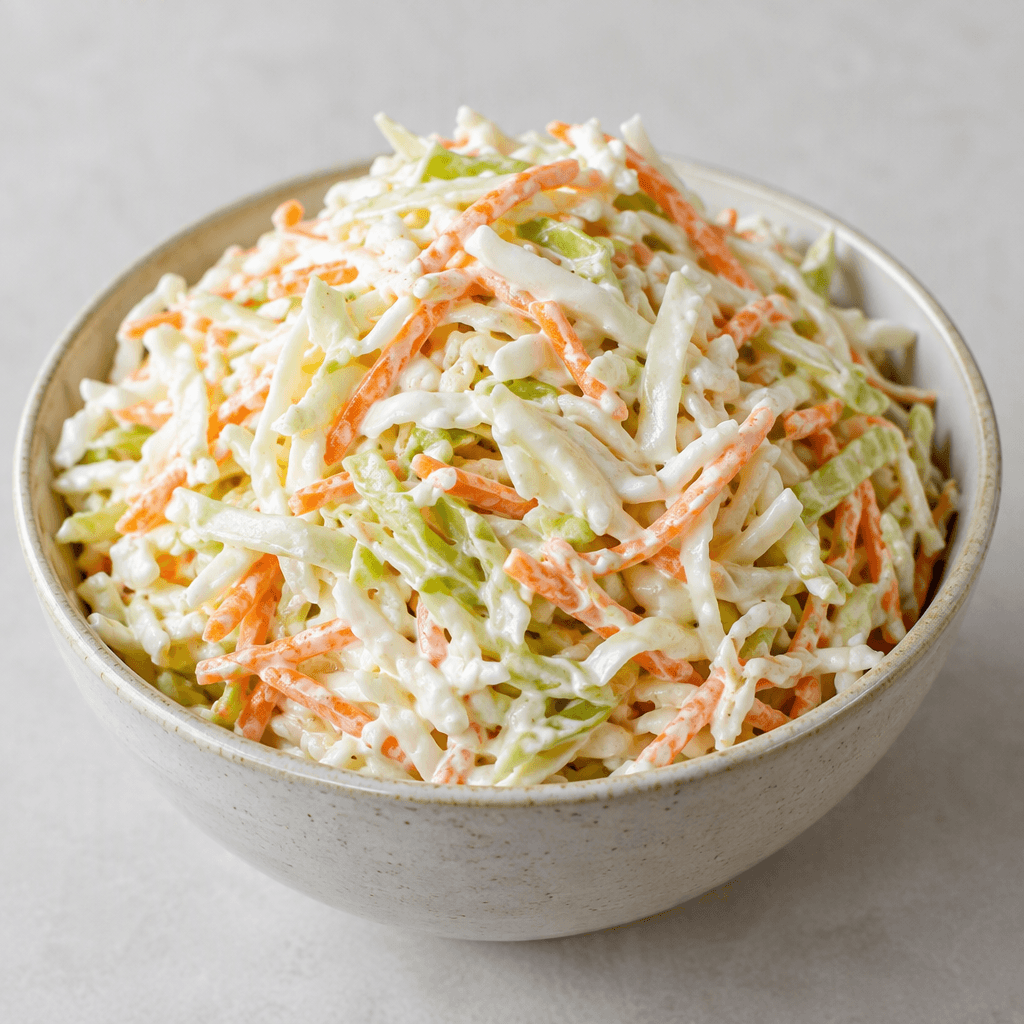
Coleslaw Salad Calories
Classic American salad made with cabbage, carrot, mayonnaise, and vinegar.
In season: Spring · Summer · Autumn · Winter
CALORIES
GI
POTASSIUM
FIBER
Quick answer
1 serving (small) of Coleslaw Salad (80 g) has 96 calories. That works out to 120 calories per 100 g. It contains 6.8 g of carbs, 1 g of protein, 6.8 g of fat and 1.8 g of fiber. Its 36 µg of Vitamin K covers 30% of the Daily Value. Its glycemic index is 45 (low), so it raises blood sugar slowly.
What is Coleslaw Salad?
Coleslaw Salad is a classic American side made from finely shredded cabbage and carrot tossed in a creamy dressing, usually with mayonnaise and vinegar. The cabbage stays crisp, while the dressing adds richness and a mild tang. Recipes vary: some lean sweeter, and others use a sharper, more vinegary dressing.
In the United States it commonly accompanies barbecue, fried chicken and sandwiches, and it is also familiar at picnics. English-speaking readers elsewhere may know it as a burger or deli side. It provides some fibre from the vegetables, but the creamy dressing makes it more substantial than a plain salad. For a lighter version, use less mayonnaise or replace part of it with yogurt.
Coleslaw Salad Nutrition Facts
Selected: 100 g
120
KCAL / 100G
Carbs
8.5g
· 3% DV
Protein
1.2g
· 2% DV
Fat
8.5g
· 11% DV
Fiber
2.2g
· 8% DV
DV is the share of the daily value covered, on a 2,000 kcal reference diet.
Calories come from: Carbs 29% · Protein 4% · Fat 67%
Coleslaw Salad Vitamins & Minerals
Vitamins
Vitamin K
45µg · 38% DV
Vitamin A
220µg · 24% DV
Vitamin C
18mg · 20% DV
Biotin
2.2µg · 7% DV
Minerals
Sodium
220mg · 10% DV
Potassium ⭐
170mg · 5% DV
Calcium
40mg · 4% DV
Phosphorus
28mg · 4% DV
How Nutritious Is Coleslaw Salad?
Nutrient density
Medium
How many vitamins, minerals and how much fiber this food carries per calorie. A high score means a lot of nutrition for few calories.
Satiety score
Medium
An EatBetter score computed from fiber, protein and calorie density. A high score means staying full longer on the same calories.
Both scores are calculated per 100 g and do not change with the selected portion. The satiety score is EatBetter's own calculation, not a clinical measure.
Coleslaw Salad Glycemic Index
GLYCEMIC INDEX
GLYCEMIC LOAD
Accounts for portion size — a more realistic measure than GI alone.
How to Burn Off Coleslaw Salad
To burn the 120 calories in 100 g:
🚶
Walking (5 km/h)
🏃
Running (8 km/h)
🚴
Cycling
🏊
Swimming
Times are calculated with the MET equation for a 70 kg adult. Actual burn varies with your weight, age and pace.
Is Coleslaw Salad Processed?
NOVA 3
Processed
1. Unprocessed
2. Minimally Processed
3. Processed
4. Ultra-Processed
NOVA classifies foods into 4 groups by industrial processing. NOVA 1 (unprocessed) is the healthiest.
Does Coleslaw Salad Contain Allergens?
Contains these allergens:
Which Diets Is Coleslaw Salad Good For?
Vegan
— Not suitable
Vegetarian
✓ Suitable
Gluten-Free
— Not suitable
Dairy-Free
— Not suitable
Mediterranean
— Not suitable
Paleo
— Not suitable
Whole30
— Not suitable
DASH
— Not suitable
Keto
— Not suitable
Low FODMAP
— Not suitable
Coleslaw Salad Fat Profile
SATURATED
1.3g
MONOUNSATURATED
2.7g
POLYUNSATURATED
2.4g
Omega 6:3 ratio 27.5:1
Above the ideal 4:1 (27.5:1).
Compare Coleslaw Salad
Foods Similar to Coleslaw Salad
Frequently Asked Questions About Coleslaw Salad
What is in coleslaw salad?
Classic coleslaw salad contains finely shredded cabbage and carrot tossed with a creamy dressing, usually made with mayonnaise and vinegar. Some recipes add mustard, sugar, or lemon, so the balance of sweet and tangy flavors varies.
How do you make coleslaw salad?
To make coleslaw salad, finely shred cabbage, grate carrot, and toss them with a mayonnaise-and-vinegar dressing. Chill it briefly for the flavors to come together, then stir again before serving.
How do you make coleslaw salad like KFC?
For a KFC-style coleslaw salad, chop the cabbage and carrot very finely and use a smooth, creamy dressing with a gently sweet, tangy taste. Small, even vegetable pieces are key to getting a similar texture.
Why does coleslaw salad get watery?
Coleslaw salad gets watery when salt draws moisture out of the cabbage or the vegetables go into the dressing wet. Dry the vegetables well, and add the dressing closer to serving time to keep the salad crisper.
Should you salt cabbage for coleslaw salad?
You do not need to salt cabbage before making coleslaw salad. Salting softens it but also pulls out water, so skip that step if you want a crisp salad; if you do salt it, drain the liquid before dressing.
Can you make coleslaw salad without mayonnaise?
Yes, coleslaw salad can be made without mayonnaise by using a vinegar-based dressing or replacing some mayonnaise with plain yogurt. The vinegar version is lighter and sharper, while yogurt keeps a creamy texture but changes the classic flavor.
What do you serve with coleslaw salad?
Coleslaw salad is commonly served with barbecue, fried chicken, burgers, and pulled-pork sandwiches. Its cool, tangy crunch works especially well alongside rich, smoky, or fried foods.
How long does coleslaw salad last in the fridge?
Keep coleslaw salad covered in the refrigerator and eat it within a few days for the best texture and quality. Discard it if it has been left out for a long time or develops an unusual smell or appearance.
Can you freeze coleslaw salad?
Freezing mayonnaise-based coleslaw salad is not recommended. The dressing may separate as it thaws, and the cabbage can turn limp and watery, so the salad will not have its usual creamy, crunchy texture.
Can you make coleslaw salad ahead of time?
Yes, you can prepare coleslaw salad ahead, but keep the shredded vegetables and dressing separate until nearer serving time. This helps the cabbage stay crisp; toss everything together and chill it before serving.
Have another question about Coleslaw Salad?
Ask the AI nutrition coach — calories, portions, alternatives and more, answered in seconds in the app.

Scan calories with your camera
Instant AI nutrition analysis

Nutrition data compiled from USDA FoodData Central and scientific sources.