

Ready & Packaged Foods
All →Vegetables & Legumes
All →Desserts & Confectionery
All →Meat & Protein
All →Grains & Bakery
All →Beverages
All →Milk & Dairy
All →

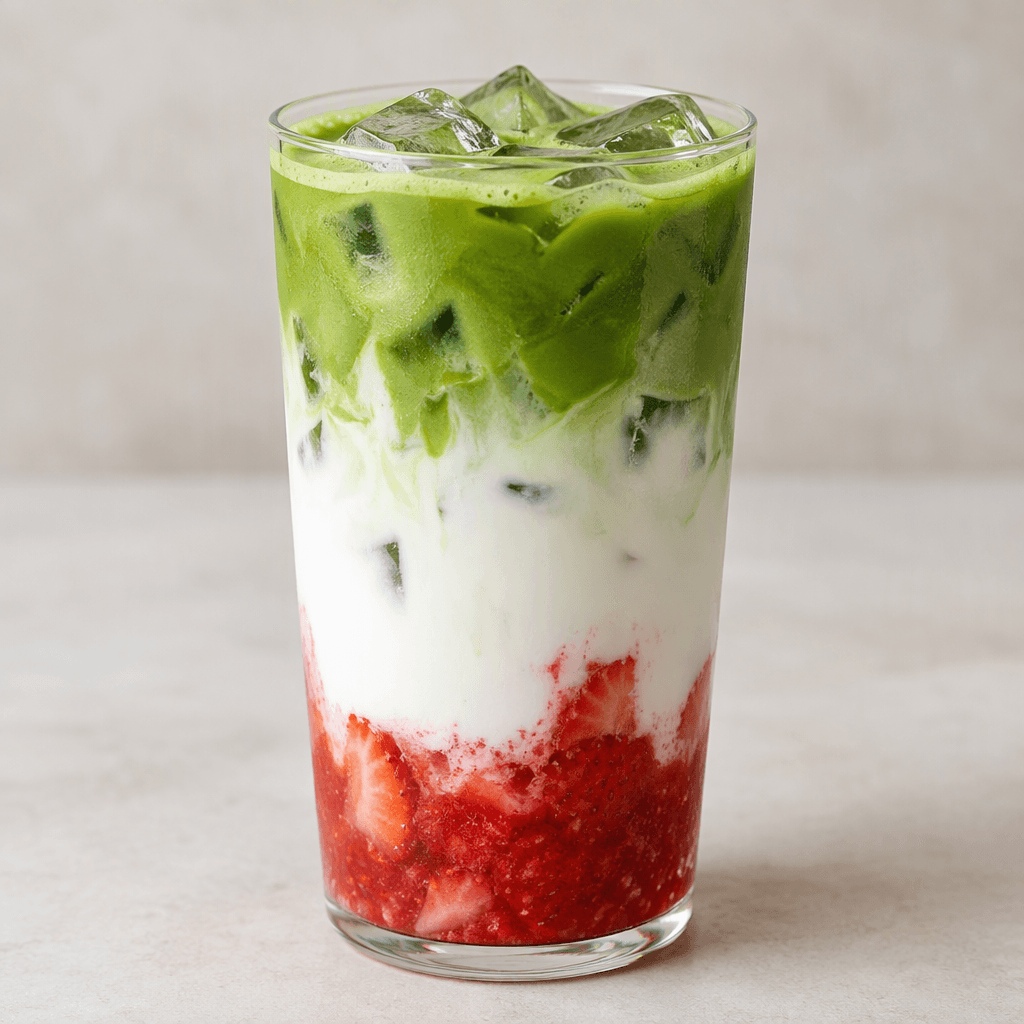
Strawberry Matcha Latte Calories
Refreshing drink made with strawberry, matcha, and milk
In season: Spring · Summer
CALORIES
GI
POTASSIUM
FIBER
Quick answer
1 cup (medium) of Strawberry Matcha Latte (240 g) has 156 calories. That works out to 65 calories per 100 g. It contains 25.9 g of carbs, 5 g of protein, 2.9 g of fat and 2.6 g of fiber. Its 31.2 mg of Vitamin C covers 35% of the Daily Value. Its glycemic index is 45 (low), so it raises blood sugar slowly.
What is Strawberry Matcha Latte?
Strawberry Matcha Latte brings together matcha—finely ground Japanese green tea—with milk and strawberry purée or crushed fruit. It is a modern café drink rather than a traditional Japanese preparation, and is often served over ice in distinct green, white and red layers. Stir it before drinking for an even flavour, or sip through the layers to taste the strawberry and earthy matcha separately.
Across cafés worldwide, it makes a refreshing alternative to coffee, especially alongside a light pastry. Milk contributes some protein, while the fruit adds a little fibre; the overall sweetness depends on how much sweetener is added to the strawberry. For a less sweet cup, use unsweetened strawberry purée and add only as much as you need to balance matcha’s grassy, slightly bitter edge.
Strawberry Matcha Latte Nutrition Facts
Selected: 100 g
65
KCAL / 100G
Carbs
10.8g
· 4% DV
Protein
2.1g
· 4% DV
Fat
1.2g
· 2% DV
Fiber
1.1g
· 4% DV
DV is the share of the daily value covered, on a 2,000 kcal reference diet.
Calories come from: Carbs 69% · Protein 13% · Fat 18%
Strawberry Matcha Latte Vitamins & Minerals
Vitamins
Vitamin C
13mg · 14% DV
B5
0.4mg · 8% DV
B2
0.09mg · 7% DV
B12
0.15µg · 6% DV
Minerals
Calcium
65mg · 7% DV
Phosphorus
52mg · 7% DV
Iodine
7µg · 5% DV
Potassium ⭐
170mg · 5% DV
How Nutritious Is Strawberry Matcha Latte?
Nutrient density
Medium
How many vitamins, minerals and how much fiber this food carries per calorie. A high score means a lot of nutrition for few calories.
Satiety score
Medium
An EatBetter score computed from fiber, protein and calorie density. A high score means staying full longer on the same calories.
Both scores are calculated per 100 g and do not change with the selected portion. The satiety score is EatBetter's own calculation, not a clinical measure.
Strawberry Matcha Latte Glycemic Index
GLYCEMIC INDEX
GLYCEMIC LOAD
Accounts for portion size — a more realistic measure than GI alone.
How to Burn Off Strawberry Matcha Latte
To burn the 65 calories in 100 g:
🚶
Walking (5 km/h)
🏃
Running (8 km/h)
🚴
Cycling
🏊
Swimming
Times are calculated with the MET equation for a 70 kg adult. Actual burn varies with your weight, age and pace.
Is Strawberry Matcha Latte Processed?
NOVA 3
Processed
1. Unprocessed
2. Minimally Processed
3. Processed
4. Ultra-Processed
NOVA classifies foods into 4 groups by industrial processing. NOVA 1 (unprocessed) is the healthiest.
Does Strawberry Matcha Latte Contain Allergens?
Contains these allergens:
Which Diets Is Strawberry Matcha Latte Good For?
Vegan
— Not suitable
Vegetarian
✓ Suitable
Gluten-Free
— Not suitable
Dairy-Free
— Not suitable
Mediterranean
✓ Suitable
Paleo
— Not suitable
Whole30
— Not suitable
DASH
— Not suitable
Keto
— Not suitable
Low FODMAP
— Not suitable
Strawberry Matcha Latte Fat Profile
SATURATED
0.7g
MONOUNSATURATED
0.3g
POLYUNSATURATED
0.1g
Omega 6:3 ratio 2:1
Below the ideal 4:1 — a good omega balance.
Compare Strawberry Matcha Latte
Foods Similar to Strawberry Matcha Latte
Frequently Asked Questions About Strawberry Matcha Latte
How do you make a Strawberry Matcha Latte at home?
Make a Strawberry Matcha Latte by blending or mashing strawberries into a puree, then adding milk and ice. Whisk matcha with a little warm water until smooth and pour it over the milk for a layered finish, or stir everything together.
Does a Strawberry Matcha Latte have caffeine?
Yes, a Strawberry Matcha Latte contains caffeine from the matcha. The amount depends on how much matcha is used, so it can affect sleep if you are sensitive to caffeine or drink it late in the day.
What does a Strawberry Matcha Latte taste like?
A Strawberry Matcha Latte tastes fruity and creamy, with matcha’s grassy, slightly bitter notes balancing the strawberry’s sweetness and tartness. Its flavor changes with the ripeness of the berries and how much sweetener is added.
Why does a Strawberry Matcha Latte separate into layers?
A Strawberry Matcha Latte separates because the strawberry puree, milk, and matcha have different textures and densities. The layers are mainly visual and will blend as the drink sits; pour each layer slowly if you want them to remain distinct longer.
Can you make a Strawberry Matcha Latte with frozen strawberries?
Yes, frozen strawberries work well in a Strawberry Matcha Latte. Thaw them first if you want a smooth puree, or blend them while frozen for a thicker, colder drink; taste before adding sweetener, since ripe berries may be sweet enough.
How do you stop matcha from clumping in a Strawberry Matcha Latte?
To prevent clumps in a Strawberry Matcha Latte, sift the matcha and whisk it with a small amount of warm water before adding it to the milk. Mixing matcha straight into cold milk makes it harder to disperse smoothly.
Can you make a Strawberry Matcha Latte without added sugar?
Yes, you can make a Strawberry Matcha Latte without added sugar by using ripe strawberries and skipping syrup. If ordering one at a café, ask for it unsweetened or without strawberry syrup, since café recipes may use a sweetened puree.
Can a Strawberry Matcha Latte be served hot?
Yes, a Strawberry Matcha Latte can be served hot. Warm the milk and strawberry puree, then add matcha whisked separately with warm water; avoid boiling the matcha, which can make its flavor harsher.
How long does a homemade Strawberry Matcha Latte keep in the fridge?
A homemade Strawberry Matcha Latte is best enjoyed soon after mixing, but it can be kept covered in the refrigerator until later the same day. The layers will blend and matcha may settle, so stir it before drinking and add ice just before serving.
Is a Strawberry Matcha Latte healthy?
A Strawberry Matcha Latte can be part of a balanced diet, but its nutritional value depends on the milk and added sweetener. Matcha and strawberries provide plant compounds, while café versions with syrup can contain more added sugar than a homemade version.
Have another question about Strawberry Matcha Latte?
Ask the AI nutrition coach — calories, portions, alternatives and more, answered in seconds in the app.

Scan calories with your camera
Instant AI nutrition analysis

Nutrition data compiled from USDA FoodData Central and scientific sources.