

Ready & Packaged Foods
All →Vegetables & Legumes
All →Desserts & Confectionery
All →Meat & Protein
All →Grains & Bakery
All →Beverages
All →Milk & Dairy
All →

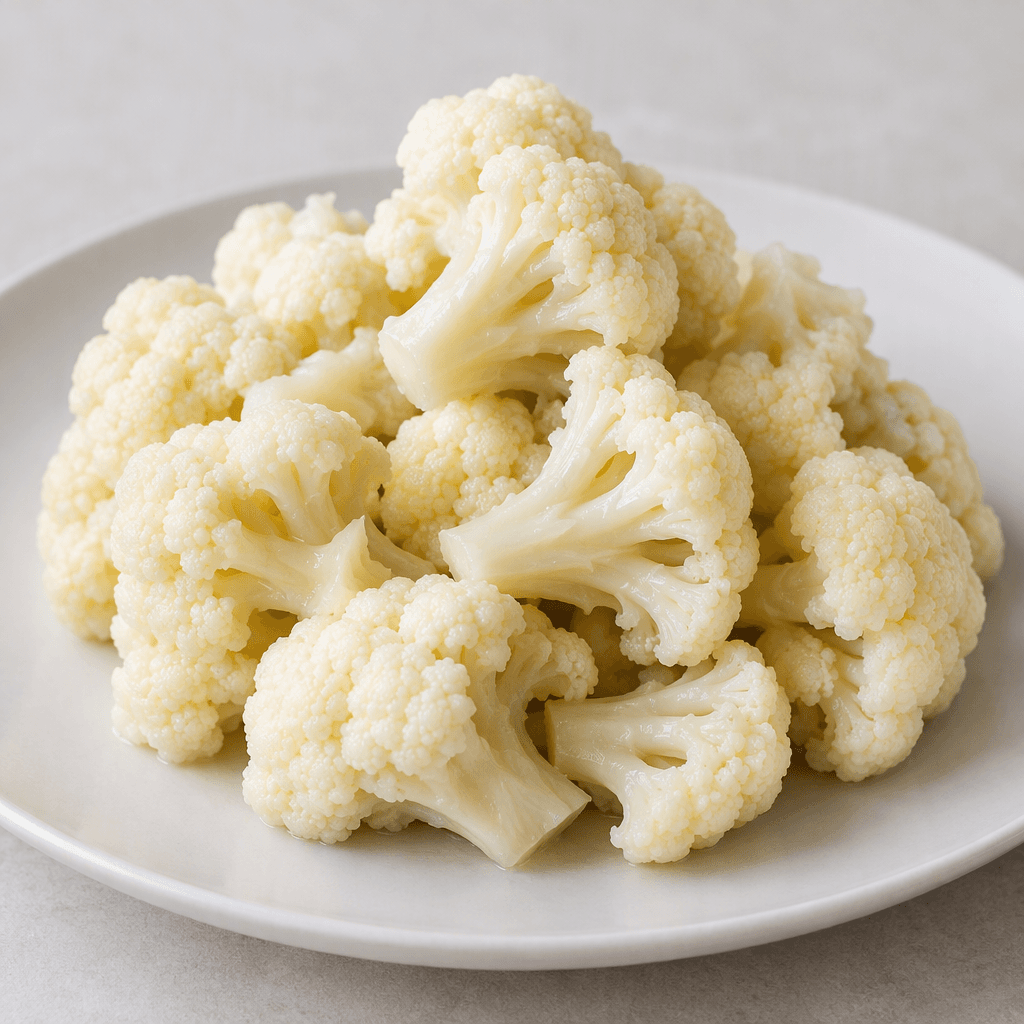
Cauliflower (Cooked) Calories
Low calorie, source of fiber and vitamin C
In season: Autumn · Winter · Spring
CALORIES
GI
POTASSIUM
FIBER
Quick answer
1 cup (medium) of Cauliflower (Cooked) (125 g) has 29 calories. That works out to 23 calories per 100 g. It contains 5.1 g of carbs, 2.3 g of protein, 0.4 g of fat and 2.9 g of fiber. Its 45 mg of Vitamin C covers 50% of the Daily Value. Its glycemic index is 15 (low), so it raises blood sugar slowly.
What is Cauliflower (Cooked)?
Cooked cauliflower is made by boiling or steaming the vegetable’s compact clusters of florets until tender. Cauliflower was developed from wild cabbage around the Mediterranean and is now cooked in many cuisines, from simple vegetable sides to curries and gratins.
Its flavour is mild and slightly sweet, and the florets turn soft while retaining some bite if you stop cooking them promptly. Serve them warm with olive oil and lemon, fold them into a salad, or pair them with a main dish; in Turkey, they’re also common in home-style stews and baked dishes. Cooked cauliflower is low in calories and provides fibre and vitamin C, with 23 calories per 100 g. Steaming it and adding herbs makes an easy, lighter side.
Cauliflower (Cooked) Nutrition Facts
Selected: 100 g
23
KCAL / 100G
Carbs
4.1g
· 1% DV
Protein
1.8g
· 4% DV
Fat
0.3g
· 0% DV
Fiber
2.3g
· 8% DV
DV is the share of the daily value covered, on a 2,000 kcal reference diet.
Calories come from: Carbs 62% · Protein 27% · Fat 11%
Cauliflower (Cooked) Vitamins & Minerals
Vitamins
Vitamin C
36mg · 40% DV
B5
0.7mg · 14% DV
B6
0.2mg · 12% DV
Vitamin K
13.8µg · 12% DV
Minerals
Phosphorus
44mg · 6% DV
Magnesium
15mg · 4% DV
Potassium ⭐
142mg · 4% DV
Calcium
22mg · 2% DV
How Nutritious Is Cauliflower (Cooked)?
Nutrient density
Very high
How many vitamins, minerals and how much fiber this food carries per calorie. A high score means a lot of nutrition for few calories.
Satiety score
Medium
An EatBetter score computed from fiber, protein and calorie density. A high score means staying full longer on the same calories.
Both scores are calculated per 100 g and do not change with the selected portion. The satiety score is EatBetter's own calculation, not a clinical measure.
Cauliflower (Cooked) Glycemic Index
GLYCEMIC INDEX
GLYCEMIC LOAD
Accounts for portion size — a more realistic measure than GI alone.
How to Burn Off Cauliflower (Cooked)
To burn the 23 calories in 100 g:
🚶
Walking (5 km/h)
🏃
Running (8 km/h)
🚴
Cycling
🏊
Swimming
Times are calculated with the MET equation for a 70 kg adult. Actual burn varies with your weight, age and pace.
Is Cauliflower (Cooked) Processed?
NOVA 2
Minimally Processed
1. Unprocessed
2. Minimally Processed
3. Processed
4. Ultra-Processed
NOVA classifies foods into 4 groups by industrial processing. NOVA 1 (unprocessed) is the healthiest.
Does Cauliflower (Cooked) Contain Allergens?
No known major allergens
Which Diets Is Cauliflower (Cooked) Good For?
Vegan
✓ Suitable
Vegetarian
✓ Suitable
Gluten-Free
✓ Suitable
Dairy-Free
— Not suitable
Mediterranean
✓ Suitable
Paleo
✓ Suitable
Whole30
— Not suitable
DASH
— Not suitable
Keto
✓ Suitable
Low FODMAP
— Not suitable
Cauliflower (Cooked) Fat Profile
SATURATED
0.07g
MONOUNSATURATED
0.03g
POLYUNSATURATED
0.06g
Omega 6:3 ratio 1.5:1
Below the ideal 4:1 — a good omega balance.
Compare Cauliflower (Cooked)
Foods Similar to Cauliflower (Cooked)
Frequently Asked Questions About Cauliflower (Cooked)
Can you roast cooked cauliflower to make it crispy?
Yes, you can roast cooked cauliflower, but pat the florets dry first so they brown rather than steam. Toss them lightly with oil and spread them in a single layer; already-soft florets need less oven time than raw ones.
How can you tell if cooked cauliflower has gone bad?
Spoiled cooked cauliflower may smell sour, feel slimy, or show mold or unusual discoloration. Discard it if you notice any of these signs, or if it was left at room temperature for too long.
Can dogs eat cooked cauliflower?
Yes, dogs can have a small amount of plain cooked cauliflower as an occasional treat. Serve it without salt, butter, garlic, onion, or sauces, and introduce it gradually because too much can cause gas or digestive upset.
Can you reheat cooked cauliflower in the microwave?
Yes, microwave cooked cauliflower in a covered, microwave-safe dish until it is steaming hot throughout. Add a small splash of water to limit drying, and avoid repeated reheating, which can make the florets mushy.
Can cooked cauliflower be mashed like potatoes?
Yes, cooked cauliflower can be mashed into a soft alternative to mashed potatoes. Drain it very well before mashing, then add seasoning and a little milk, butter, or olive oil; excess water can make the mash runny.
Does cooking cauliflower destroy its vitamin C?
Cooking reduces some of cauliflower’s vitamin C, and boiling can carry some into the cooking water. Steaming or cooking it briefly with little water helps retain more; you can also use the drained cooking liquid in soup.
Can you freeze cooked cauliflower?
Yes, cooked cauliflower freezes safely, though thawed florets may be softer and more watery. Cool and drain them first, then freeze in an airtight container; the thawed cauliflower works especially well in soups, casseroles, or purées.
Is cooked cauliflower good for meal prep?
Yes, cooked cauliflower works well for meal prep when stored promptly in a sealed container in the refrigerator. Keep it separate from wet sauces until serving to preserve its texture, and use it within 3–4 days.
Why does cooked cauliflower make some people bloated?
Cooked cauliflower can cause bloating because its fiber and fermentable carbohydrates are broken down by gut bacteria. A smaller serving and thorough cooking may help; people who know they are sensitive to it may prefer another vegetable.
Can cooked cauliflower replace rice in a meal?
Yes, finely chopped cooked cauliflower can stand in for rice in bowls, curries, and stir-fries. Drain it well and add it near the end of cooking, since it is already soft and can turn watery if heated too long.
Have another question about Cauliflower (Cooked)?
Ask the AI nutrition coach — calories, portions, alternatives and more, answered in seconds in the app.

Scan calories with your camera
Instant AI nutrition analysis

Nutrition data compiled from USDA FoodData Central and scientific sources.