

Ready & Packaged Foods
All →Vegetables & Legumes
All →Desserts & Confectionery
All →Meat & Protein
All →Grains & Bakery
All →Beverages
All →Milk & Dairy
All →

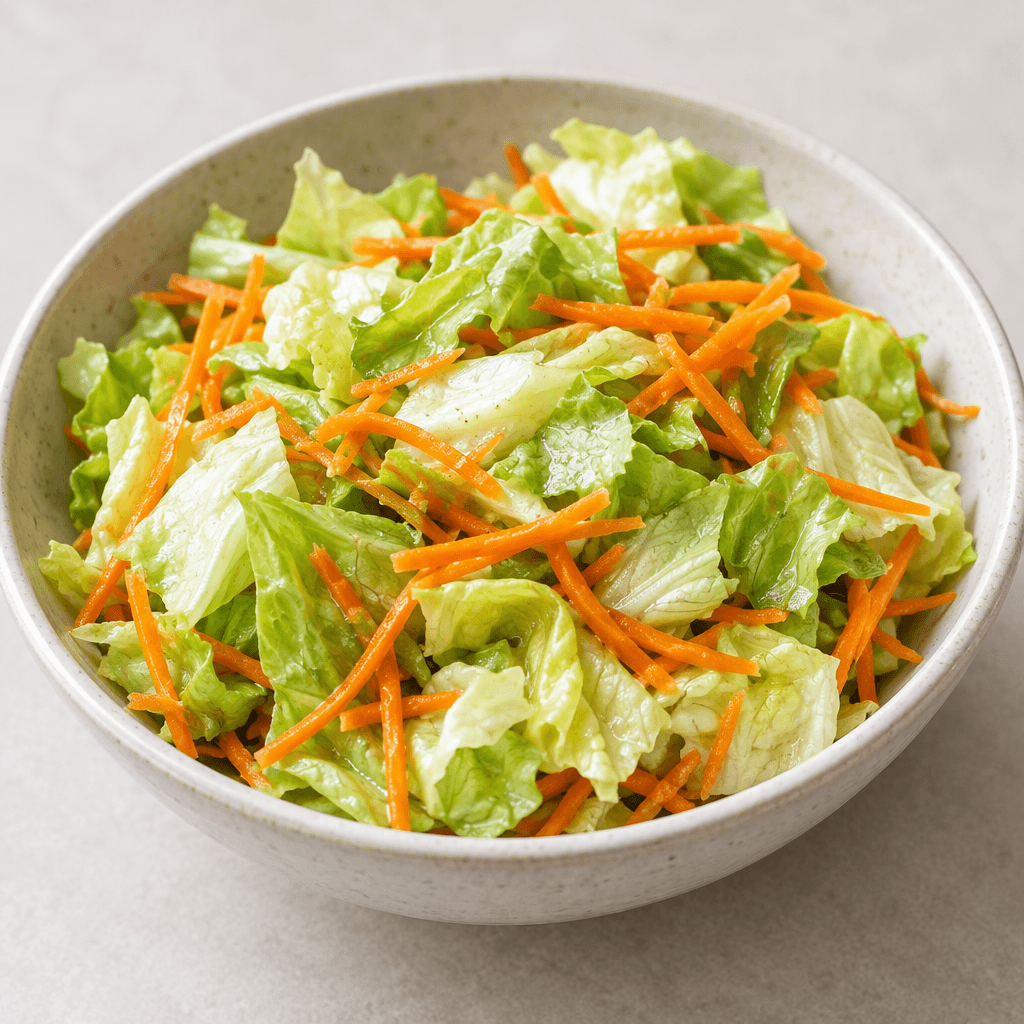
Carrot Lettuce Salad Calories
Fresh, low-calorie, high fiber, rich in vitamins
In season: Spring · Summer · Autumn · Winter
CALORIES
GI
POTASSIUM
FIBER
Quick answer
1 cup (medium) of Carrot Lettuce Salad (70 g) has 20 calories. That works out to 28 calories per 100 g. It contains 3.7 g of carbs, 0.8 g of protein, 0.1 g of fat and 1.5 g of fiber. Its 584.5 µg of Vitamin A covers 65% of the Daily Value. Its glycemic index is 25 (low), so it raises blood sugar slowly.
What is Carrot Lettuce Salad?
Carrot Lettuce Salad brings together crisp lettuce leaves and thin strips of fresh carrot. It is a simple everyday salad rather than a dish tied to one particular region, and can be put together with ingredients commonly found in home kitchens.
The lettuce tastes cool and mild, while the carrot adds a gentle sweetness and extra crunch. Serve it as a side with lunch or dinner, or add it to a sandwich or grain bowl; a squeeze of lemon and a little olive oil make a straightforward dressing. Naturally light and a source of fibre, it works well alongside richer dishes. For a more substantial meal, top it with chickpeas or another favourite protein.
Carrot Lettuce Salad Nutrition Facts
Selected: 100 g
28
KCAL / 100G
Carbs
5.3g
· 2% DV
Protein
1.1g
· 2% DV
Fat
0.2g
· 0% DV
Fiber
2.1g
· 8% DV
DV is the share of the daily value covered, on a 2,000 kcal reference diet.
Calories come from: Carbs 77% · Protein 16% · Fat 7%
Carrot Lettuce Salad Vitamins & Minerals
Vitamins
Vitamin A
835µg · 93% DV
Vitamin K
70µg · 58% DV
Vitamin C
10.5mg · 12% DV
Folate
38µg · 10% DV
Minerals
Potassium ⭐
245mg · 7% DV
Iron
1mg · 6% DV
Calcium
38mg · 4% DV
Phosphorus
28mg · 4% DV
How Nutritious Is Carrot Lettuce Salad?
Nutrient density
Very high
How many vitamins, minerals and how much fiber this food carries per calorie. A high score means a lot of nutrition for few calories.
Satiety score
Medium
An EatBetter score computed from fiber, protein and calorie density. A high score means staying full longer on the same calories.
Both scores are calculated per 100 g and do not change with the selected portion. The satiety score is EatBetter's own calculation, not a clinical measure.
Carrot Lettuce Salad Glycemic Index
GLYCEMIC INDEX
GLYCEMIC LOAD
Accounts for portion size — a more realistic measure than GI alone.
How to Burn Off Carrot Lettuce Salad
To burn the 28 calories in 100 g:
🚶
Walking (5 km/h)
🏃
Running (8 km/h)
🚴
Cycling
🏊
Swimming
Times are calculated with the MET equation for a 70 kg adult. Actual burn varies with your weight, age and pace.
Is Carrot Lettuce Salad Processed?
NOVA 1
Unprocessed
1. Unprocessed
2. Minimally Processed
3. Processed
4. Ultra-Processed
NOVA classifies foods into 4 groups by industrial processing. NOVA 1 (unprocessed) is the healthiest.
Does Carrot Lettuce Salad Contain Allergens?
No known major allergens
Which Diets Is Carrot Lettuce Salad Good For?
Vegan
✓ Suitable
Vegetarian
✓ Suitable
Gluten-Free
✓ Suitable
Dairy-Free
— Not suitable
Mediterranean
✓ Suitable
Paleo
✓ Suitable
Whole30
— Not suitable
DASH
— Not suitable
Keto
— Not suitable
Low FODMAP
— Not suitable
Carrot Lettuce Salad Fat Profile
SATURATED
0.04g
MONOUNSATURATED
0.02g
POLYUNSATURATED
0.04g
Omega 6:3 ratio 2:1
Below the ideal 4:1 — a good omega balance.
Compare Carrot Lettuce Salad
Foods Similar to Carrot Lettuce Salad
Frequently Asked Questions About Carrot Lettuce Salad
How do you make Carrot Lettuce Salad?
To make Carrot Lettuce Salad, wash and thoroughly dry the lettuce, then tear it into bite-sized pieces. Add grated or finely julienned carrot, toss with a simple lemon-and-olive-oil dressing, and serve straight away for the crispest texture.
Can you cook the carrots for Carrot Lettuce Salad?
You can, but raw carrot is the usual choice for Carrot Lettuce Salad because it adds crunch and contrasts with the soft leaves. If you prefer cooked carrot, let it cool completely before adding it so it does not wilt the lettuce.
What dressing goes well with Carrot Lettuce Salad?
A light vinaigrette works well with Carrot Lettuce Salad: combine lemon juice or vinegar with olive oil, salt, and black pepper. A creamy yogurt dressing is another option, but add either dressing just before serving to keep the leaves crisp.
How do you stop Carrot Lettuce Salad from getting soggy?
Keep Carrot Lettuce Salad dry and leave the dressing off until serving. Dry the washed leaves thoroughly, store the carrot and lettuce in a covered container, and avoid adding watery vegetables until you are ready to eat.
Can you make Carrot Lettuce Salad the night before?
Yes, you can prepare the components for Carrot Lettuce Salad the night before, but store them separately and keep the dressing in its own container. Combine everything shortly before serving; dressed lettuce left overnight will usually soften.
Which type of lettuce is best in Carrot Lettuce Salad?
Crisp romaine or iceberg holds up well in Carrot Lettuce Salad, while softer leaf lettuce gives it a more delicate texture. Choose fresh leaves without slimy patches, and dry them well after washing regardless of the variety.
What can you serve with Carrot Lettuce Salad?
Carrot Lettuce Salad pairs well with grilled chicken, fish, beans, or a sandwich, where its fresh crunch balances richer foods. To turn it into a more filling lunch, add a protein such as chickpeas, egg, or tofu.
Is Carrot Lettuce Salad a good choice for weight loss?
Carrot Lettuce Salad can fit a weight-loss meal because its vegetables add volume and crunch without a heavy base. Keep creamy toppings and large pours of oil in check, and pair it with a protein source if you want a more satisfying meal.
How long do Carrot Lettuce Salad leftovers last?
Undressed Carrot Lettuce Salad is best eaten within a day or two when kept covered in the refrigerator. Once dressed, it tends to lose its crunch much sooner, so refrigerate leftovers promptly and discard them if they look or smell spoiled.
Why does Carrot Lettuce Salad turn limp after mixing?
Carrot Lettuce Salad turns limp when moisture and salt draw water from the leaves, or when dressing sits on them for too long. Dry the lettuce well, add salt and dressing at the last moment, and serve the salad promptly.
Have another question about Carrot Lettuce Salad?
Ask the AI nutrition coach — calories, portions, alternatives and more, answered in seconds in the app.

Scan calories with your camera
Instant AI nutrition analysis

Nutrition data compiled from USDA FoodData Central and scientific sources.