

Ready & Packaged Foods
All →Vegetables & Legumes
All →Desserts & Confectionery
All →Meat & Protein
All →Grains & Bakery
All →Beverages
All →Milk & Dairy
All →

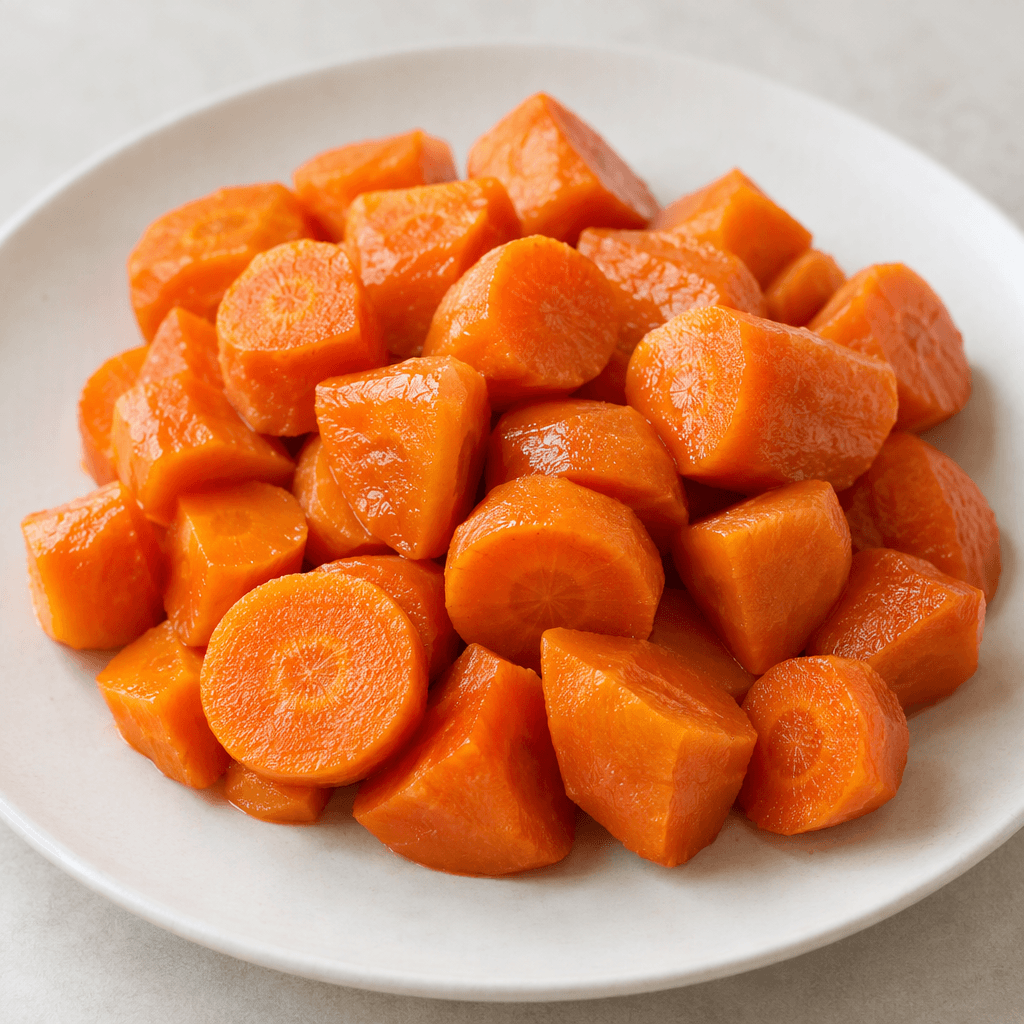
Carrot (Cooked) Calories
Beta-carotene, fiber, low calorie, cooked vegetable
In season: Spring · Summer · Autumn · Winter
CALORIES
GI
POTASSIUM
FIBER
Quick answer
1 cup (medium) of Carrot (Cooked) (130 g) has 46 calories. That works out to 35 calories per 100 g. It contains 10.7 g of carbs, 1 g of protein, 0.3 g of fat and 3.6 g of fiber. Its 1107.6 µg of Vitamin A covers 123% of the Daily Value. Its glycemic index is 39 (low), so it raises blood sugar slowly.
What is Carrot (Cooked)?
Cooked carrot is the familiar orange root vegetable softened by boiling, steaming or cooking it as part of another dish. Heat brings out its gentle sweetness, while the texture can range from tender with a little bite to quite soft. It is served as a side, stirred into soups and stews, or added to salads and vegetable dishes. In many kitchens, it also appears mashed or alongside a roast; a little lemon or fresh herb can brighten its flavour.
Carrot is a low-calorie source of fibre and beta-carotene, with 2.8 g of fibre per 100 g. Steam it for a tender texture without adding much fat, or pair it with beans, grains or a main dish for a more substantial plate.
Carrot (Cooked) Nutrition Facts
Selected: 100 g
35
KCAL / 100G
Carbs
8.2g
· 3% DV
Protein
0.8g
· 2% DV
Fat
0.2g
· 0% DV
Fiber
2.8g
· 10% DV
DV is the share of the daily value covered, on a 2,000 kcal reference diet.
Calories come from: Carbs 87% · Protein 8% · Fat 5%
Carrot (Cooked) Vitamins & Minerals
Vitamins
Vitamin A
852µg · 95% DV
Vitamin K
13.7µg · 11% DV
B6
0.13mg · 8% DV
B5
0.3mg · 6% DV
Minerals
Potassium ⭐
235mg · 7% DV
Phosphorus
30mg · 4% DV
Calcium
32mg · 3% DV
Magnesium
12mg · 3% DV
How Nutritious Is Carrot (Cooked)?
Nutrient density
High
How many vitamins, minerals and how much fiber this food carries per calorie. A high score means a lot of nutrition for few calories.
Satiety score
Medium
An EatBetter score computed from fiber, protein and calorie density. A high score means staying full longer on the same calories.
Both scores are calculated per 100 g and do not change with the selected portion. The satiety score is EatBetter's own calculation, not a clinical measure.
Carrot (Cooked) Glycemic Index
GLYCEMIC INDEX
GLYCEMIC LOAD
Accounts for portion size — a more realistic measure than GI alone.
How to Burn Off Carrot (Cooked)
To burn the 35 calories in 100 g:
🚶
Walking (5 km/h)
🏃
Running (8 km/h)
🚴
Cycling
🏊
Swimming
Times are calculated with the MET equation for a 70 kg adult. Actual burn varies with your weight, age and pace.
Is Carrot (Cooked) Processed?
NOVA 2
Minimally Processed
1. Unprocessed
2. Minimally Processed
3. Processed
4. Ultra-Processed
NOVA classifies foods into 4 groups by industrial processing. NOVA 1 (unprocessed) is the healthiest.
Does Carrot (Cooked) Contain Allergens?
No known major allergens
Which Diets Is Carrot (Cooked) Good For?
Vegan
✓ Suitable
Vegetarian
✓ Suitable
Gluten-Free
✓ Suitable
Dairy-Free
— Not suitable
Mediterranean
✓ Suitable
Paleo
✓ Suitable
Whole30
— Not suitable
DASH
— Not suitable
Keto
— Not suitable
Low FODMAP
— Not suitable
Carrot (Cooked) Fat Profile
SATURATED
0.04g
MONOUNSATURATED
0.01g
POLYUNSATURATED
0.04g
Omega 6:3 ratio 2:1
Below the ideal 4:1 — a good omega balance.
Compare Carrot (Cooked)
Foods Similar to Carrot (Cooked)
Frequently Asked Questions About Carrot (Cooked)
Are cooked carrots healthier than raw carrots?
Neither is automatically healthier: cooking softens carrots and makes their beta-carotene easier for the body to access, while raw carrots retain a crisp texture and avoid heat-related nutrient losses. Including both is a practical choice.
How do you cook carrots without making them mushy?
Cut the carrots into similar-sized pieces and cook them just until a fork can pierce them easily. Steaming or roasting helps them keep their shape; check often near the end rather than leaving them in boiling water.
Do cooked carrots lose nutrients?
Some nutrients, especially water-soluble vitamins, can decrease during cooking, but cooked carrots still provide fiber and beta-carotene. Use a short cooking time and little water, or serve the cooking liquid in a soup.
Do you need to peel carrots before cooking them?
No, peeling carrots before cooking is optional. Scrub them thoroughly under running water and trim any damaged spots; leave the skin on if you like its texture, or peel for a smoother result.
Does cooking carrots help your body absorb beta-carotene?
Yes, heating softens carrot cell walls and can make beta-carotene more accessible. Eating cooked carrots with a little fat, such as olive oil, also helps the body absorb this fat-soluble compound.
Can you freeze cooked carrots?
Yes, cooked carrots freeze well, though they may be softer after thawing. Let them cool, seal them in a freezer-safe container, and use the thawed carrots in soups, stews, or other dishes where a tender texture works.
How long do cooked carrots last in the fridge?
Keep cooked carrots covered in the refrigerator and eat them within a few days. Refrigerate them promptly rather than leaving them out, and discard them if they develop mold, an unusual smell, or a slimy surface.
Can dogs eat cooked carrots?
Yes, plain cooked carrots are generally safe for dogs in small pieces. Serve them without salt, butter, or seasoning, and let them cool first; avoid large chunks that could be a choking hazard.
Are cooked carrots good for people with diabetes?
Cooked carrots can fit into a diabetes-friendly meal; pair a sensible portion with protein and other foods rather than treating them as a meal on their own. Individual glucose responses vary, so follow your care team's guidance.
Can cooked carrots relieve constipation?
Cooked carrots provide fiber, which can support regular bowel movements, but they are not a stand-alone treatment for constipation. Drink enough fluids and include a variety of fiber-rich foods in your meals.
Have another question about Carrot (Cooked)?
Ask the AI nutrition coach — calories, portions, alternatives and more, answered in seconds in the app.

Scan calories with your camera
Instant AI nutrition analysis

Nutrition data compiled from USDA FoodData Central and scientific sources.