

Ready & Packaged Foods
All →Vegetables & Legumes
All →Desserts & Confectionery
All →Meat & Protein
All →Grains & Bakery
All →Beverages
All →Milk & Dairy
All →

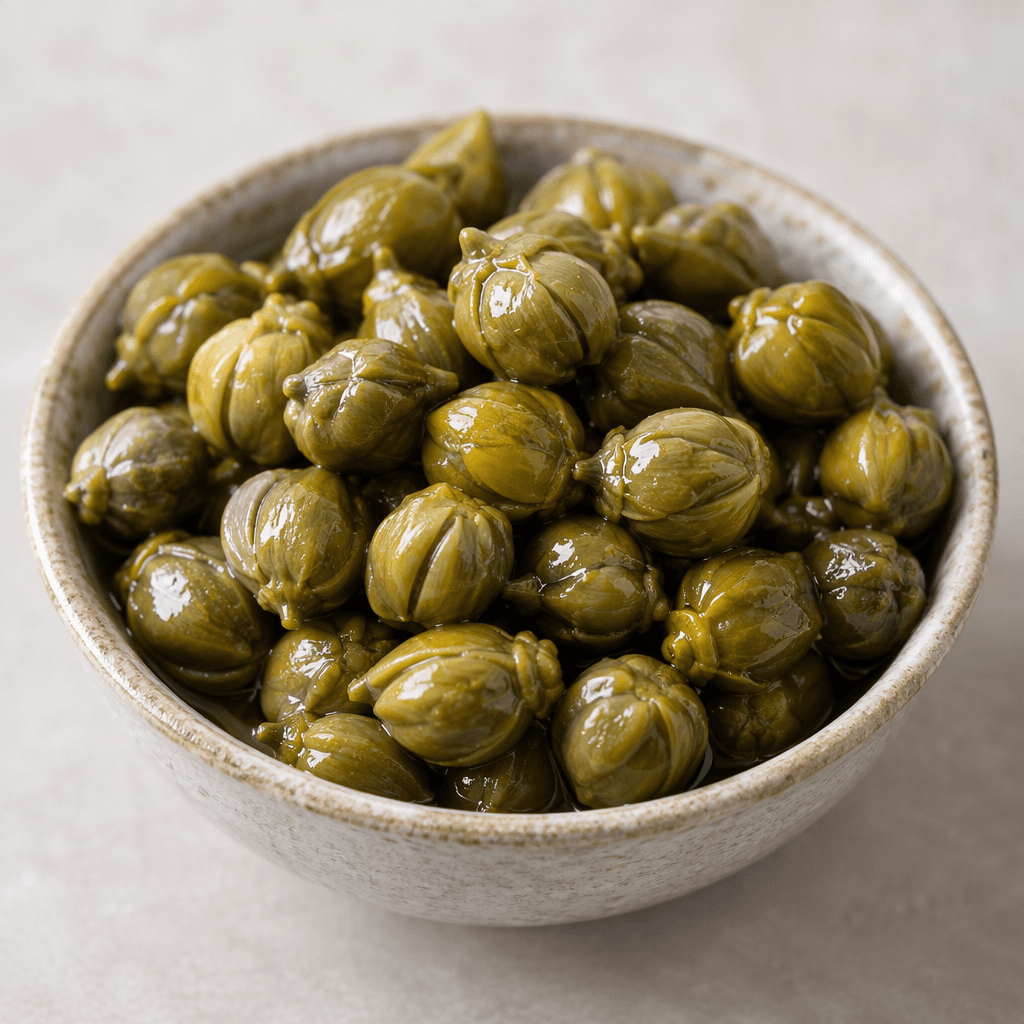
Pickled capers Calories
Tangy, salty, adds flavor to salads and dishes
In season: Spring · Summer
CALORIES
GI
POTASSIUM
FIBER
Quick answer
1 tablespoon (medium) of Pickled capers (8 g) has 2 calories. That works out to 23 calories per 100 g. It contains 0.4 g of carbs, 0.2 g of protein, 0.1 g of fat and 0.3 g of fiber. Its 236.8 mg of Sodium covers 10% of the Daily Value. Its glycemic index is 15 (low), so it raises blood sugar slowly.
What is Pickled capers?
Pickled capers are the unopened flower buds of the caper bush, preserved in brine or vinegar. They have a long history in Mediterranean cooking and are now used widely in salads, sauces and other savoury dishes.
Their sharp, tangy, salty flavour and pleasantly firm bite mean a small spoonful can bring a dish into focus. Try them with fish, pasta, roasted vegetables or in a vinaigrette; rinsing them briefly can soften their briny edge. They add flavour without much energy—100 g contains 23 calories—so they work well when you want a bold accent rather than a substantial ingredient. Taste before adding extra salt to the dish.
Pickled capers Nutrition Facts
Selected: 100 g
23
KCAL / 100G
Carbs
4.9g
· 2% DV
Protein
2.4g
· 5% DV
Fat
0.9g
· 1% DV
Fiber
3.2g
· 11% DV
DV is the share of the daily value covered, on a 2,000 kcal reference diet.
Calories come from: Carbs 53% · Protein 26% · Fat 21%
Pickled capers Vitamins & Minerals
Vitamins
Vitamin K
24.6µg · 21% DV
Vitamin A
138µg · 15% DV
B2
0.14mg · 11% DV
Folate
23µg · 6% DV
Minerals
Sodium
2960mg · 129% DV
Iron
2mg · 11% DV
Magnesium
38mg · 9% DV
Calcium
40mg · 4% DV
How Nutritious Is Pickled capers?
Nutrient density
Medium
How many vitamins, minerals and how much fiber this food carries per calorie. A high score means a lot of nutrition for few calories.
Satiety score
Medium
An EatBetter score computed from fiber, protein and calorie density. A high score means staying full longer on the same calories.
Both scores are calculated per 100 g and do not change with the selected portion. The satiety score is EatBetter's own calculation, not a clinical measure.
Pickled capers Glycemic Index
GLYCEMIC INDEX
GLYCEMIC LOAD
Accounts for portion size — a more realistic measure than GI alone.
How to Burn Off Pickled capers
To burn the 23 calories in 100 g:
🚶
Walking (5 km/h)
🏃
Running (8 km/h)
🚴
Cycling
🏊
Swimming
Times are calculated with the MET equation for a 70 kg adult. Actual burn varies with your weight, age and pace.
Is Pickled capers Processed?
NOVA 3
Processed
1. Unprocessed
2. Minimally Processed
3. Processed
4. Ultra-Processed
NOVA classifies foods into 4 groups by industrial processing. NOVA 1 (unprocessed) is the healthiest.
Does Pickled capers Contain Allergens?
No known major allergens
Which Diets Is Pickled capers Good For?
Vegan
✓ Suitable
Vegetarian
✓ Suitable
Gluten-Free
✓ Suitable
Dairy-Free
— Not suitable
Mediterranean
✓ Suitable
Paleo
— Not suitable
Whole30
— Not suitable
DASH
— Not suitable
Keto
✓ Suitable
Low FODMAP
— Not suitable
Pickled capers Fat Profile
SATURATED
0.22g
MONOUNSATURATED
0.18g
POLYUNSATURATED
0.25g
Omega 6:3 ratio 2:1
Below the ideal 4:1 — a good omega balance.
Compare Pickled capers
Foods Similar to Pickled capers
Frequently Asked Questions About Pickled capers
What are pickled capers?
Pickled capers are unopened flower buds from the caper plant preserved in brine or vinegar. They are not olives, although their small size and green appearance can make them look similar.
What do pickled capers taste like?
Pickled capers taste tangy, salty, and sharply savory. Their flavor is concentrated, so a small amount can stand out in a dish; taste the food before adding extra salt.
How do you use pickled capers?
Use pickled capers straight from the jar or chop them into sauces, salads, pasta, and fish dishes. Add a modest amount first, since their briny, tangy flavor can quickly dominate a mild dish.
Are pickled capers olives?
No, pickled capers are not olives. Capers are preserved flower buds, while olives are fruits from the olive tree. Their similar size and brined preparation are the main reasons people confuse them.
Should you rinse pickled capers before using them?
No, rinsing pickled capers is not necessary, but a quick rinse in cold water can soften their salty, vinegary taste. Drain them well afterward, especially when adding them to a delicate sauce or salad.
What is the difference between capers and caper berries?
Capers are the small unopened flower buds, while caper berries are the larger fruits that develop after flowering. Pickled capers are usually tiny and firm; caper berries are often served whole with their stems.
How long do pickled capers last after opening?
Keep opened pickled capers refrigerated in their brine with the lid tightly closed. Use a clean utensil and keep the buds submerged; discard them if you notice mold, an unusual smell, or a changed appearance.
What can you use instead of pickled capers?
Chopped green olives are a practical substitute for pickled capers when you want a salty, savory bite. They are less sharply tangy, so add a little lemon juice or vinegar if the recipe needs more acidity.
Do pickled capers need to be cooked?
No, pickled capers are ready to eat and do not need cooking. Add them to cold salads or sandwiches as they are, or stir them into hot dishes near the end so their distinctive flavor stays noticeable.
Can you eat pickled capers straight from the jar?
Yes, pickled capers can be eaten straight from the jar after draining them. Their brine makes them intensely salty and tangy, so they are commonly used as a small accent rather than eaten in large handfuls.
Have another question about Pickled capers?
Ask the AI nutrition coach — calories, portions, alternatives and more, answered in seconds in the app.

Scan calories with your camera
Instant AI nutrition analysis

Nutrition data compiled from USDA FoodData Central and scientific sources.