

Ready & Packaged Foods
All →Vegetables & Legumes
All →Desserts & Confectionery
All →Meat & Protein
All →Grains & Bakery
All →Beverages
All →Milk & Dairy
All →

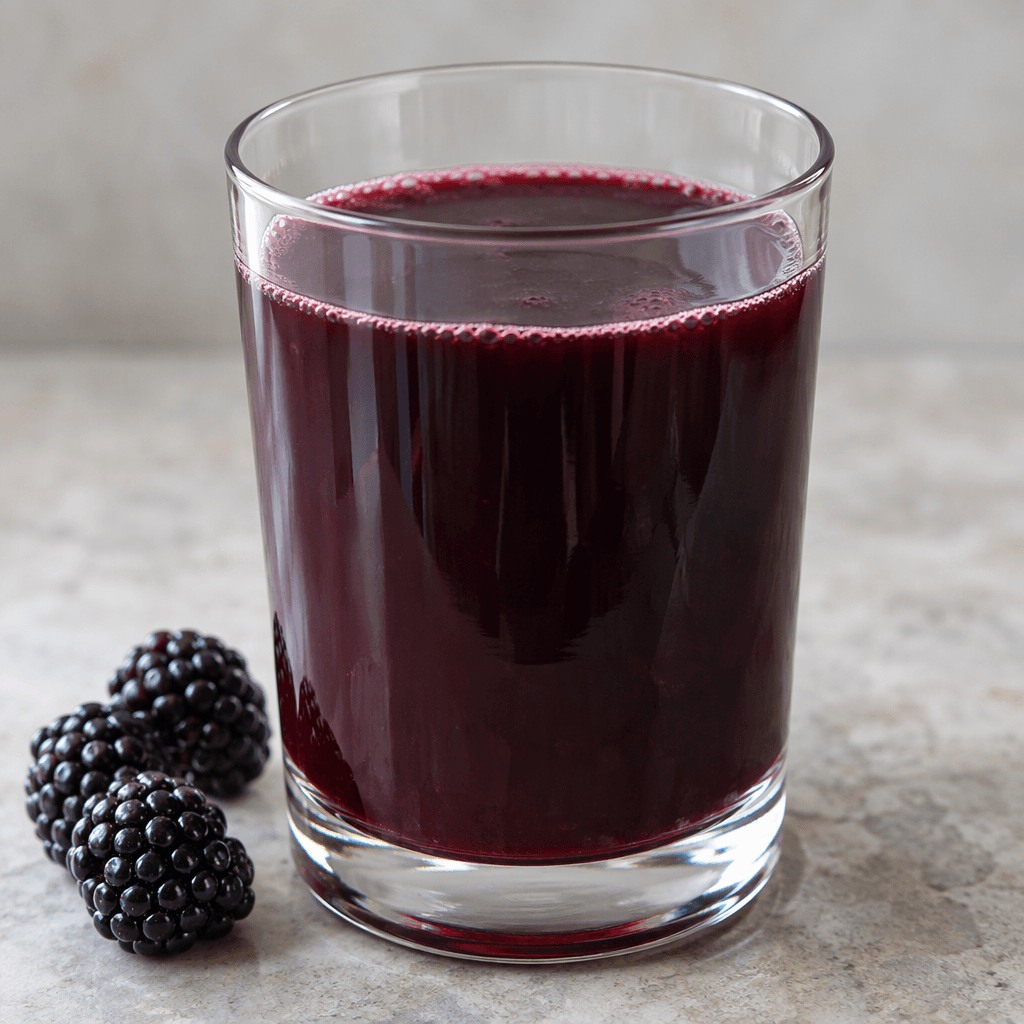
Blackberry juice (unsweetened) Calories
Antioxidant, vitamin C, low calorie, unsweetened
In season: Summer · Autumn
CALORIES
GI
POTASSIUM
FIBER
Quick answer
1 cup (medium) of Blackberry juice (unsweetened) (200 g) has 70 calories. That works out to 35 calories per 100 g. It contains 16.4 g of carbs, 0.8 g of protein, 0.4 g of fat and 3 g of fiber. Its 36 mg of Vitamin C covers 40% of the Daily Value. Its glycemic index is 40 (low), so it raises blood sugar slowly.
What is Blackberry juice (unsweetened)?
Unsweetened blackberry juice is made by crushing or pressing ripe blackberries, sometimes with water added to make a lighter drink. With no added sugar, its flavour comes from the fruit: berry-rich, tart and gently sweet, with a deep colour. Depending on how it is prepared, it may be clear or retain some pulp.
Serve it chilled at breakfast or as a refreshing drink between meals; in places where blackberries are gathered or grown, it is also a familiar way to preserve their seasonal flavour. It has a relatively light energy content—about 35 calories per 100 g—and retains some of the fruit’s fibre when pulp is left in. Dilute it with sparkling or still water for an easy, less intense drink, or pair it with plain yoghurt.
Blackberry juice (unsweetened) Nutrition Facts
Selected: 100 g
35
KCAL / 100G
Carbs
8.2g
· 3% DV
Protein
0.4g
· 1% DV
Fat
0.2g
· 0% DV
Fiber
1.5g
· 5% DV
DV is the share of the daily value covered, on a 2,000 kcal reference diet.
Calories come from: Carbs 91% · Protein 4% · Fat 5%
Blackberry juice (unsweetened) Vitamins & Minerals
Vitamins
Vitamin C
18mg · 20% DV
Vitamin K
12µg · 10% DV
Folate
18µg · 5% DV
Vitamin E
0.7mg · 5% DV
Minerals
Iron
1mg · 6% DV
Potassium ⭐
120mg · 4% DV
Magnesium
13mg · 3% DV
Calcium
18mg · 2% DV
How Nutritious Is Blackberry juice (unsweetened)?
Nutrient density
High
How many vitamins, minerals and how much fiber this food carries per calorie. A high score means a lot of nutrition for few calories.
Satiety score
Medium
An EatBetter score computed from fiber, protein and calorie density. A high score means staying full longer on the same calories.
Both scores are calculated per 100 g and do not change with the selected portion. The satiety score is EatBetter's own calculation, not a clinical measure.
Blackberry juice (unsweetened) Glycemic Index
GLYCEMIC INDEX
GLYCEMIC LOAD
Accounts for portion size — a more realistic measure than GI alone.
How to Burn Off Blackberry juice (unsweetened)
To burn the 35 calories in 100 g:
🚶
Walking (5 km/h)
🏃
Running (8 km/h)
🚴
Cycling
🏊
Swimming
Times are calculated with the MET equation for a 70 kg adult. Actual burn varies with your weight, age and pace.
Is Blackberry juice (unsweetened) Processed?
NOVA 2
Minimally Processed
1. Unprocessed
2. Minimally Processed
3. Processed
4. Ultra-Processed
NOVA classifies foods into 4 groups by industrial processing. NOVA 1 (unprocessed) is the healthiest.
Does Blackberry juice (unsweetened) Contain Allergens?
No known major allergens
Which Diets Is Blackberry juice (unsweetened) Good For?
Vegan
✓ Suitable
Vegetarian
✓ Suitable
Gluten-Free
✓ Suitable
Dairy-Free
— Not suitable
Mediterranean
✓ Suitable
Paleo
✓ Suitable
Whole30
— Not suitable
DASH
— Not suitable
Keto
— Not suitable
Low FODMAP
— Not suitable
Blackberry juice (unsweetened) Fat Profile
SATURATED
0.01g
MONOUNSATURATED
0.03g
POLYUNSATURATED
0.09g
Omega 6:3 ratio 2.3:1
Below the ideal 4:1 — a good omega balance.
Compare Blackberry juice (unsweetened)
Foods Similar to Blackberry juice (unsweetened)
Frequently Asked Questions About Blackberry juice (unsweetened)
Is unsweetened blackberry juice good for you?
Yes, unsweetened blackberry juice can contribute vitamin C and antioxidant plant compounds. It is still juice rather than whole fruit, so it usually provides less fiber and may be less filling than eating blackberries.
Does unsweetened blackberry juice still contain sugar?
Yes, it can contain naturally occurring sugars from the blackberries even when no sugar is added. “Unsweetened” means there is no added sweetener; it does not mean the drink is sugar-free.
How do you make unsweetened blackberry juice at home?
Blend ripe blackberries with a little water, then strain the mixture if you want a smoother drink. For a cooked version, gently heat the berries until soft, mash them, and strain; skip sugar to keep it unsweetened.
How can you get the seeds out of unsweetened blackberry juice?
Pass unsweetened blackberry juice through a fine-mesh sieve or a clean nut-milk bag to remove most seeds and pulp. Avoid pressing the solids too hard if you want a clearer, less astringent-tasting juice.
How long does unsweetened blackberry juice last after opening?
Keep opened unsweetened blackberry juice tightly covered in the refrigerator and use it within a few days, especially if it is homemade. Discard it if its smell, appearance, or taste changes.
Can you freeze unsweetened blackberry juice?
Yes, unsweetened blackberry juice freezes well. Leave room for expansion in a freezer-safe container, or freeze it in small portions; thaw it in the refrigerator and stir before serving if it separates.
What is the difference between unsweetened blackberry juice and blackberry cordial?
Unsweetened blackberry juice is the juice of the fruit without added sugar. Blackberry cordial is generally a sweetened concentrate or syrup meant to be diluted, so it is not a direct substitute if you want to avoid added sugar.
Why does unsweetened blackberry juice taste tart?
Unsweetened blackberry juice tastes tart because blackberries have natural fruit acids, and the drink has no added sugar to soften that flavor. Riper berries generally taste less sharp than under-ripe ones.
Can you use unsweetened blackberry juice in cocktails or smoothies?
Yes, unsweetened blackberry juice works in cocktails, mocktails, and smoothies. Its tart berry flavor pairs well with citrus, sparkling water, or yogurt; add it gradually so it does not overpower milder ingredients.
Can babies drink unsweetened blackberry juice?
Babies under 12 months should not be given fruit juice, including unsweetened blackberry juice. For older children, whole blackberries are usually a more filling option; serve them in an age-appropriate form to reduce choking risk.
Have another question about Blackberry juice (unsweetened)?
Ask the AI nutrition coach — calories, portions, alternatives and more, answered in seconds in the app.

Scan calories with your camera
Instant AI nutrition analysis

Nutrition data compiled from USDA FoodData Central and scientific sources.