

Ready & Packaged Foods
All →Vegetables & Legumes
All →Desserts & Confectionery
All →Meat & Protein
All →Grains & Bakery
All →Beverages
All →Milk & Dairy
All →

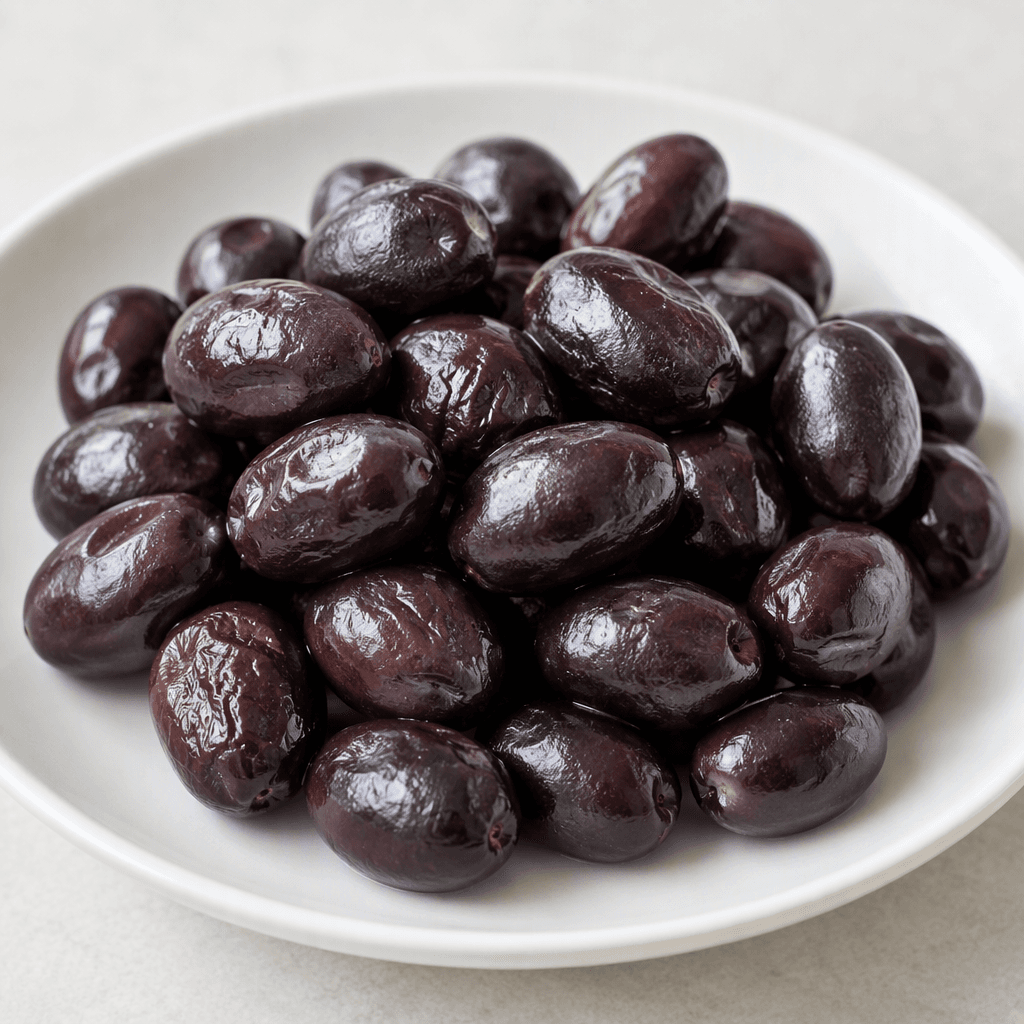
Black olive (small) Calories
Small black olives, source of healthy fats and antioxidants.
In season: Autumn · Winter
CALORIES
GI
POTASSIUM
FIBER
Quick answer
10 piece (small) of Black olive (small) (30 g) has 35 calories. That works out to 115 calories per 100 g. It contains 1.9 g of carbs, 0.2 g of protein, 3.2 g of fat and 1 g of fiber. Its 220.5 mg of Sodium covers 10% of the Daily Value. Its glycemic index is 15 (low), so it raises blood sugar slowly.
What is Black olive (small)?
Small black olives are ripe olives, a staple of Mediterranean food cultures, cured in brine or otherwise treated to develop their characteristic savoury flavour. They are usually eaten whole, with a firm, fleshy bite, a little bitterness and a salty finish.
Across the Mediterranean they appear on breakfast and meze tables, and in salads, sandwiches and cooked dishes; elsewhere, they are an easy addition to antipasti boards and everyday meals. They are mostly a source of fat, with some fibre, so a few can add flavour and richness without needing much else. If they taste too salty, rinse them briefly before serving.
Black olive (small) Nutrition Facts
Selected: 100 g
115
KCAL / 100G
Carbs
6.3g
· 2% DV
Protein
0.8g
· 2% DV
Fat
10.7g
· 14% DV
Fiber
3.2g
· 11% DV
DV is the share of the daily value covered, on a 2,000 kcal reference diet.
Calories come from: Carbs 20% · Protein 3% · Fat 77%
Black olive (small) Vitamins & Minerals
Vitamins
Vitamin E
1.7mg · 11% DV
B5
0.3mg · 6% DV
Biotin
0.8µg · 3% DV
Vitamin A
20µg · 2% DV
Minerals
Sodium
735mg · 32% DV
Iron
3mg · 17% DV
Calcium
88mg · 9% DV
Magnesium
20mg · 5% DV
How Nutritious Is Black olive (small)?
Nutrient density
High
How many vitamins, minerals and how much fiber this food carries per calorie. A high score means a lot of nutrition for few calories.
Satiety score
Medium
An EatBetter score computed from fiber, protein and calorie density. A high score means staying full longer on the same calories.
Both scores are calculated per 100 g and do not change with the selected portion. The satiety score is EatBetter's own calculation, not a clinical measure.
Black olive (small) Glycemic Index
GLYCEMIC INDEX
GLYCEMIC LOAD
Accounts for portion size — a more realistic measure than GI alone.
How to Burn Off Black olive (small)
To burn the 115 calories in 100 g:
🚶
Walking (5 km/h)
🏃
Running (8 km/h)
🚴
Cycling
🏊
Swimming
Times are calculated with the MET equation for a 70 kg adult. Actual burn varies with your weight, age and pace.
Is Black olive (small) Processed?
NOVA 2
Minimally Processed
1. Unprocessed
2. Minimally Processed
3. Processed
4. Ultra-Processed
NOVA classifies foods into 4 groups by industrial processing. NOVA 1 (unprocessed) is the healthiest.
Does Black olive (small) Contain Allergens?
No known major allergens
Which Diets Is Black olive (small) Good For?
Vegan
✓ Suitable
Vegetarian
✓ Suitable
Gluten-Free
✓ Suitable
Dairy-Free
— Not suitable
Mediterranean
✓ Suitable
Paleo
— Not suitable
Whole30
— Not suitable
DASH
— Not suitable
Keto
✓ Suitable
Low FODMAP
— Not suitable
Black olive (small) Fat Profile
SATURATED
1.4g
MONOUNSATURATED
7.7g
POLYUNSATURATED
0.8g
Omega 6:3 ratio 23.3:1
Above the ideal 4:1 (23.3:1).
Compare Black olive (small)
Foods Similar to Black olive (small)
Frequently Asked Questions About Black olive (small)
Are small black olives healthy?
Yes, small black olives can fit into a balanced diet and provide mostly unsaturated fats. Brined olives can also be high in sodium, so people limiting salt should keep portions modest and compare preparation styles.
How are small black olives made?
Small black olives are cured to reduce the strong bitterness of freshly picked fruit. Producers may use brine, dry salt, or other curing methods; the process affects how wrinkled, firm, and salty the olives taste.
Are small black olives naturally black?
Some small black olives darken as they ripen, while others are darkened during processing. The color alone does not tell you which method was used, so the product description or ingredient information is the best clue.
What is the difference between small black olives and green olives?
Small black olives are generally picked later, when the fruit is riper, whereas green olives are harvested earlier. Curing methods also shape their color, bitterness, and texture, so color does not guarantee one particular flavor.
Do small black olives need to be refrigerated after opening?
Yes, refrigerate small black olives after opening, especially if they came in brine. Keep them in a clean, covered container and submerged in their liquid; use a clean utensil to avoid introducing contamination.
Can you eat small black olives straight from the jar?
Yes, small black olives sold as table olives are already cured and can usually be eaten straight from the jar. If they taste too salty, rinse them briefly or soak them in water before serving.
Can you eat small black olives raw?
Freshly picked small black olives are usually too bitter to eat as they are. Table olives are cured before sale to make them palatable, so “raw” olives from a tree are not the same as ready-to-eat olives.
Can small black olives be frozen?
Yes, you can freeze small black olives, but thawing may make them softer. Freeze them in meal-sized portions in an airtight container, then use the thawed olives in cooked dishes or eat them soon rather than refreezing.
Why are small black olives wrinkled?
Small black olives often wrinkle because curing draws moisture from the fruit, especially when dry salt is used. Wrinkles are a normal feature of some curing styles and do not by themselves mean the olives have spoiled.
How do you remove the pits from small black olives?
To pit small black olives, press each one gently with the flat side of a knife or use an olive pitter, then lift out the loosened pit. If the olives are very soft, cut them lengthwise and remove the pit carefully.
Have another question about Black olive (small)?
Ask the AI nutrition coach — calories, portions, alternatives and more, answered in seconds in the app.

Scan calories with your camera
Instant AI nutrition analysis

Nutrition data compiled from USDA FoodData Central and scientific sources.