

Ready & Packaged Foods
All →Vegetables & Legumes
All →Desserts & Confectionery
All →Meat & Protein
All →Grains & Bakery
All →Beverages
All →Milk & Dairy
All →

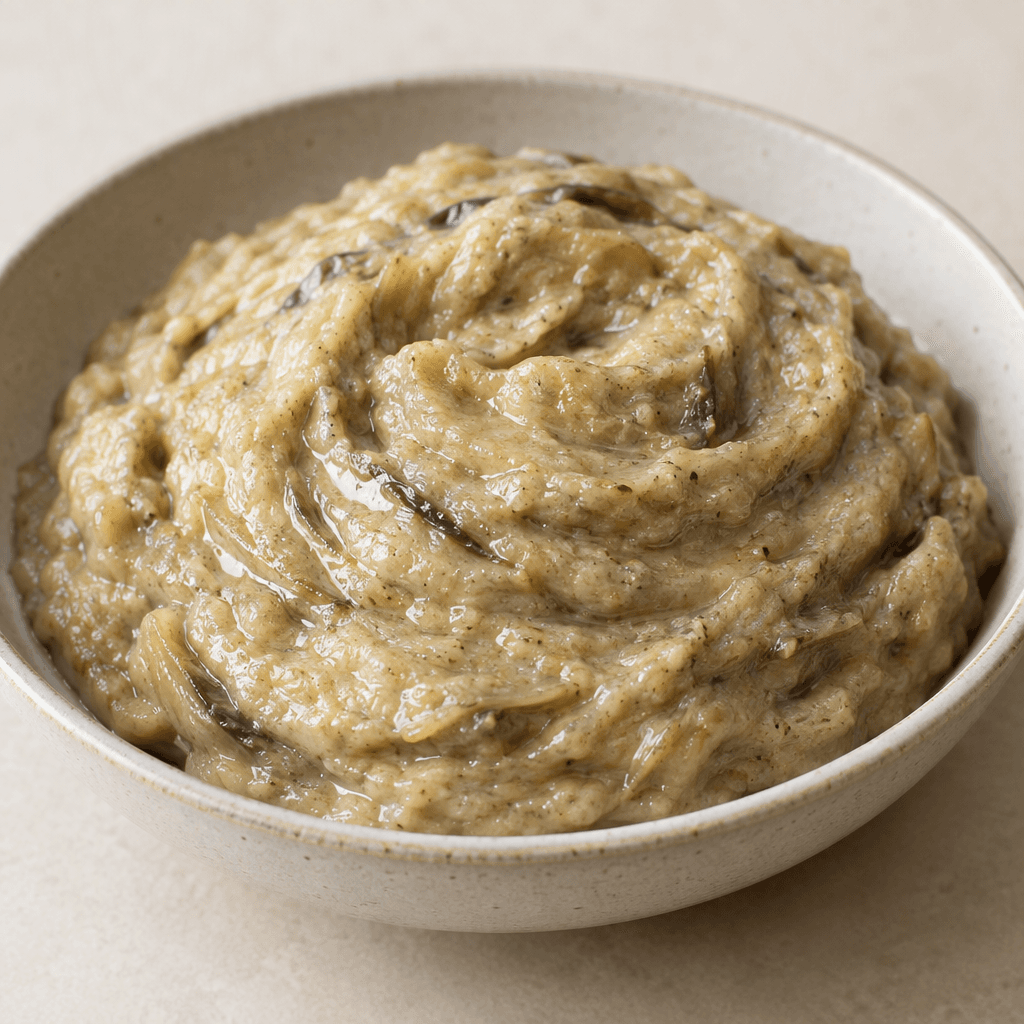
Begendi (Eggplant Purée) Calories
Classic Ottoman eggplant purée with milk, butter, and cheese.
In season: Summer · Autumn
CALORIES
GI
POTASSIUM
FIBER
Quick answer
1 serving (medium) of Begendi (Eggplant Purée) (120 g) has 144 calories. That works out to 120 calories per 100 g. It contains 10.2 g of carbs, 3.8 g of protein, 9.4 g of fat and 2.6 g of fiber. Its 0.1 mg of Copper covers 12% of the Daily Value. Its glycemic index is 35 (low), so it raises blood sugar slowly.
What is Begendi (Eggplant Purée)?
Begendi (eggplant purée) is a classic Ottoman dish made by cooking roasted eggplant with milk, butter and cheese. The eggplant’s smoky flavour is mellowed by the dairy, creating a smooth, thick purée with a soft, creamy texture.
In Turkey, it is most famously served as the base for Hünkâr Beğendi, topped with a meat stew, and it also makes a rich side for grilled meat or vegetables. Eggplant contributes fibre, while butter and cheese give the dish much of its richness. For a lighter plate, serve a smaller portion alongside grilled vegetables or a crisp salad.
Begendi (Eggplant Purée) Nutrition Facts
Selected: 100 g
120
KCAL / 100G
Carbs
8.5g
· 3% DV
Protein
3.2g
· 6% DV
Fat
7.8g
· 10% DV
Fiber
2.2g
· 8% DV
DV is the share of the daily value covered, on a 2,000 kcal reference diet.
Calories come from: Carbs 29% · Protein 11% · Fat 60%
Begendi (Eggplant Purée) Vitamins & Minerals
Vitamins
B2
0.09mg · 7% DV
B5
0.28mg · 6% DV
Vitamin A
45µg · 5% DV
B1
0.06mg · 5% DV
Minerals
Sodium
210mg · 9% DV
Phosphorus
62mg · 9% DV
Calcium
65mg · 7% DV
Iron
1mg · 6% DV
How Nutritious Is Begendi (Eggplant Purée)?
Nutrient density
Medium
How many vitamins, minerals and how much fiber this food carries per calorie. A high score means a lot of nutrition for few calories.
Satiety score
Medium
An EatBetter score computed from fiber, protein and calorie density. A high score means staying full longer on the same calories.
Both scores are calculated per 100 g and do not change with the selected portion. The satiety score is EatBetter's own calculation, not a clinical measure.
Begendi (Eggplant Purée) Glycemic Index
GLYCEMIC INDEX
GLYCEMIC LOAD
Accounts for portion size — a more realistic measure than GI alone.
How to Burn Off Begendi (Eggplant Purée)
To burn the 120 calories in 100 g:
🚶
Walking (5 km/h)
🏃
Running (8 km/h)
🚴
Cycling
🏊
Swimming
Times are calculated with the MET equation for a 70 kg adult. Actual burn varies with your weight, age and pace.
Is Begendi (Eggplant Purée) Processed?
NOVA 2
Minimally Processed
1. Unprocessed
2. Minimally Processed
3. Processed
4. Ultra-Processed
NOVA classifies foods into 4 groups by industrial processing. NOVA 1 (unprocessed) is the healthiest.
Does Begendi (Eggplant Purée) Contain Allergens?
Contains these allergens:
Which Diets Is Begendi (Eggplant Purée) Good For?
Vegan
— Not suitable
Vegetarian
✓ Suitable
Gluten-Free
— Not suitable
Dairy-Free
— Not suitable
Mediterranean
✓ Suitable
Paleo
— Not suitable
Whole30
— Not suitable
DASH
— Not suitable
Keto
— Not suitable
Low FODMAP
— Not suitable
Begendi (Eggplant Purée) Fat Profile
SATURATED
4.1g
MONOUNSATURATED
2.3g
POLYUNSATURATED
0.18g
Omega 6:3 ratio 4:1
Below the ideal 4:1 — a good omega balance.
Compare Begendi (Eggplant Purée)
Foods Similar to Begendi (Eggplant Purée)
Frequently Asked Questions About Begendi (Eggplant Purée)
What is Begendi (Eggplant Purée)?
Begendi is a silky Turkish eggplant purée traditionally made with roasted eggplant, milk, butter, and cheese. It is often served as a rich base for meat, especially in the dish hünkar begendi.
How do you make Begendi eggplant purée?
To make Begendi, roast eggplants until soft, peel and mash them, then stir them into a buttery flour-and-milk mixture with cheese. Add the milk gradually and keep stirring so the purée turns smooth rather than lumpy.
What is the difference between Begendi and hünkar begendi?
Begendi is the creamy eggplant purée itself; hünkar begendi is a composed dish that serves meat stew over that purée. The names are sometimes used loosely, but the meat topping is what makes it hünkar begendi.
What should you serve with Begendi?
Begendi pairs especially well with braised lamb or beef, and it can also accompany grilled chicken or vegetables. Since the purée is rich and creamy, serve it with a crisp salad or another light side to balance the plate.
How do you roast eggplant for Begendi?
For Begendi, roast whole eggplants over a flame, under a broiler, or in a hot oven until the flesh is completely tender. Peel them after roasting, remove any charred skin, and drain excess liquid before mashing.
Why is my Begendi watery?
Begendi can turn watery when the roasted eggplant holds too much liquid or the milk mixture is too thin. Drain the peeled eggplant well, then cook the purée gently while stirring until it reaches a thick, spoonable consistency.
Can you make Begendi without cheese?
Yes, you can make Begendi without cheese, although it will taste less savory and may be slightly less rich. Add the mashed eggplant to the milk mixture and season it well; adjust the thickness with a little more milk if needed.
Can Begendi be made ahead of time?
Yes, Begendi can be prepared ahead and gently reheated before serving. Refrigerate it in a covered container, then warm it over low heat while stirring; add a splash of milk if it has thickened.
How long does Begendi keep in the fridge?
Begendi keeps for about three days in a covered container in the refrigerator. Refrigerate it promptly after cooking, and discard it if it develops an off smell, visible mold, or an unusual change in texture.
Can you freeze Begendi eggplant purée?
Yes, Begendi can be frozen, but its dairy-based texture may separate or become grainy after thawing. Freeze it in an airtight container, thaw it in the refrigerator, and stir it over low heat to bring it back together.
Have another question about Begendi (Eggplant Purée)?
Ask the AI nutrition coach — calories, portions, alternatives and more, answered in seconds in the app.

Scan calories with your camera
Instant AI nutrition analysis

Nutrition data compiled from USDA FoodData Central and scientific sources.