

Ready & Packaged Foods
All →Vegetables & Legumes
All →Desserts & Confectionery
All →Meat & Protein
All →Grains & Bakery
All →Beverages
All →Milk & Dairy
All →

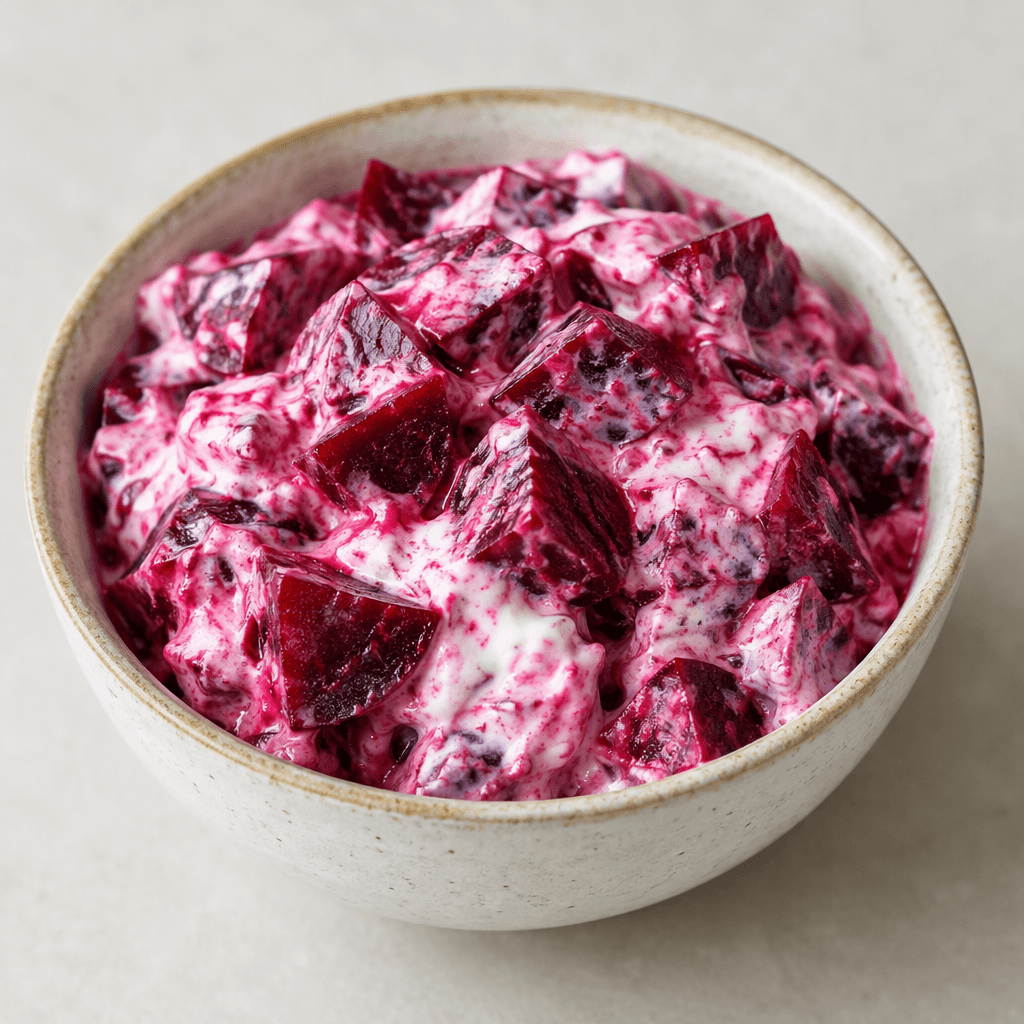
Beetroot with Yogurt Calories
Rich in iron and folate, contains probiotics
In season: Spring · Summer · Autumn · Winter
CALORIES
GI
POTASSIUM
FIBER
Quick answer
1 serving (medium) of Beetroot with Yogurt (150 g) has 98 calories. That works out to 65 calories per 100 g. It contains 15.8 g of carbs, 3.8 g of protein, 1.8 g of fat and 3 g of fiber. Its 82.5 µg of Folate covers 21% of the Daily Value. Its glycemic index is 40 (low), so it raises blood sugar slowly.
What is Beetroot with Yogurt?
Beetroot with yogurt is a Turkish home-style salad or meze made by mixing cooked beetroot with yogurt. The beetroot may be diced or grated; once stirred in, it gives the yogurt a striking pink-red colour. Garlic is a common addition, though the dish can be made without it.
Its earthy sweetness is softened by the yogurt’s cool tang and creamy texture. In Turkey it is served as a meze or alongside grilled food and other shared dishes; it also works well with bread. Beetroot brings fibre and most of the dish’s carbohydrate, while yogurt contributes some protein, making this a light, vegetable-forward side. For a looser, lighter mixture, use regular plain yogurt rather than relying entirely on thick yogurt, and chill it before serving.
Beetroot with Yogurt Nutrition Facts
Selected: 100 g
65
KCAL / 100G
Carbs
10.5g
· 4% DV
Protein
2.5g
· 5% DV
Fat
1.2g
· 2% DV
Fiber
2g
· 7% DV
DV is the share of the daily value covered, on a 2,000 kcal reference diet.
Calories come from: Carbs 67% · Protein 16% · Fat 17%
Beetroot with Yogurt Vitamins & Minerals
Vitamins
Folate
55µg · 14% DV
B2
0.09mg · 7% DV
Biotin
2.2µg · 7% DV
B12
0.17µg · 7% DV
Minerals
Potassium ⭐
260mg · 8% DV
Calcium
55mg · 6% DV
Iron
1mg · 6% DV
Phosphorus
42mg · 6% DV
How Nutritious Is Beetroot with Yogurt?
Nutrient density
High
How many vitamins, minerals and how much fiber this food carries per calorie. A high score means a lot of nutrition for few calories.
Satiety score
Medium
An EatBetter score computed from fiber, protein and calorie density. A high score means staying full longer on the same calories.
Both scores are calculated per 100 g and do not change with the selected portion. The satiety score is EatBetter's own calculation, not a clinical measure.
Beetroot with Yogurt Glycemic Index
GLYCEMIC INDEX
GLYCEMIC LOAD
Accounts for portion size — a more realistic measure than GI alone.
How to Burn Off Beetroot with Yogurt
To burn the 65 calories in 100 g:
🚶
Walking (5 km/h)
🏃
Running (8 km/h)
🚴
Cycling
🏊
Swimming
Times are calculated with the MET equation for a 70 kg adult. Actual burn varies with your weight, age and pace.
Is Beetroot with Yogurt Processed?
NOVA 2
Minimally Processed
1. Unprocessed
2. Minimally Processed
3. Processed
4. Ultra-Processed
NOVA classifies foods into 4 groups by industrial processing. NOVA 1 (unprocessed) is the healthiest.
Does Beetroot with Yogurt Contain Allergens?
Contains these allergens:
Which Diets Is Beetroot with Yogurt Good For?
Vegan
— Not suitable
Vegetarian
✓ Suitable
Gluten-Free
— Not suitable
Dairy-Free
— Not suitable
Mediterranean
✓ Suitable
Paleo
— Not suitable
Whole30
— Not suitable
DASH
— Not suitable
Keto
— Not suitable
Low FODMAP
— Not suitable
Beetroot with Yogurt Fat Profile
SATURATED
0.8g
MONOUNSATURATED
0.3g
POLYUNSATURATED
0.1g
Omega 6:3 ratio 2:1
Below the ideal 4:1 — a good omega balance.
Compare Beetroot with Yogurt
Foods Similar to Beetroot with Yogurt
Frequently Asked Questions About Beetroot with Yogurt
What is beetroot with yogurt?
Beetroot with yogurt is a chilled dish of cooked beetroot mixed with plain yogurt, often served as a Turkish-style side or meze. Garlic, olive oil, or herbs may be added, and the beetroot turns the yogurt a vivid pink or burgundy.
How do you make beetroot with yogurt?
To make beetroot with yogurt, cook the beetroot until tender, cool it completely, then grate or dice it and stir it into thick plain yogurt. Add crushed garlic if you like, and season to taste; mixing hot beetroot into yogurt can make it runny.
Should beetroot for beetroot with yogurt be boiled or roasted?
Either method works for beetroot with yogurt. Boiling gives the beetroot a softer, milder flavor, while roasting concentrates its earthy sweetness. Let the cooked beetroot cool fully before combining it with yogurt so the mixture stays creamy.
Why does beetroot with yogurt turn pink?
Beetroot with yogurt turns pink because natural betalain pigments from the beetroot spread through the white yogurt. The stronger the mixing, the more evenly colored the dish becomes. This vivid color is normal and does not mean the beetroot contains added coloring.
Can I make beetroot with yogurt using pre-cooked beetroot?
Yes, pre-cooked beetroot works well in beetroot with yogurt and saves preparation time. Drain it thoroughly and use plain beetroot rather than pickled beetroot, which can make the mixture noticeably tangy or sweet. Cool it before stirring it into the yogurt.
How do you stop beetroot with yogurt from becoming watery?
Use well-drained, completely cooled beetroot and thick yogurt to keep beetroot with yogurt from becoming watery. If the grated beetroot releases a lot of liquid, gently squeeze out the excess before mixing. Stirring it just before serving also helps preserve a creamy texture.
Does beetroot with yogurt usually contain garlic?
Often, yes: garlic is a common addition to beetroot with yogurt, especially when it is served as a savory side or meze. Use crushed garlic sparingly at first, since its flavor intensifies as the mixture sits; leaving it out keeps the beetroot flavor more prominent.
What should I serve with beetroot with yogurt?
Serve beetroot with yogurt alongside grilled meat, chicken, rice, or legume dishes, or offer it as part of a spread of cold sides. Its cool, tangy texture contrasts especially well with warm, savory foods.
How long does beetroot with yogurt keep in the fridge?
Beetroot with yogurt keeps for a few days in a covered container in the refrigerator. Discard it if it has been left out for an extended time or develops an off smell. It may release some liquid in storage; stir it before serving.
Is beetroot with yogurt good for you?
Yes, beetroot with yogurt can be a nourishing side, providing folate and fiber from beetroot and protein from yogurt. Yogurt may contain live cultures, depending on the product. It is a useful part of a varied diet, not a treatment for any condition.
Have another question about Beetroot with Yogurt?
Ask the AI nutrition coach — calories, portions, alternatives and more, answered in seconds in the app.

Scan calories with your camera
Instant AI nutrition analysis

Nutrition data compiled from USDA FoodData Central and scientific sources.