

Ready & Packaged Foods
All →Vegetables & Legumes
All →Desserts & Confectionery
All →Meat & Protein
All →Grains & Bakery
All →Beverages
All →Milk & Dairy
All →

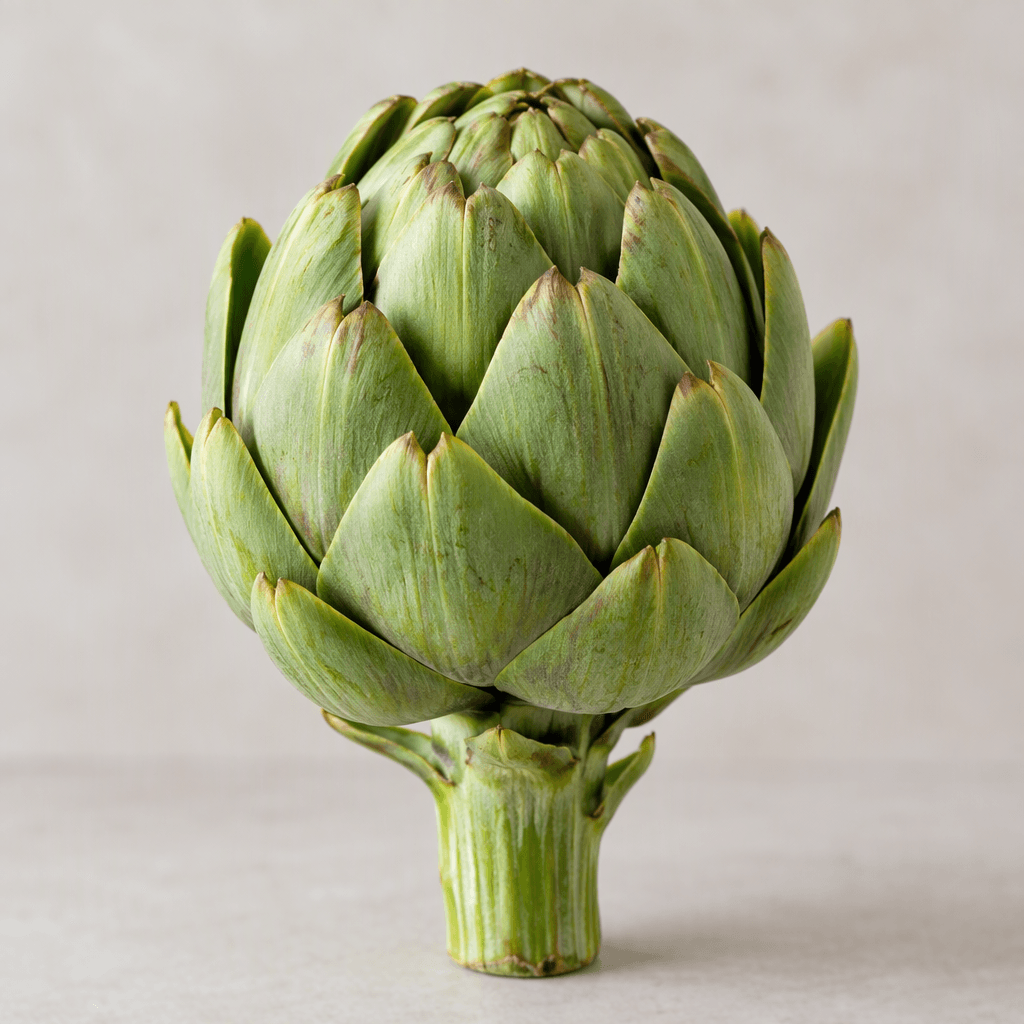
Artichoke Calories
Fiber and antioxidant-rich, low-calorie vegetable
In season: Spring
CALORIES
GI
POTASSIUM
FIBER
Quick answer
1 piece (medium) of Artichoke (120 g) has 56 calories. That works out to 47 calories per 100 g. It contains 12.6 g of carbs, 4 g of protein, 0.2 g of fat and 6.5 g of fiber. Its 0.3 mg of Copper covers 31% of the Daily Value. Its glycemic index is 15 (low), so it raises blood sugar slowly.
What is Artichoke?
An artichoke is the unopened flower bud of a thistle, with fleshy leaf bases and a tender heart that can be eaten. It has deep roots in Mediterranean cooking, but it is also familiar in many English-speaking kitchens. The leaves are commonly steamed or boiled and pulled through the teeth to scrape off their soft inner flesh; the heart is the prized, tender centre. Serve it warm with lemon and olive oil, or with a dipping sauce, as a starter or side.
Artichokes are notably high in fibre while remaining low in calories: 100 g provides 47 calories. Their mild, slightly nutty flavour pairs well with herbs, grains and fish. For a lighter serving, keep the dip simple—lemon, herbs and a little olive oil bring out the vegetable’s flavour without weighing it down.
Artichoke Nutrition Facts
Selected: 100 g
47
KCAL / 100G
Carbs
10.5g
· 4% DV
Protein
3.3g
· 7% DV
Fat
0.2g
· 0% DV
Fiber
5.4g
· 19% DV
DV is the share of the daily value covered, on a 2,000 kcal reference diet.
Calories come from: Carbs 74% · Protein 23% · Fat 3%
Artichoke Vitamins & Minerals
Vitamins
Folate
68µg · 17% DV
Vitamin C
11.7mg · 13% DV
Vitamin K
14.8µg · 12% DV
B3
1.05mg · 7% DV
Minerals
Magnesium
60mg · 14% DV
Phosphorus
90mg · 13% DV
Potassium ⭐
370mg · 11% DV
Iron
1mg · 6% DV
How Nutritious Is Artichoke?
Nutrient density
Very high
How many vitamins, minerals and how much fiber this food carries per calorie. A high score means a lot of nutrition for few calories.
Satiety score
High
An EatBetter score computed from fiber, protein and calorie density. A high score means staying full longer on the same calories.
Both scores are calculated per 100 g and do not change with the selected portion. The satiety score is EatBetter's own calculation, not a clinical measure.
Artichoke Glycemic Index
GLYCEMIC INDEX
GLYCEMIC LOAD
Accounts for portion size — a more realistic measure than GI alone.
How to Burn Off Artichoke
To burn the 47 calories in 100 g:
🚶
Walking (5 km/h)
🏃
Running (8 km/h)
🚴
Cycling
🏊
Swimming
Times are calculated with the MET equation for a 70 kg adult. Actual burn varies with your weight, age and pace.
Is Artichoke Processed?
NOVA 1
Unprocessed
1. Unprocessed
2. Minimally Processed
3. Processed
4. Ultra-Processed
NOVA classifies foods into 4 groups by industrial processing. NOVA 1 (unprocessed) is the healthiest.
Does Artichoke Contain Allergens?
No known major allergens
Which Diets Is Artichoke Good For?
Vegan
✓ Suitable
Vegetarian
✓ Suitable
Gluten-Free
✓ Suitable
Dairy-Free
— Not suitable
Mediterranean
✓ Suitable
Paleo
✓ Suitable
Whole30
— Not suitable
DASH
— Not suitable
Keto
— Not suitable
Low FODMAP
— Not suitable
Artichoke Fat Profile
SATURATED
0.04g
MONOUNSATURATED
0.01g
POLYUNSATURATED
0.07g
Omega 6:3 ratio 3:1
Below the ideal 4:1 — a good omega balance.
Compare Artichoke
Foods Similar to Artichoke
Frequently Asked Questions About Artichoke
How do you cook an artichoke?
You can steam, boil, or roast a whole artichoke. It is ready when the leaves pull away easily and the base is tender when pierced with a fork; cooking time varies with its size and method.
What part of an artichoke do you eat?
You eat the tender flesh at the base of the leaves and the heart after removing the fuzzy choke. The tough leaf tips and the inedible fuzzy center are discarded.
How do you prepare an artichoke for cooking?
Trim the stem and the top, then remove any tough outer leaves. Spread the inner leaves and scoop out the fuzzy choke if your recipe calls for a cleaned heart; rub cut surfaces with lemon to slow browning.
How do you eat artichoke leaves?
Pull off a cooked leaf and scrape its soft, fleshy base between your teeth. Discard the tough remainder and pointed tip, then continue toward the tender heart; do not eat the fuzzy choke.
How do you stop an artichoke from turning brown?
Rub cut surfaces with lemon or place the trimmed artichoke in water with lemon juice. Exposure to air causes the discoloration, so keep it submerged while you prepare the rest of the recipe.
Can you eat an artichoke raw?
Yes, small, tender artichokes can be eaten raw when thinly sliced. Remove the tough outer leaves and choke, and toss the slices with lemon; larger, more fibrous artichokes are usually more enjoyable cooked.
How can you tell if an artichoke is fresh?
A fresh artichoke has compact, tightly closed leaves and feels firm and heavy for its size. Avoid one with widely opened, limp, or badly dried leaves; a slight squeak when you press the leaves can also indicate freshness.
How should you store fresh artichokes?
Keep whole, unwashed artichokes in the refrigerator, loosely wrapped so they do not dry out. Trimmed artichokes brown quickly, so rub them with lemon and cook them soon; refrigerate cooked artichokes in a covered container.
What is the fuzzy part inside an artichoke?
The fuzzy center is called the choke, and it is not eaten. Scrape it out after cutting the artichoke in half or removing the leaves, taking care not to remove the tender heart underneath.
What does an artichoke taste like?
An artichoke tastes mildly sweet and earthy, with a subtle nutty quality. The heart is tender, while the cooked leaf bases have a softer, more delicate flavor; lemon, olive oil, and herbs pair well with both.
Have another question about Artichoke?
Ask the AI nutrition coach — calories, portions, alternatives and more, answered in seconds in the app.

Scan calories with your camera
Instant AI nutrition analysis

Nutrition data compiled from USDA FoodData Central and scientific sources.