

Ready & Packaged Foods
All →Vegetables & Legumes
All →Desserts & Confectionery
All →Meat & Protein
All →Grains & Bakery
All →Beverages
All →Milk & Dairy
All →

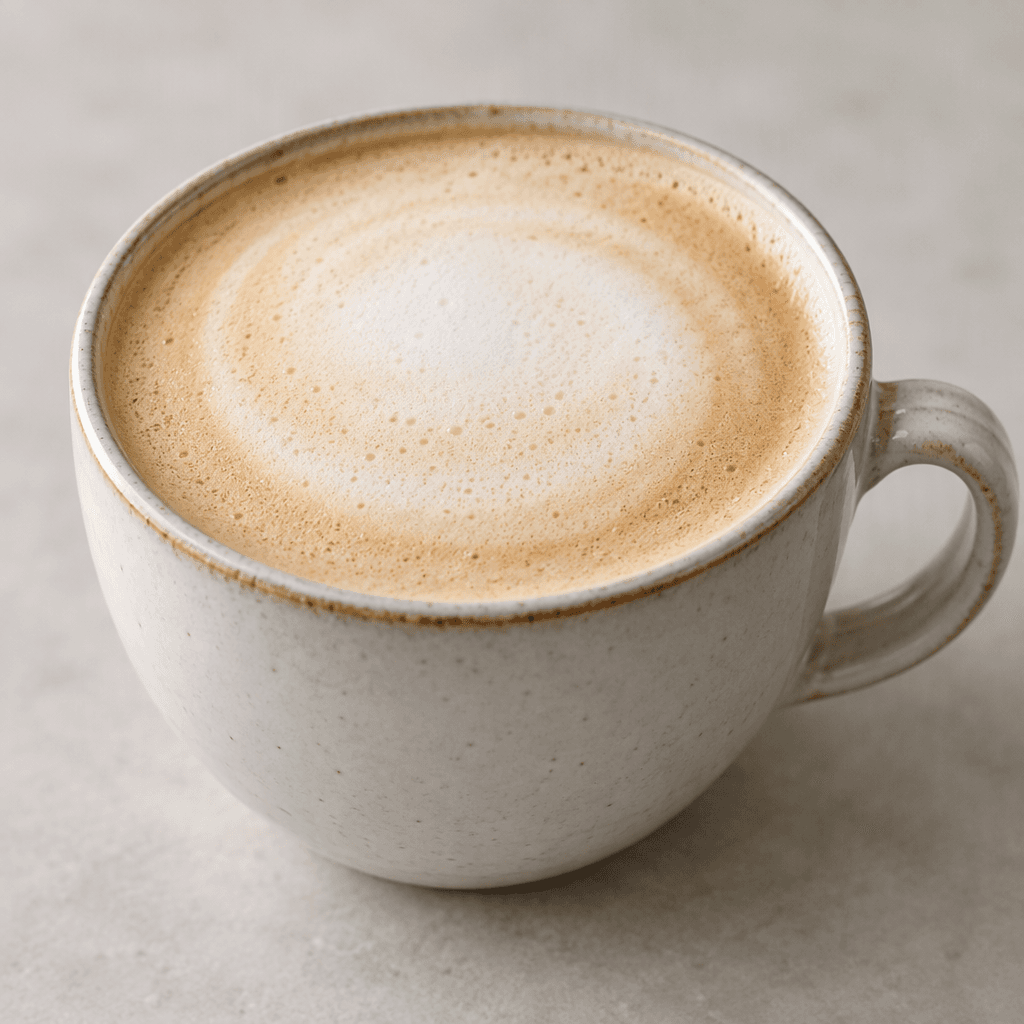
Almond milk misto Calories
Plant-based milk coffee, low-calorie, lactose-free
In season: Winter · Autumn · Spring · Summer
CALORIES · 100 G
GI
POTASSIUM · 100 G
FIBER · 100 G
Quick answer
1 cup (medium) of Almond milk misto (240 g) has 53 calories. That works out to 22 calories per 100 g. It contains 6.5 g of carbs, 1.2 g of protein, 2.4 g of fat and 0.7 g of fiber. Its 288 mg of Calcium covers 29% of the Daily Value. Its glycemic index is 35 (low), so it raises blood sugar slowly.
Almond milk misto Nutrition Facts
Selected: 1 cup (medium) · 240 g
53
KCAL / 240G
Carbs
6.5g
· 2% DV
Protein
1.2g
· 2% DV
Fat
2.4g
· 3% DV
Fiber
0.7g
· 3% DV
DV is the share of the daily value covered, on a 2,000 kcal reference diet.
Calories come from: Carbs 50% · Protein 9% · Fat 41%
Almond milk misto nutrition facts table · 1 cup (medium) (240 g)
| Nutrient | Amount | % DV |
|---|---|---|
| Calories | 53 kcal | |
| Total fat | 2.4 g | 3% |
| Saturated fat | 0.24 g | 1% |
| Trans fat | 0 g | |
| Sodium | 84 mg | 4% |
| Total carbohydrate | 6.5 g | 2% |
| Fiber | 0.7 g | 3% |
| Protein | 1.2 g | 2% |
Calories: Calories measure energy. Average daily need is 2,000 kcal. Excess calories are stored as fat, too few cause weight loss.
Carbs: Your body's primary energy source. The brain runs exclusively on carbs. Daily need: 275g.
Protein: Essential for muscle repair and cell growth. Daily need: 50g. Keeps you full and boosts metabolism.
Fat: Needed for hormone production and vitamin absorption. Daily need: 78g. Limit saturated fats, choose unsaturated.
Fiber: Critical for digestive health and satiety. Daily need: 28g. Stabilizes blood sugar, lowers cholesterol.

Log this food in EatBetter
100,000+ people use it
- Get your daily calorie target
- Snap your meal, log it in seconds
- See every vitamin and mineral

📸 Scan the code to get the app free.

How Many Calories in 1 Cup of Almond milk misto?
| Serving | Amount | Calories |
|---|---|---|
| 1 cup (medium) | 240 g | 53 kcal |
| 100 g | 100 g | 22 kcal |
| 1 cup (small) | 120 g | 26 kcal |
| 1 piece (medium) | 180 g | 40 kcal |
| 1 serving (medium) | 200 g | 44 kcal |
| 1 serving (large) | 300 g | 66 kcal |
| 1 cup (large) | 350 g | 77 kcal |
| 1 cup (jumbo) | 480 g | 106 kcal |
Calculated from 22 calories per 100 g.
Frequently Asked Questions About Almond milk misto
What is an almond milk misto?
An almond milk misto is brewed coffee combined with steamed almond milk, usually in roughly equal parts. It is a coffee-and-milk drink rather than an espresso-based drink, though cafés may adjust the proportions.
Does an almond milk misto contain caffeine?
Yes, an almond milk misto contains caffeine from its brewed coffee. The amount varies with the coffee, brewing method, and cup size, so ask for decaf if you want to avoid most of the caffeine.
Can you order an almond milk misto iced?
Yes, an almond milk misto can be served iced. The coffee is brewed and cooled before it is mixed with cold almond milk and ice; this gives it a different, more refreshing feel than the usual steamed version.
Is an almond milk misto stronger than a cappuccino?
An almond milk misto is not automatically stronger than a cappuccino; the caffeine depends mainly on the coffee used and the serving. A misto uses brewed coffee, while a cappuccino is made with espresso, so their coffee flavor and caffeine can differ.
How do you make an almond milk misto at home?
To make an almond milk misto, pour steamed almond milk into brewed coffee and stir gently. Froth the milk first if you want a café-style foam; an unsweetened variety lets you control how sweet the finished drink tastes.
Does an almond milk misto have added sugar?
Not necessarily. An almond milk misto can be made without added sugar, but sweetened almond milk or flavored syrup will make it sweeter. Ask for unsweetened almond milk and no syrup if you prefer a less sweet drink.
Why does almond milk separate in an almond milk misto?
Almond milk can separate when it meets very hot or acidic coffee, sometimes forming small flecks. This does not always mean the milk has spoiled; pouring it in slowly and avoiding extremely hot coffee can help keep the drink smoother.
Can an almond milk misto be made with decaf coffee?
Yes, you can make an almond milk misto with decaf brewed coffee and steamed almond milk. Decaf still contains a small amount of caffeine, but it is a practical choice when you want the misto flavor with less caffeine.
What does an almond milk misto taste like?
An almond milk misto tastes like brewed coffee softened by almond milk, with a mild nutty note. Its flavor is usually less espresso-forward than a latte, and sweetened milk or syrup can make the almond flavor seem more pronounced.
Does an almond milk misto have foam?
It can have a light layer of foam if the almond milk is steamed or frothed. The amount depends on the milk and preparation; barista-style almond milk is generally designed to foam more readily than many standard varieties.
Almond milk misto Vitamins & Minerals
Vitamins
B12
0.48µg · 20% DV
Vitamin D
1.68µg · 8% DV
Vitamin E
1.2mg · 8% DV
B2
0.05mg · 4% DV
Minerals
Calcium
288mg · 29% DV
Manganese
0.24mg · 10% DV
Copper
0.07mg · 8% DV
Phosphorus
43mg · 6% DV
Potassium ⭐
144mg · 4% DV
Sodium
84mg · 4% DV
Almond milk misto Glycemic Index
GLYCEMIC INDEX
GLYCEMIC LOAD
Accounts for portion size — a more realistic measure than GI alone.
How to Burn Off Almond milk misto
To burn the 53 calories in 1 cup (medium) (240 g):
🚶
Walking (5 km/h)
🏃
Running (8 km/h)
🚴
Cycling
🏊
Swimming
Times are calculated with the MET equation for a 70 kg adult. Actual burn varies with your weight, age and pace.
What is Almond milk misto?
Almond milk misto is a café-style coffee made by combining brewed coffee with warmed, lightly frothed almond milk. A traditional misto uses steamed dairy milk; this version swaps in almond milk for a plant-based drink with a similarly smooth finish.
It has a gentle coffee flavour, a creamy texture and usually a thin cap of foam, and is served warm. It works well at breakfast or as an afternoon café order, on its own or alongside toast or a pastry. Nutritionally, it is a relatively light coffee drink: the supplied figures list 22 calories per 100 g. If you prefer a more filling pairing, have it with something that provides protein, such as eggs or a handful of nuts.
How Nutritious Is Almond milk misto?
Nutrient density
Low
How many vitamins, minerals and how much fiber this food carries per calorie. A high score means a lot of nutrition for few calories.
Satiety score
Medium
An EatBetter score computed from fiber, protein and calorie density. A high score means staying full longer on the same calories.
Both scores are calculated per 100 g and do not change with the selected portion. The satiety score is EatBetter's own calculation, not a clinical measure.
Is Almond milk misto Processed?
NOVA 2
Minimally Processed
1. Unprocessed
2. Minimally Processed
3. Processed
4. Ultra-Processed
NOVA classifies foods into 4 groups by industrial processing. NOVA 1 (unprocessed) is the healthiest.
Does Almond milk misto Contain Allergens?
No known major allergens
Which Diets Is Almond milk misto Good For?
Vegan
✓ Suitable
Vegetarian
✓ Suitable
Gluten-Free
✓ Suitable
Dairy-Free
— Not suitable
Mediterranean
✓ Suitable
Paleo
— Not suitable
Whole30
— Not suitable
DASH
— Not suitable
Keto
— Not suitable
Low FODMAP
— Not suitable
Almond milk misto Fat Profile
SATURATED
0.24g
MONOUNSATURATED
1.44g
POLYUNSATURATED
0.48g
Omega 6:3 ratio 26.5:1
Above the ideal 4:1 (26.5:1).
Compare Almond milk misto
Foods Similar to Almond milk misto
Have another question about Almond milk misto?
Ask the AI nutrition coach — calories, portions, alternatives and more, answered in seconds in the app.

Scan calories with your camera
Instant AI nutrition analysis

Nutrition data compiled from USDA FoodData Central and scientific sources.