


How Much Protein Should I Eat Per Day?
earn how daily protein needs are estimated, what the adult RDA means, why athletes may need more and how to spread protein across your day.
EatBetter · October 1, 2026 · 4 min read
Contents
Protein needs are usually estimated relative to body weight, but there is no single gram target that fits every person.
Quick answer: The current adult U.S. RDA is 0.8 g of protein per kilogram of body weight per day. Athletes may require more; NIH's sports-nutrition guidance cites roughly 1.2–2.0 g/kg/day for athletes depending on training and context.
Start with body weight
The general adult RDA can be estimated as:
body weight in kilograms × 0.8 g
Example: 60 kg adult
60 × 0.8 = 48 g protein/day
Example: 75 kg adult
75 × 0.8 = 60 g protein/day
Example: 90 kg adult
90 × 0.8 = 72 g protein/day
The RDA is designed to cover the needs of nearly all healthy adults. It is not necessarily an "optimal" athletic target.
When protein needs may be higher
Needs can vary with:
- resistance training
- endurance training
- energy restriction
- pregnancy or lactation
- growth
- aging
- illness or recovery
- individual medical conditions
NIH notes that athletes may need around 1.2 to 2.0 g/kg/day.
That range is not intended for every person.
Why there is not one perfect protein number
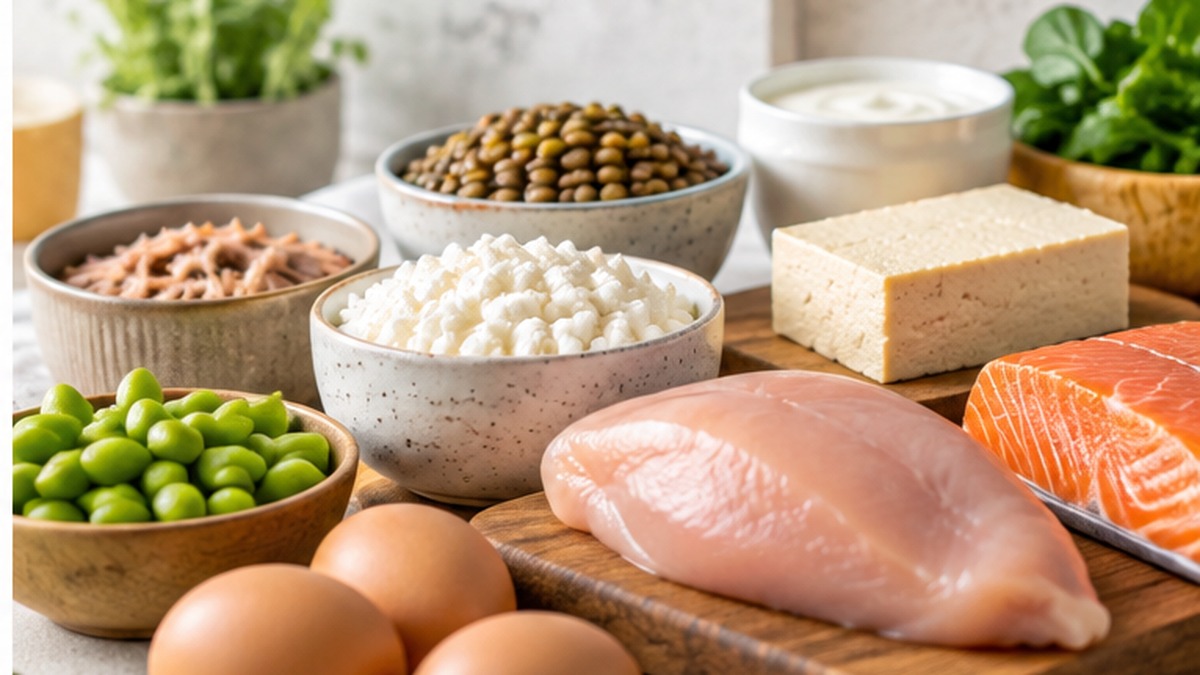
A person's requirement depends on both physiology and goals.
Two adults of the same weight may differ in:
- training volume
- age
- calorie intake
- health
- muscle mass
- recovery needs
That is why blanket advice such as "everyone needs 150 g of protein" is not appropriate.
Protein examples from real foods
Use EatBetter to see how foods contribute to your daily total.
Chicken Breast
Meat & Protein · 110 kcal / 100g
View →
Tuna
Fish · 132 kcal / 100g
View →
Boiled Egg
Meat & Protein · 155 kcal / 100g
View →
Green Lentils (Boiled)
Vegetables & Legumes · 116 kcal / 100g
View →
Natural Tofu
Meat & Protein · 76 kcal / 100g
View →
Approximate protein per 100 g from current EatBetter entries:
- Chicken breast: 23.1 g
- Tuna: 28 g
- Boiled egg: 13 g
- Green lentils, boiled: 9 g
- Natural tofu: 8.1 g
Portion size matters.
A simple way to distribute protein
Instead of trying to eat most of your daily protein at one meal, you can include a source at several eating occasions.
For example:
Breakfast
- eggs
- yogurt
- cottage cheese
- tofu
Lunch
- chicken
- tuna
- lentils
- beans
Snack
- yogurt
- cottage cheese
- edamame
Dinner
- fish
- poultry
- tofu
- legumes
Stop guessing your portions 📲
Photograph your meal and let EatBetter break down calories and macros in seconds.


Does protein help with fullness?
Protein can influence satiety, but the effect depends on the complete meal.
Fiber, food volume, fats, total calories and individual hunger also matter.
A high-protein meal is not automatically a low-calorie meal.
Do you need protein immediately after exercise?
Total daily protein intake is usually more important than obsessing over a narrow minute-by-minute window.
For athletes, distributing protein across the day can be practical.
Can you eat too much protein?
Very high protein intake may be inappropriate for some people, particularly those with certain kidney conditions or other medical concerns.
If you have a health condition, seek individualized guidance rather than using a generic online target.
Protein needs during weight loss
When calories are reduced, adequate protein can be important for maintaining a balanced diet and supporting lean tissue, particularly alongside resistance training.
However, the correct intake depends on the individual.
Do not replace vegetables, fruits, whole grains and other nutrient-rich foods simply to maximize protein.
Explore related EatBetter pages
Sources
- NCBI Bookshelf — Evaluation of Dietary Protein and Amino Acid Requirements: https://www.ncbi.nlm.nih.gov/books/NBK614631/
- NIH Office of Dietary Supplements — Exercise and Athletic Performance: https://ods.od.nih.gov/factsheets/ExerciseAndAthleticPerformance-HealthProfessional/
- EatBetter — Food Guide: https://www.eatbetter.app/en
Note: This article provides general information. Protein needs can change with health conditions, pregnancy, aging and training. Seek individualized professional guidance when appropriate.
Frequently asked questions
How much protein does an average adult need?
The current U.S. adult RDA is 0.8 g/kg/day.
How much protein do athletes need?
NIH sports-nutrition guidance cites approximately 1.2–2.0 g/kg/day for athletes, depending on training and context.
Is 100 g of protein a lot?
It depends on body weight, activity and individual needs. For one person it may be appropriate; for another it may be unnecessarily high.
Can I get enough protein without meat?
Yes. Dairy, eggs, tofu, soy foods, lentils, beans, nuts and seeds can all contribute protein.
Should I count protein every day?
Not everyone needs to. Tracking temporarily can help you understand your usual intake.
