


What Is BMI? Formula, Meaning and Limitations
Learn what BMI means, how body mass index is calculated, what adult BMI categories represent and why BMI is only a screening measure.
EatBetter · October 1, 2026 · 4 min read
Contents
BMI, or Body Mass Index, is a simple calculation that relates a person's weight to their height.
Quick answer: BMI is calculated as weight in kilograms divided by height in meters squared. It is widely used as a screening measure, but it does not directly measure body fat, muscle mass, health status or disease risk by itself.
BMI Calculator
See your body mass index from height and weight.
Calculate →
What does BMI stand for?
BMI stands for Body Mass Index.
The calculation is:
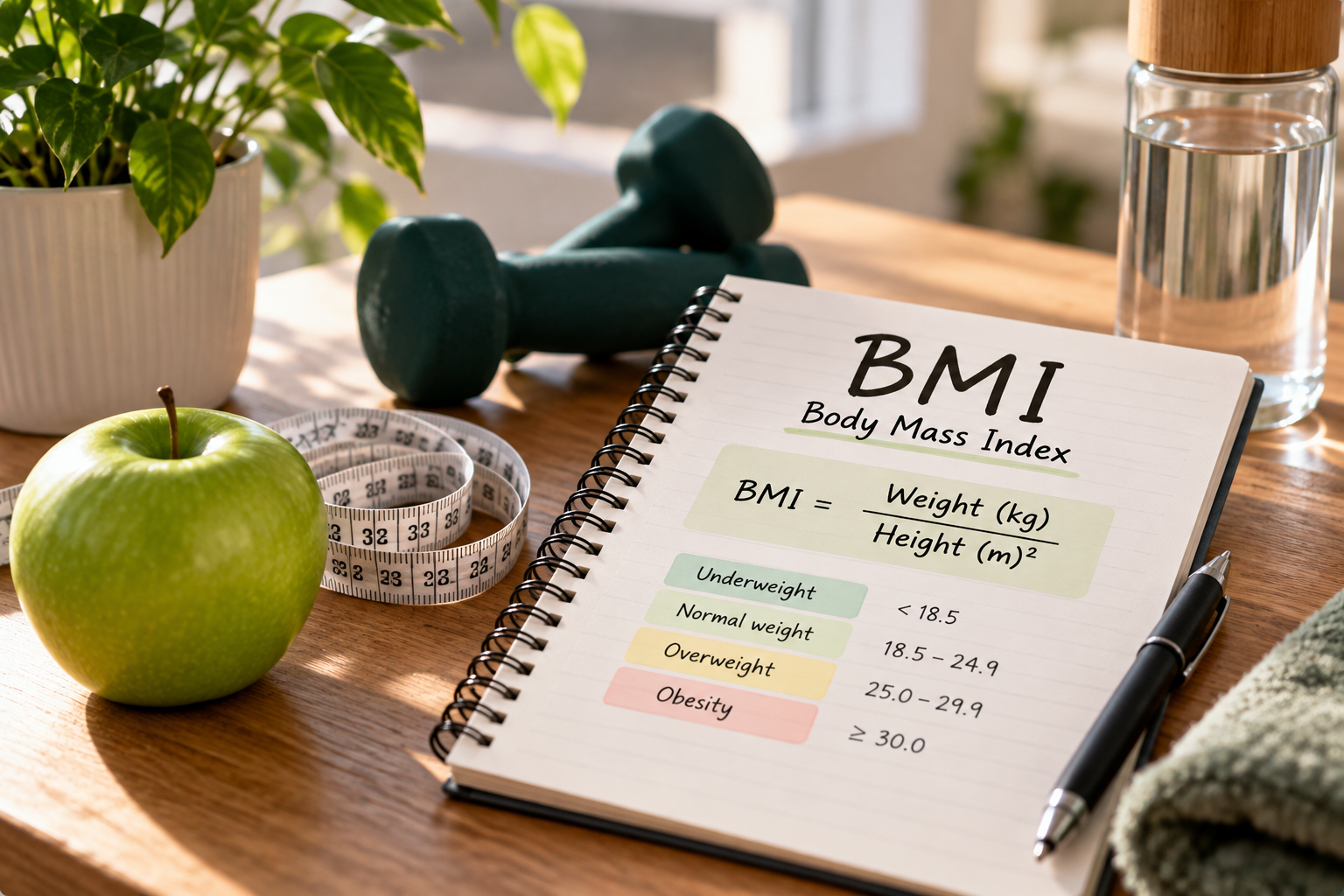
BMI = weight (kg) ÷ height (m)²
For example, an adult who weighs 70 kg and is 1.75 m tall has a BMI of approximately:
70 ÷ 1.75² = 22.9
The number can then be compared with standard adult BMI categories.
Adult BMI categories
CDC uses the following categories for adults age 20 and older:
| BMI | Category |
|---|---|
| Below 18.5 | Underweight |
| 18.5 to <25 | Healthy weight |
| 25 to <30 | Overweight |
| 30 or greater | Obesity |
Obesity is further divided into classes.
These categories are population-level screening thresholds. They are not diagnoses.
What does BMI actually measure?
BMI measures weight relative to height.
It does not directly measure:
- body fat percentage
- muscle mass
- bone mass
- fat distribution
- cardiovascular fitness
- blood pressure
- blood glucose
- cholesterol
CDC describes BMI as a quick, inexpensive and noninvasive screening measure.
Why is BMI used so often?
BMI is widely used because it is:
- easy to calculate
- inexpensive
- noninvasive
- useful for comparing large populations
- available from basic height and weight measurements
For public-health research, that simplicity is valuable.
For an individual person, however, BMI should be interpreted with more context.
What are the limitations of BMI?
It cannot separate muscle from fat
A muscular athlete can have a relatively high BMI even with a low body-fat percentage.
It does not show where fat is stored
Fat distribution can matter for health, but BMI does not tell you where body fat is located.
It does not measure health behaviors
Two people with the same BMI can have very different:
- diets
- activity levels
- sleep patterns
- medical histories
- blood pressure
- lab results
It is a screening tool, not a diagnosis
CDC explicitly recommends considering BMI together with other health indicators.
BMI is interpreted differently for children
Adult BMI categories should not be applied directly to children and teenagers.
For people ages 2 through 19, BMI is interpreted using age- and sex-specific percentiles.
This article focuses on adult BMI.
When is BMI useful?
BMI can be useful for:
- population research
- initial health screening
- tracking weight relative to height over time
- identifying when further assessment may be appropriate
It becomes less useful when treated as a complete description of an individual's health.
What should you look at alongside BMI?
Depending on the situation, a health professional may consider:
- waist circumference
- blood pressure
- blood lipids
- blood glucose
- medical history
- physical activity
- body composition
- diet quality
- medications
No single number summarizes health.
Stop guessing your portions 📲
Photograph your meal and let EatBetter break down calories and macros in seconds.


Explore related EatBetter tools
Sources
- CDC — About Body Mass Index: https://www.cdc.gov/bmi/about/index.html
- CDC — Adult BMI Categories: https://www.cdc.gov/bmi/adult-calculator/bmi-categories.html
- CDC — BMI Frequently Asked Questions: https://www.cdc.gov/bmi/faq/
Note: BMI is a screening measure and is not a substitute for professional medical evaluation.
Frequently asked questions
Is BMI the same as body fat percentage?
No. BMI uses only weight and height. Body-fat percentage estimates how much of the body is fat tissue.
Is BMI accurate?
BMI is reliable for measuring weight relative to height, but it does not directly measure body composition. It is best used as a screening measure.
Can a fit person have a high BMI?
Yes. People with more muscle mass may have a higher BMI without having a high body-fat percentage.
Does BMI diagnose obesity-related disease?
No. BMI categories can be associated with population-level health risks, but BMI itself does not diagnose a disease.
What BMI is considered healthy for adults?
CDC defines the adult "healthy weight" category as 18.5 to less than 25, but individual health should be interpreted with more than BMI alone.
